The quest to measure physical quantities with ever-increasing precision drives advances across science and technology, but fundamental limits exist on how accurately we can determine these values. Researchers at JILA, University of Colorado Boulder – Christopher Wilson, John Drew Wilson, Luke Coffman, and colleagues – now demonstrate a surprising conservation law governing the sensitivity of quantum measurements. Their work reveals that when measurements rely on a specific set of operators, the potential precision achievable remains fixed, much like a conserved quantity in physics. This discovery establishes an intrinsic ‘budget’ of sensitivity for any quantum state, and opens the door to efficiently classifying states based on their measurable properties, offering a powerful new tool for optimising quantum technologies and deepening our understanding of the limits of measurement itself.
Symmetry Dictates Ultimate Quantum Measurement Limits Researchers have uncovered a fundamental conservation law governing how precisely we can measure physical quantities using quantum systems. This work addresses a core challenge in quantum metrology – maximizing the sensitivity of measurements – and reveals a surprising link between symmetry and the ultimate limits of precision. Currently, scientists strive to enhance measurement accuracy by exploiting quantum phenomena, but understanding how much improvement is possible, and what resources are truly needed, remains complex.
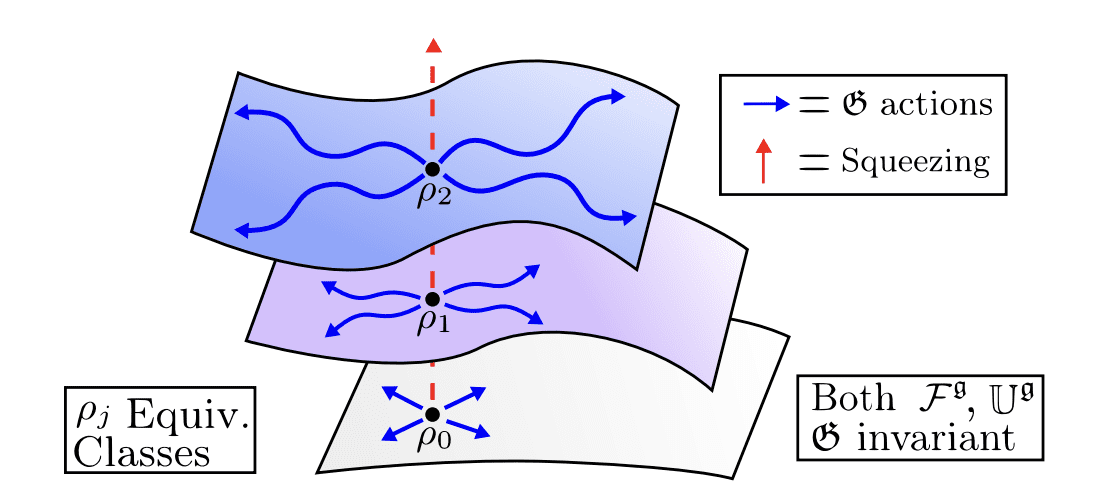
This new research provides a powerful framework for classifying quantum states based on their inherent capacity for sensitive measurement. The team’s breakthrough centers on the Quantum Fisher Information Matrix, a tool that quantifies the sensitivity of a quantum state to changes in measurable parameters. They demonstrate that when this matrix is constructed using a specific set of measurable properties – those that form a Lie algebra – the resulting spectrum of sensitivity remains constant under certain transformations.
A Lie algebra essentially defines a set of operations that, when combined, obey specific mathematical rules, imposing a kind of symmetry on the measurement process. This means that a quantum state possesses a fixed “budget” of metrological sensitivity, an intrinsic resource that cannot be amplified by operations respecting this symmetry. This conservation law has profound implications for quantum technologies.
Just as understanding symmetries is crucial in fields like particle physics, this work reveals that symmetries within the measurement process dictate the limits of achievable precision. The researchers also show that this conservation extends to measures of quantum incompatibility, suggesting that even the potential for enhancing precision through incompatibility is fundamentally constrained by these underlying symmetries. This discovery establishes a metrological analog to Liouville’s theorem, a cornerstone of classical physics that describes the conservation of phase space volume.
This means that certain geometric properties of the quantum state – statistical distances, volumes, and curvatures – remain invariant under transformations dictated by the Lie algebra. This allows scientists to efficiently classify quantum states based on these geometric invariants, providing a roadmap for identifying states best suited for high-precision measurements. Ultimately, this research offers a new lens through which to understand the fundamental limits of quantum sensing and opens exciting avenues for designing more effective quantum technologies.
👉 More information
🗞 Geometric Invariants of Quantum Metrology
🧠 DOI: https://doi.org/10.48550/arXiv.2507.06128