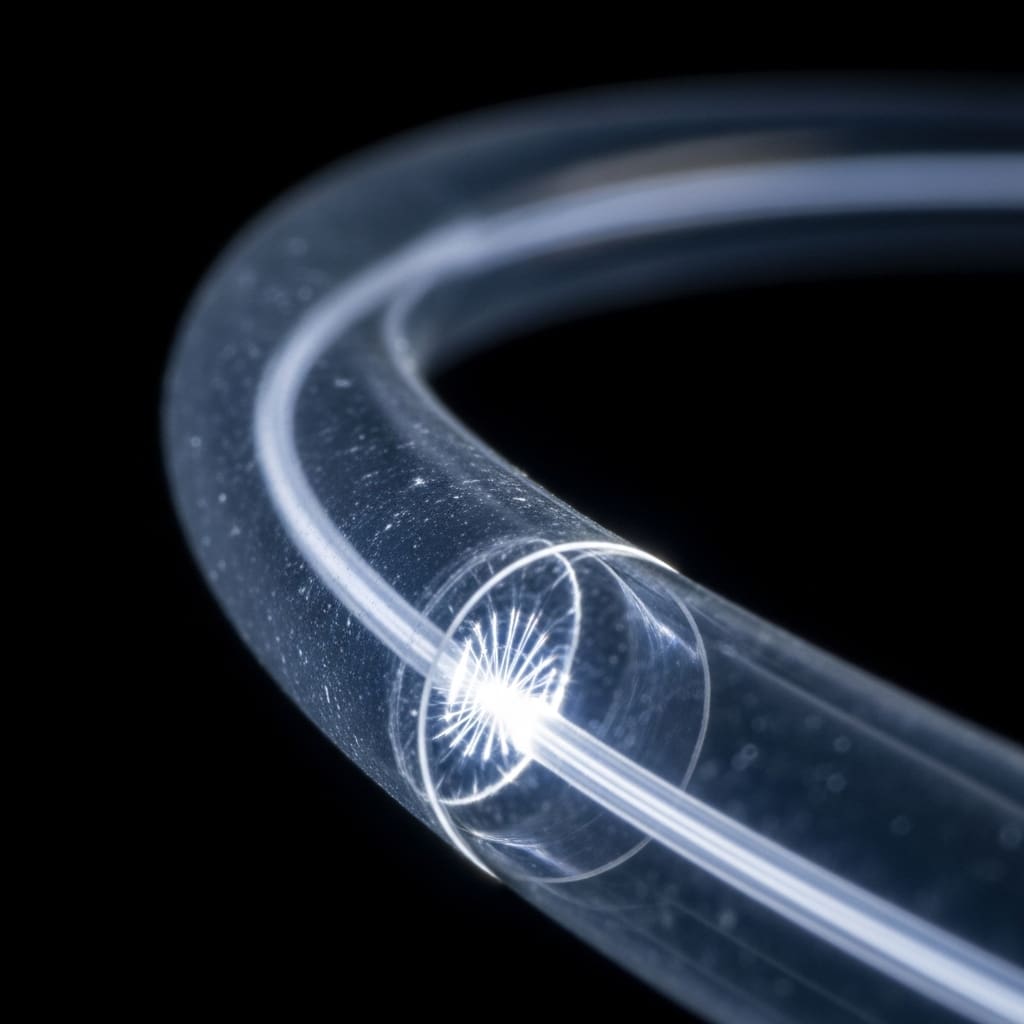
Researchers have developed a new method to accurately calculate electromagnetic modes within cylindrical step-index nanofibres, a crucial advancement for nanophotonic applications such as interfaces and vectorial light sensing. Sebastian Golat and Francisco J. Rodríguez-Fortuño, both from King’s College London, present this work in collaboration with King’s College London, addressing the limitations of conventional techniques which introduce errors when determining crucial longitudinal field components. Their semi-analytical approach leverages the symmetries inherent in cylindrical waveguides and a refined normalisation process, reducing the calculation to a simpler, analytically solvable form. This reformulation not only streamlines the process of obtaining dispersion relations but, critically, allows for the analytical determination of modal field amplitudes, bypassing problematic numerical calculations and ensuring greater accuracy in modelling nanofibre-based devices, particularly those used in chiral optics and nanophotonics.
Scientists have developed a more accurate technique for modelling light travelling through incredibly fine optical fibres. The advance promises to unlock better designs for nanoscale devices used in sensing and manipulating light. By eliminating a key source of error in previous calculations, this method offers greater control over the behaviour of light at the nanoscale.
Scientists have developed a new method for accurately modelling light travelling through optical nanofibres, structures with diameters comparable to the wavelength of light. These nanofibres are increasingly important in nanophotonics, enabling applications ranging from sensitive biosensors to quantum experiments. Conventional calculations of how light behaves within these fibres rely on solving complex equations, but contain a hidden flaw that introduces significant errors in crucial field components.
This work overcomes this limitation with a fundamentally more robust semi-analytical approach, ensuring greater precision in nanofibre design and analysis. The research centres on accurately determining the electromagnetic modes, the specific patterns of light propagation, within the nanofibre. Existing techniques involve solving a matrix eigenvalue problem, a standard procedure in optics.
However, determining the precise amplitude of the light field requires calculating the ‘null space’ of a matrix, a process prone to numerical instability and introducing errors, particularly in the longitudinal field components which dictate how light interacts with chiral materials. By leveraging the inherent symmetries of the cylindrical nanofibre and a novel normalisation of field amplitudes, researchers have bypassed this problematic calculation entirely.
This new formulation elegantly reduces the complexity of the problem, transforming a four-equation system into a simpler two-equation system. The dispersion relation, which describes how the speed of light changes within the fibre, is now obtained from a well-behaved equation, simplifying numerical analysis. Critically, the resulting field amplitudes are determined analytically, meaning they are calculated directly without relying on potentially inaccurate numerical approximations.
This ensures the full vectorial field structure, including the often-subtle longitudinal components, is accurately represented. The implications of this advancement are significant for a range of applications. Precise knowledge of field polarisation, and specifically the longitudinal components, is paramount in areas like chiral optics and advanced nanophotonic devices.
This method provides a powerful and reliable tool for designing and analysing nanofibre-based devices, paving the way for more sensitive sensors and more robust quantum technologies. An open-source Python package, Anafibre, has been created to implement and disseminate this improved calculation method.
Simplified electromagnetic mode calculation in optical nanofibres via 2×2 matrix reduction
The reformulated method yields a dispersion relation obtained from a simple transcendental equation, greatly simplifying numerical root-finding. The research demonstrates that the complex interplay of electromagnetic modes within optical nanofibres can be accurately calculated by reducing the problem to a 2×2 matrix system, a significant simplification from traditional 4×4 approaches.
This reduction is achieved through a judicious normalisation of field amplitudes, effectively bypassing the need for calculating the numerical null space of a singular matrix, a process prone to introducing substantial relative errors. Consequently, the modal field amplitudes are determined analytically, ensuring the accuracy of the full vectorial field structure.
This analytical determination is a key achievement, as it eliminates the ill-conditioned null space calculation that plagues conventional methods and compromises the precision of longitudinal field components. The work establishes that the longitudinal field components, crucial for applications in chiral optics and nanophotonics, are calculated with enhanced reliability.
By starting from the symmetries inherent in cylindrical waveguides, the study derives a system where the determinant of a 2×2 matrix, equated to zero, yields the dispersion relation. Once the propagation constant and frequency are known, the field amplitudes follow directly from the remaining two equations, further streamlining the process. This approach is implemented in the open-source Python package Anafibre, providing routines for solving the dispersion relation, evaluating full vectorial fields, and normalising modes for practical application.
Symmetry exploitation and normalisation to resolve ill-conditioned mode calculations
A semi-analytical method underpinned this work, designed to accurately calculate guided electromagnetic modes within optical nanofibres. Conventional techniques typically involve solving a 4 × 4 matrix eigenvalue problem derived from Maxwell’s equations, applied to both the core and cladding of the fibre, and enforcing continuity of the tangential electromagnetic fields at the boundary between them.
This standard approach expresses the electric and magnetic fields using four constants multiplied by Bessel functions, leading to a homogeneous linear system of equations. However, a critical flaw was identified in this established procedure: determining the field amplitudes necessitates calculating the numerical null space of a theoretically singular matrix.
To circumvent this ill-conditioned problem, the research began by exploiting the inherent symmetries present in the cylindrical waveguide geometry. A judicious normalisation of the field amplitudes was then implemented, allowing the original 4 × 4 system to be analytically reduced to a significantly simpler 2 × 2 system of equations. This reformulation directly yields the dispersion relation, describing the relationship between wave propagation constant and frequency, from a well-behaved transcendental equation, streamlining the numerical root-finding process.
Crucially, the modal field amplitudes are then determined analytically, completely avoiding the problematic numerical null space calculation. This analytical determination ensures the accuracy of the full vectorial field structure, particularly the often-small but physically significant longitudinal field components. The method’s foundation rests on demonstrating the equivalence of the standard 4 × 4 system to a reduced form, where the first two rows directly imply relationships between the initial constants, effectively halving the computational complexity. By deriving this 2 × 2 system from first principles, the study establishes a robust and reliable tool for nanofibre-based device design and analysis, especially for applications demanding precise control of field polarisation.
Symmetry and normalisation resolve instabilities in nanoscale fibre optic modelling
The persistent challenge of accurately modelling light within nanoscale optical fibres has long hampered progress in fields ranging from sensing to atom trapping. Existing computational methods, while ubiquitous, suffer from inherent numerical instabilities when calculating crucial aspects of light’s behaviour, specifically, the longitudinal field components.
These components, often small in magnitude, are disproportionately important for applications demanding precise control of light-matter interactions. This new work offers a significant step forward by sidestepping this problematic calculation altogether. What distinguishes this approach is its elegant reformulation of the fundamental equations governing light propagation within these fibres.
By leveraging the inherent symmetries of the cylindrical geometry and employing a clever normalisation scheme, the researchers have transformed a complex numerical problem into a far simpler analytical one. The result is a method that not only delivers more reliable results but does so with greater computational efficiency. This is not merely an incremental improvement; it represents a shift from wrestling with numerical approximations to obtaining genuine analytical solutions.
However, the technique, while robust for standard step-index fibres, may encounter limitations when applied to more complex fibre designs or those incorporating materials with extreme refractive indices. Further investigation is needed to assess its performance in these scenarios. Looking ahead, this analytical framework could be extended to model more intricate nanofibre structures, including those with tapered geometries or chiral modifications. Ultimately, a deeper understanding of light’s behaviour at the nanoscale will unlock new possibilities for manipulating matter and sensing the world around us with unprecedented precision.
🗞 A robust and efficient method to calculate electromagnetic modes on a cylindrical step-index nanofibre
🧠 ArXiv: https://arxiv.org/abs/2602.14930