

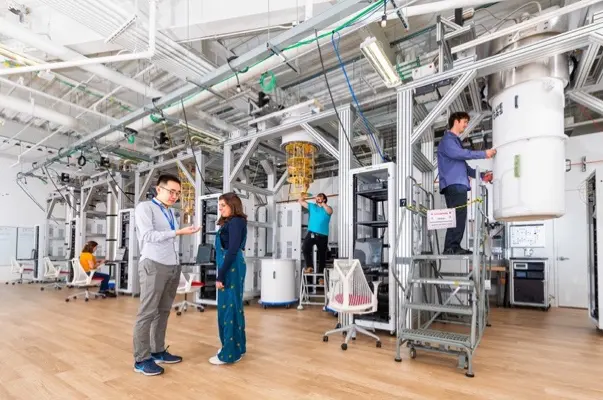
The future of computing may be microscopic, and a $125 million investment is poised to accelerate its arrival. Fermi National Accelerator Laboratory’s Superconducting Quantum Materials and Systems (SQMS) Center has received renewed funding from the U.S. Department of Energy to scale up quantum technology, moving it from theoretical potential to practical application. Building on five years of groundbreaking progress—and uniting over 300 scientists from 43 institutions—the center will focus on developing the next generation of quantum computers, communication networks, and sensors, promising revolutionary advances for fields ranging from medicine to national security and solidifying U.S. leadership in this rapidly evolving field.
SQMS Center Receives $125 Million Renewal
Fermilab’s Superconducting Quantum Materials and Systems (SQMS) Center is poised for a new era of quantum innovation following a $125 million renewal from the U.S. Department of Energy Office of Science. This five-year investment will accelerate the center’s work in translating fundamental quantum research into deployable technologies, specifically in computation, communication, and sensing. Established in 2020 as part of the National Quantum Initiative Act, SQMS leverages Fermilab’s established expertise in superconducting radio-frequency (SRF) cavities, materials science, and cryogenics – technologies originally developed for particle accelerators – uniting over 300 researchers from 43 partner institutions nationwide.
According to SQMS Director Anna Grassellino, the center has already demonstrated significant progress, achieving record-setting quantum coherence times and developing new materials, and this renewal will allow a crucial shift “from discovery to deployment.” The renewed funding will focus on three key efforts: chip-based material and device breakthroughs, aiming for even higher coherence superconducting devices; advancements in scalable cryogenics to overcome technological hurdles; and the development of world-leading computational capabilities and resilient quantum systems. Building on its success in extending quantum coherence – the duration a qubit can reliably hold information – and achieving record sensitivities in quantum sensing, SQMS aims to strengthen U.S. leadership in quantum information science and unlock powerful new tools for scientific advancement and societal benefit. Future funding beyond the initial $25 million allocation is contingent upon congressional appropriations.
Scaling Quantum Systems for Impact
Fermilab’s Superconducting Quantum Materials and Systems (SQMS) Center is poised to dramatically accelerate the transition of quantum technology from theoretical promise to practical impact, bolstered by a renewed $125 million investment from the U.S. Department of Energy. Building on five years of foundational progress established under the National Quantum Initiative Act, the center is shifting its focus to scaling quantum systems – moving beyond simply achieving quantum effects to building robust, deployable technologies. This next phase prioritizes overcoming key hurdles to widespread adoption, particularly extending quantum coherence – the duration qubits can reliably maintain information – and increasing the scalability of quantum systems.
SQMS has already demonstrated world-leading coherence times through innovations in materials science, fabrication techniques, and unique 3D-cavity architectures, and will now leverage ultra-high-coherence superconducting radio-frequency cavities and advanced cryogenics to push these boundaries even further. The center’s ambitious program centers around three core efforts: achieving breakthroughs in chip-based materials and device fabrication, developing scalable and resilient quantum systems, and building computational capabilities. Uniting over 300 experts from 43 partner institutions, SQMS isn’t merely pursuing scientific advancement; it’s strategically engineering a pathway to unlock powerful new tools for scientific discovery, technological innovation, and ultimately, strengthen U.S. leadership in quantum information science, with applications spanning computation, communication, and sensing – including novel approaches to dark matter detection and precision measurement.
Source: http://www.fnal.gov/


