

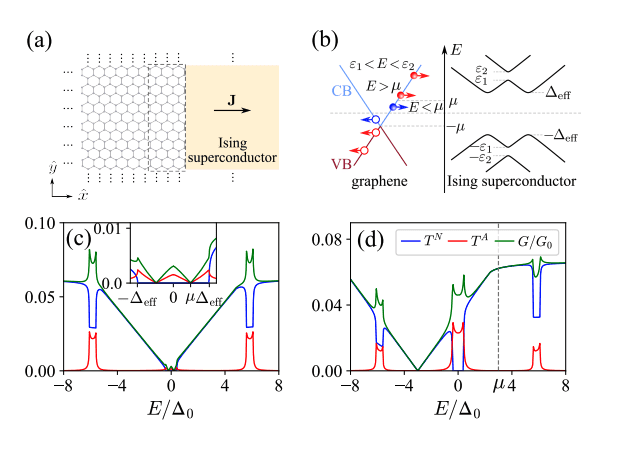
The article Specular-Andreev reflection and Andreev interference in an Ising superconductor junction, published on May 2, 2025, delves into the transport properties of Ising superconductors under exchange fields, revealing insights into quantum interference effects.
The study investigates Ising superconductors’ resilience to magnetic fields and their transport properties in two-terminal junctions. It identifies a chemical potential range supporting specular-Andreev reflection between mirage gaps, enhancing experimental stability. In four-terminal junctions with exchange fields, Andreev interference is modulated by the relative orientation of exchange fields, alongside traditional phase difference and chemical potential tuning.
Recent research has unveiled intriguing electron behaviour at the interface between graphene and superconductors, offering fresh perspectives on how electrons interact with superconducting materials. This study focuses on two distinct forms of Andreev reflection—specular and retroreflection—which occur as electrons transition into Cooper pairs.
Electrons exhibit unique reflective properties when encountering a superconductor. In specular reflection, electrons mirror their approach angle upon reflection, akin to light reflecting off a smooth surface. Conversely, retroreflection causes electrons to bounce back in the opposite direction upon contact with the superconductor. These phenomena provide valuable insights into electron-superconductor interactions.
Experimental Setup and Observations
The research employed a four-terminal setup connecting graphene to superconductors. By adjusting voltages and temperatures, researchers observed how electrons transitioned into Cooper pairs at specific points. A significant finding was the ability to control these reflections through parameters such as voltage or magnetic fields, enabling precise management of electron behaviour.
This research represents a notable advancement in controlling electron transitions, potentially leading to novel electronic devices like thermal switches and superconducting transistors. These innovations could find applications in quantum computing and high-speed electronics, leveraging the demonstrated precision in electron control.
Building on existing models using tools such as transfer matrices and Green functions, this research applies explicitly these methods to graphene-superconductor interfaces. While it marks progress in understanding superconductivity in graphene, its practical implications are still emerging compared to established materials or methods. This discovery underscores the potential for innovative technological applications, enhancing our comprehension of electron behaviour at the interface between graphene and superconductors.
👉 More information
🗞 Specular-Andreev reflection and Andreev interference in an Ising superconductor junction
🧠 DOI: https://doi.org/10.48550/arXiv.2505.01330


