

Electron tunneling, a quantum mechanical phenomenon where particles pass through barriers they classically cannot overcome, forms the basis of many modern technologies, and researchers continually seek ways to control and enhance this process. Yupeng Huang from Jiangxi University of Science and Technology, alongside W. Zeng, now demonstrate a method for reviving efficient electron tunneling in bilayer graphene structures, even when conventional physics predicts it should be blocked. Their work focuses on manipulating the flow of electrons using carefully tuned electric fields and exploiting the unique properties of evanescent waves, those that decay rapidly with distance. This achievement represents a significant step towards designing novel electronic devices with enhanced performance and opens new avenues for exploring fundamental quantum phenomena in two-dimensional materials.
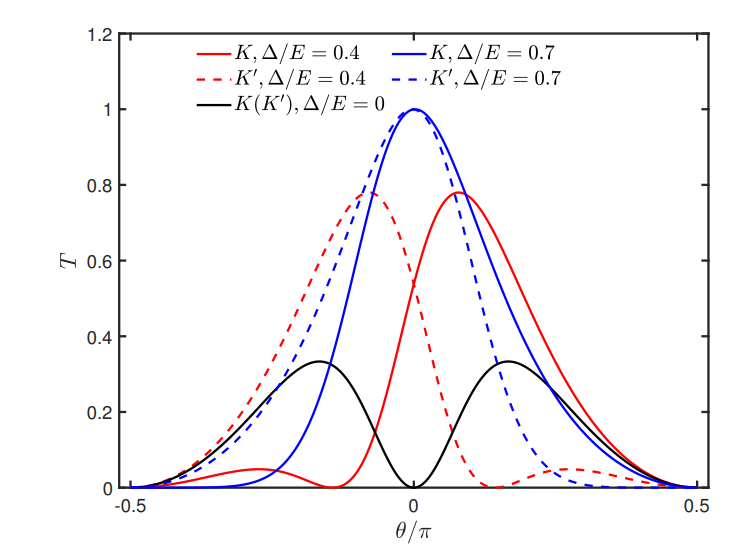
This occurs because orthogonal spin configurations and evanescent waves combine to facilitate electron transmission. The research reveals that the Berry phase associated with this tunneling varies with the specific junction parameters, and a distinct jump in the reflection phase of electrons accompanies tunneling at direct incidence, a phenomenon not observed when tunneling is suppressed. This behaviour represents a significant departure from conventional quantum mechanical reflection and transmission, offering new insights into electron transport across potential barriers, and potentially enabling novel electronic devices.
Graphene Tunneling, Band Gaps, and Valley Polarization
This research comprehensively investigates Klein tunneling and anti-Klein tunneling in bilayer graphene, focusing on how band gaps, electric fields, and valley polarization influence these phenomena. Bilayer graphene is central to this work because its band gap can be tuned with electric fields, offering a pathway to control electron behaviour. The study explores the transition between these tunneling regimes and how manipulating these factors can control electron transport, with implications for developing novel electronic devices, including valley filters and devices that leverage valley polarization, and potentially new types of transistors.
Klein Tunneling with Orthogonal Electron Spins
This research presents a theoretical investigation into electron tunneling within dual-gated bilayer graphene junctions, revealing a pathway to control tunneling behaviour through applied voltage. Scientists discovered that manipulating the gate voltage introduces a band gap, which alters the polarization of electron spins and disrupts typical tunneling at direct incidence. Notably, a revival of efficient tunneling, known as Klein tunneling, occurs when the spin orientations of electrons on either side of the junction are orthogonal, highlighting the combined role of spin and wave behaviour. Furthermore, the Berry phase associated with this tunneling varies depending on the junction’s parameters, and a distinct jump in the reflection phase of electrons accompanies the tunneling at direct incidence, an effect absent when tunneling is suppressed.
👉 More information
🗞 Evanescent-mode-assisted Klein tunneling in dual-gated bilayer graphene
🧠 ArXiv: https://arxiv.org/abs/2509.23096


