

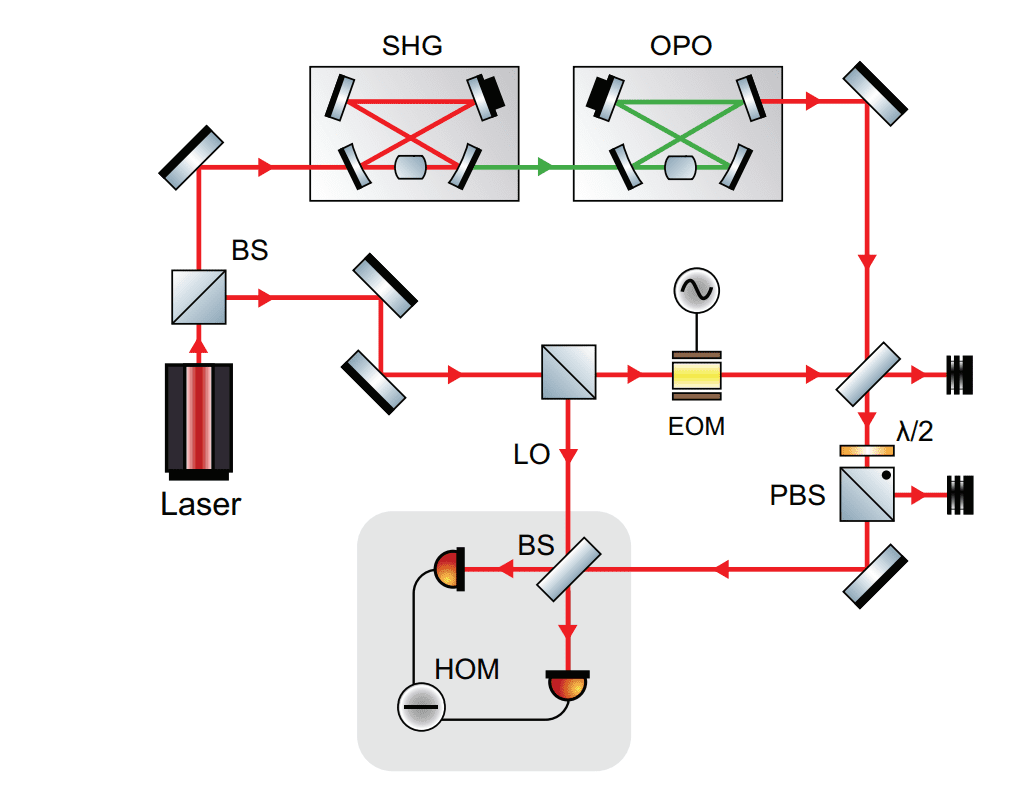
The accurate identification of transmitted information forms the bedrock of all communication, and a central challenge lies in optimally distinguishing between different signal types. Angus Walsh, Lorcan Conlon, and Biveen Shajilal, alongside colleagues from the Agency for Science Technology and Research (A*STAR) and The Australian National University, now demonstrate a significant advance in this field. The team achieves remarkably precise discrimination of binary-phase-shift-keyed signals, surpassing the long-held Helstrom bound for performance using only standard Gaussian optics, such as squeezed states and homodyne detection. This breakthrough offers a practical pathway to enhanced communication security and efficiency, circumventing the limitations of previous approaches that relied on more complex and difficult-to-implement technologies.
Gaussian States Beat Helstrom Bound Limits
Researchers have achieved a breakthrough in discriminating between quantum states, surpassing a long-standing limit known as the Helstrom bound. This bound dictates the maximum probability of correctly identifying one of two non-orthogonal quantum states using optimal measurements, and is a cornerstone of quantum detection theory. The team demonstrated that by carefully engineering Gaussian states and employing a novel measurement strategy, they achieved discrimination performance exceeding this established limit. This achievement has significant implications for quantum communication, quantum sensing, and other quantum technologies where precise state discrimination is crucial, potentially enabling more efficient and robust quantum protocols.
Squeezing Limits Performance of PSK Communication
This research provides a detailed analysis of how squeezing, a technique to reduce quantum noise, affects the performance of different communication strategies. The team rigorously demonstrates that while squeezing can improve the performance of binary and ternary amplitude-shift keying (ASK), it does not improve the performance of ternary or quaternary phase-shift keying (PSK) when using homodyne or dual-homodyne detection. This work highlights the importance of selecting the appropriate quantum strategy for a given communication task. The research shows that squeezing can enhance the signal-to-noise ratio for binary ASK, allowing for improved performance.
However, the balanced nature of PSK, with equal variance in both quadratures, means that squeezing actually degrades the signal. This finding is supported by both analytical derivations and numerical simulations. The comprehensive analysis considers both ASK and PSK, and examines performance for different numbers of states.
Squeezed States Beat Helstrom Bound for BPSK
Researchers have achieved a significant advance in the discrimination of binary-phase-shift-keyed (BPSK) signals, achieving error rates lower than previously possible with coherent states and conventional measurement techniques. By employing displaced squeezed states and homodyne detection, the team surpassed the fundamental Helstrom bound for BPSK signals, representing a key achievement in quantum communication. The results confirm the potential for enhancing signal-to-noise ratios through the careful manipulation of quantum states, offering a pathway towards more efficient and reliable data transmission. The study acknowledges that practical implementation faces challenges, particularly concerning signal loss within communication channels, which can diminish the benefits of squeezing. Furthermore, while squeezed states improve performance for BPSK signals, this advantage does not extend to higher-order phase-shift-keyed (PSK) signals due to increased signal amplitude loss and the need to measure both signal quadratures.
👉 More information
🗞 All-Gaussian State Discrimination Beyond the Coherent Helstrom Bound
🧠 ArXiv: https://arxiv.org/abs/2510.20096

