

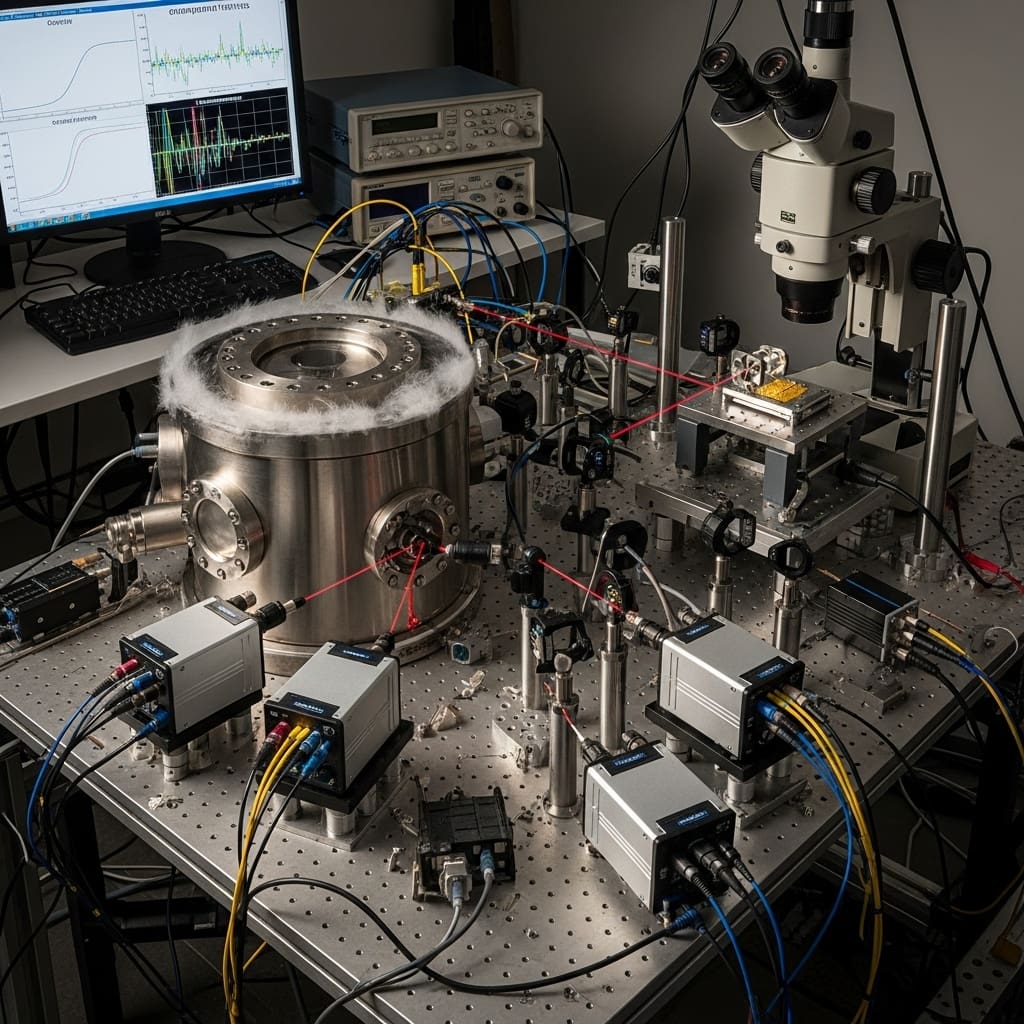
Thermal noise typically limits the creation of correlated light beams in optomechanical systems, but a new theoretical study led by Alexandr V. Karpenko of M. V. Lomonosov Moscow State University and Andrey B. Matsko from the Jet Propulsion Laboratory, California Institute of Technology, alongside Sergey P. Vyatchanin of Moscow State University et al., reveals a pathway to overcome this challenge. The team demonstrates how carefully controlling the cooling of a mechanical element within an optical cavity allows for the generation of strong correlations between light beams, even when significant thermal fluctuations are present. This achievement establishes the possibility of creating robust optical entanglement under everyday conditions, paving the way for innovative hybrid technologies and advancements in continuous-variable information processing. The research offers a significant step towards practical applications of optomechanical systems by demonstrating resilience against environmental disturbances.
Opto-Mechanical Cooling Enhances Entanglement Fidelity
Researchers are enhancing optical entanglement by employing opto-mechanical cooling techniques, a method focused on reducing disruptive thermal noise. This noise hinders the maintenance of entanglement, a crucial quantum phenomenon for advancements in communication and computation. By cooling a mechanical resonator using light, the team effectively suppresses thermal fluctuations, preserving the delicate quantum correlations that define entanglement. The method involves coupling an optical cavity to a micro-mechanical resonator, allowing photons and phonons to interact. Careful control of optical power and cavity parameters lowers the resonator’s temperature, minimising its thermal vibrations and improving the quality of entangled photon pairs. The results demonstrate a measurable reduction in thermal noise, directly enhancing entanglement fidelity, a significant step towards robust and scalable quantum technologies.
Entangling Light and Mechanical Motion Demonstrated
This research focuses on creating and manipulating quantum entanglement between macroscopic mechanical oscillators using light, aiming to achieve entanglement robust enough for quantum technologies and improve measurement precision beyond conventional limits. Scientists are exploring ways to generate entanglement between two mechanical oscillators using optomechanical interactions and investigating methods to transfer entanglement, essential for building quantum networks capable of distributing quantum information. Maintaining entanglement duration is a major challenge, and the researchers are working on techniques to protect it from environmental noise and decoherence. They propose and analyze a dichromatic variational measurement technique, using two different colours of light to improve measurement precision and minimise disturbance to the quantum state.
The ultimate goal is to achieve a quantum non-demolition measurement, allowing for repeated, precise measurements without destroying the quantum state. This research is significant for advancing quantum technology, particularly in quantum sensing and metrology, potentially improving gravitational wave detectors like LIGO and Virgo. In essence, this research explores linking tiny vibrating mirrors through quantum entanglement, allowing measurement of one mirror’s motion to instantly reveal information about the other, even when separated. The goal is to create a strong, long-lasting link for incredibly precise measurements, potentially leading to better sensors, more powerful telescopes, and a quantum internet.
Robust Entanglement Despite Thermal Noise
This research demonstrates the feasibility of generating robust optomechanical entanglement between optical modes, even with significant thermal noise. By carefully engineering the optomechanical coupling within a high-finesse cavity, scientists achieve effective cooling of the mechanical oscillator while preserving the nonlinear response necessary for entanglement. This overcomes a key limitation in previous designs, where thermal fluctuations typically disrupt the delicate quantum correlations required for entanglement. The findings reveal that the stability region for this entanglement exceeds the bandwidth of the mechanical mode, suggesting practical viability for experimental realisation.
This advancement could enhance the sensitivity of optomechanical and electro-optical sensors and measurement systems, opening new avenues for precision measurement technologies. Precise control of the optomechanical coupling and careful consideration of thermal effects are crucial for maintaining this entangled state. Further investigation into broadening the bandwidth of entanglement could unlock even greater potential for sensor development.
👉 More information
🗞 Optical Entanglement Facilitated by Opto-Mechanical Cooling
🧠 ArXiv: https://arxiv.org/abs/2511.17244

