

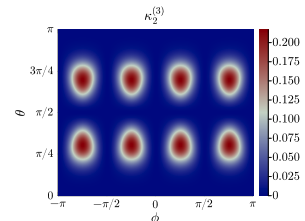
Multi-entropy and dihedral measures, quantifying multi-partite entanglement and labelled by the Rényi index, accurately identify critical points in lattice field theories. Numerical results from massless scalar field theory and the transverse-field Ising model align with conformal field theory calculations for certain Rényi indices, and new predictions are provided.
The behaviour of matter at critical points, where systems undergo dramatic phase transitions, reveals fundamental connections between quantum entanglement and geometry. Understanding these relationships necessitates quantifiable measures of entanglement that extend beyond traditional metrics. Recent research focuses on multi-entropy and dihedral measures, a class of tractable tools for characterising multi-partite entanglement, labelled by the Rényi index, a parameter determining the sensitivity to different entanglement contributions. Jonathan Harper, Ali Mollabashi, Tadashi Takayanagi, and Kenya Tasuki, from institutions including the Yukawa Institute for Theoretical Physics and the Institute for Research in Fundamental Sciences, present their investigation into these measures in the article, “Multi-entropy and the Dihedral Measures at Quantum Critical Points”. Their work examines concrete examples within dimensional massless free scalar field theory on a lattice and the transverse-field Ising model, demonstrating quantitative agreement with conformal field theory calculations for certain Rényi indices and providing new predictions for others.
Quantum systems exhibit complex entanglement structures at critical points, offering a refined methodology for characterising phase transitions and advancing comprehension of intricate quantum phenomena. Researchers currently investigate multi-entropy and dihedral measures as potent probes of these critical points, establishing a demonstrable link between entanglement and critical behaviour through both theoretical calculations and numerical simulations. This work focuses on the dimensional massless free scalar field theory and the transverse-field Ising model, providing a comparative analysis of their critical properties and validating the efficacy of these novel entanglement measures.
The study demonstrates quantitative agreement between numerical results
The study demonstrates quantitative agreement between numerical results and predictions derived from conformal field theory regarding Rényi entropy. Rényi entropy, a generalisation of the more commonly known Shannon entropy, quantifies the amount of information needed to describe a quantum state, and its precise calculation at critical points strengthens confidence in these measures as reliable indicators of critical behaviour and validates the underlying theoretical framework. Researchers leverage the properties of conformal field theory, a framework describing systems at critical points exhibiting scale invariance, to calculate entanglement measures and establish benchmarks for comparison with numerical simulations, providing a robust foundation for further investigation. Predictions are extended to higher-order Rényi entropies within the massless scalar field theory, generating testable hypotheses for future research and expanding understanding of entanglement characteristics.
Researchers successfully apply both multi-entropy and dihedral measures, highlighting their potential as complementary tools to conventional methods for characterising critical phenomena. These measures reveal details inaccessible through traditional order parameters, which identify the state of a system, or correlation functions, which describe the relationships between different parts of the system. The findings contribute to a deeper understanding of the relationship between entanglement, criticality, and the underlying quantum field theory, opening avenues for further exploration of complex quantum systems. Density Matrix Renormalization Group (DMRG), a numerical method for finding the ground state of quantum many-body systems, and tensor networks, a mathematical framework for representing many-body quantum states, are actively utilised as powerful numerical tools for studying one-dimensional quantum systems.
The Ryu-Takayanagi formula, and its subsequent generalisations, proposes
The Ryu-Takayanagi formula, and its subsequent generalisations, proposes a connection between entanglement entropy and the geometry of the dual spacetime, suggesting a deeper relationship between quantum information and gravity. This connection, rooted in the holographic principle, posits that a quantum system can be described by a gravitational theory in one higher dimension. Further research is necessary to explore these connections and develop new tools for studying entanglement in increasingly complex systems, potentially bridging the gap between quantum mechanics and general relativity.
🗞 Multi-entropy and the Dihedral Measures at Quantum Critical Points
🧠 DOI: https://doi.org/10.48550/arXiv.2506.10396


