Researchers at the University of California have demonstrated the creation of entanglement between mechanical oscillators using quantum optomechanical Stimulated Raman Adiabatic Passage (STIRAP). Analytical and numerical modelling reveals that this technique can generate a mechanical Bell state originating from a single phonon Fock state of one mechanical mode, with the other mechanical mode initially in its vacuum state, and a product state from a coherent state. Crucially, the relative phases within the final state of the STIRAP process are determined by the initial parity, whether even or odd, of the phonon-number, offering a novel degree of control over the entangled output. The team propose a new interferometric protocol, leveraging time-reversed fractional STIRAP, to quantify the entanglement between the mechanical modes, representing a significant step towards the development of advanced quantum technologies.
Fractional STIRAP yields high-fidelity mechanical entanglement and parity control
Entanglement quantification reaches approximately 0.48, consistent with a highly entangled mechanical Bell state.. This threshold is significant because below it, thermal noise typically overwhelms any attempts at entanglement generation, indicating a transition from purely classical behaviour to demonstrably quantum correlations within the mechanical system. Achieving this level of entanglement necessitated the employment of fractional STIRAP, a technique meticulously refined through both analytical calculations and numerical simulations. These simulations were designed to generate a mechanical Bell state from a single phonon, the quantum unit of vibrational energy, and a product state originating from a coherent state, which describes a well-defined amplitude and phase of oscillation. The research highlights that the relative phases of the final entangled state are intrinsically linked to the initial phonon-number parity, providing a means of precise control over the characteristics of the entangled output. This parity control is a key feature, allowing for the selective creation of different entangled states based on the initial conditions.
The STIRAP process was successfully reversed with a high fidelity of 0.971 at a cryogenic temperature of 10 millikelvins, confirming the reliable transfer of entanglement and the preservation of the quantum state for a duration of up to four milliseconds. This demonstrates the robustness of the entanglement generation and its potential for use in quantum information processing. Detailed analysis, utilising the Wigner quasi-probability distribution, a powerful tool for characterising quantum states, revealed a close match, with a fidelity of 0.98, between the created state and the ideal Bell state. This validates the high quality of the generated entanglement and confirms that the system is behaving as predicted by quantum mechanical principles. While the current demonstration relies on numerical modelling to account for energy loss within the system, rather than conclusive experimental proof of loss mitigation, this modelling provides a promising pathway towards constructing more complex and scalable quantum systems. This refined approach constitutes a major advancement in the field of mechanical quantum systems. It opens up possibilities for quantifying the delicate link between vibrating components and furthering the development of quantum optomechanics. Although the abstract acknowledges a key challenge, the notorious fragility of quantum states, ongoing development will focus on realising scalable quantum technologies, building upon this foundational work and addressing the limitations imposed by decoherence.
Fractional STIRAP enables mechanical Bell state creation via vibrational coupling
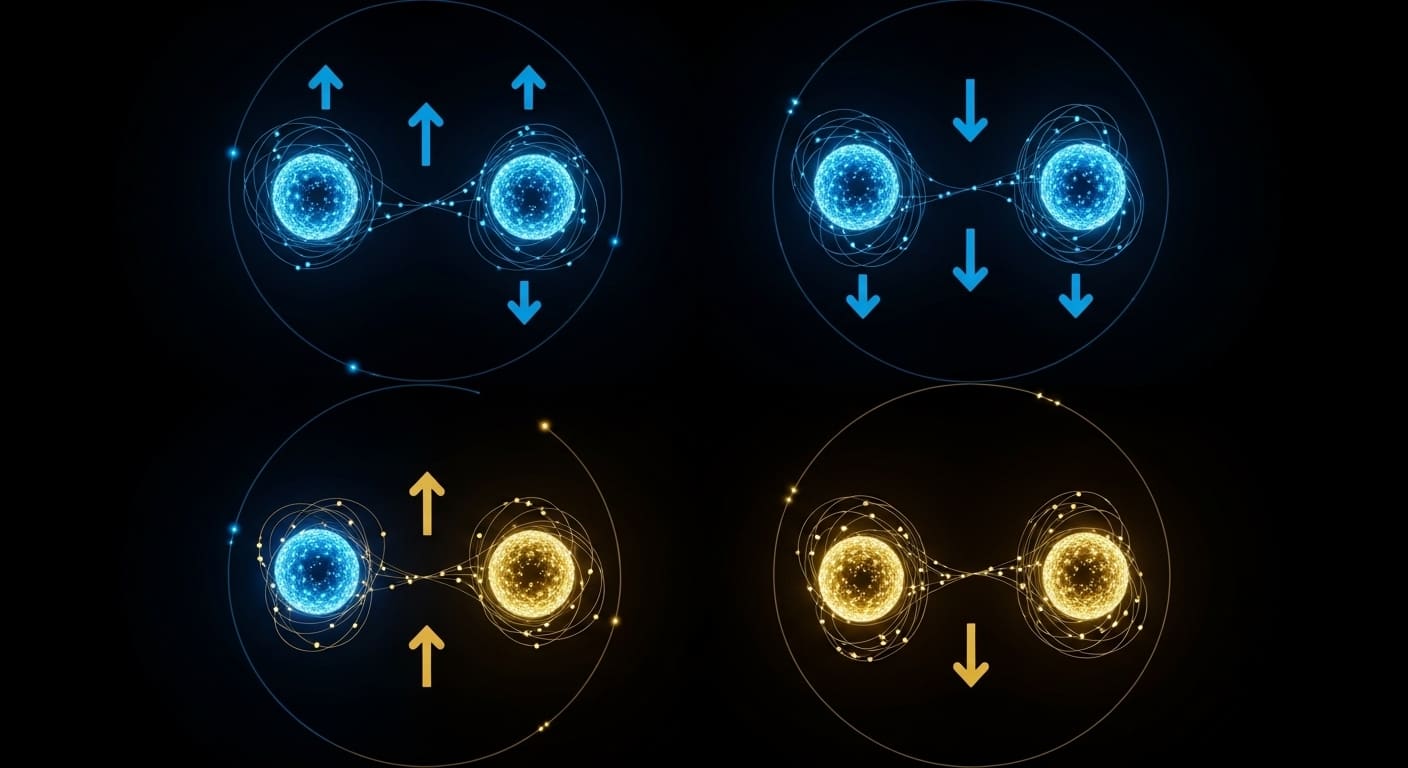
Generating entanglement between macroscopic objects remains a fundamental challenge and a cornerstone in the pursuit of scalable quantum technologies. This work presents a viable method for achieving this, utilising fractional STIRAP to create a ‘mechanical Bell state’ from readily available initial conditions. The initial parity, or evenness/oddness, of the starting vibration’s energy level plays a crucial role in establishing this entanglement, providing a new and valuable control parameter for quantum systems. To facilitate efficient energy transfer and entanglement generation, a low-quality factor (Q) was intentionally engineered for the optical mode compared to the mechanical modes (Qopt ≪ Qm). The quality factor represents the degree of energy storage in a resonant system; a lower Q for the optical mode ensures that it does not impede the transfer of quantum information between the mechanical modes. This technique effectively transfers quantum states, creating an entangled connection, or ‘Bell state’, between two vibrating objects. Stimulated Raman Adiabatic Passage (STIRAP) is a quantum control technique that allows for the efficient and coherent transfer of a quantum state between two energy levels. In this context, it bypasses limitations imposed by spontaneous emission or optical decay, which can destroy entanglement, and introduces a time-reversed protocol for quantifying the entanglement. The time-reversed protocol allows for the precise measurement of the entanglement by effectively running the STIRAP process in reverse, enabling the reconstruction of the initial entangled state.
The underlying principle relies on the strong coupling between the optical and mechanical modes within an optomechanical system. These systems typically consist of a mechanical resonator, such as a micro- or nano-mechanical beam, coupled to an optical cavity. The interaction between light and motion allows for the manipulation of the mechanical resonator’s quantum state. Fractional STIRAP, in particular, allows for the partial transfer of the quantum state, enabling the creation of more complex entangled states. The analytical modelling employed in this research provides a theoretical framework for understanding the dynamics of the STIRAP process and predicting the characteristics of the generated entanglement. Numerical simulations were then used to validate the analytical results and to explore the effects of various parameters, such as energy loss and temperature, on the fidelity of the entanglement. The ability to generate and control entanglement between macroscopic mechanical oscillators has significant implications for a range of applications, including quantum sensing, quantum communication, and the development of quantum networks. Furthermore, this work contributes to a deeper understanding of the fundamental principles governing quantum mechanics at the macroscopic scale, paving the way for future advancements in quantum technology.
Researchers demonstrated the generation of a mechanical Bell state, a connection between two vibrating objects, using a technique called fractional STIRAP. This method efficiently transfers quantum information between mechanical modes, even with some energy loss, and allows for the creation of entanglement. The study confirms high-fidelity entanglement is achievable with current cryogenic cooling technology and mechanical devices. The authors also propose a time-reversed STIRAP protocol to precisely measure the entanglement between the two mechanical modes.
👉 More information
🗞 Modeling Quantum Optomechanical STIRAP
🧠 ArXiv: https://arxiv.org/abs/2603.28692