Superconductivity, the ability of a material to conduct electricity with zero resistance, holds immense promise for future technologies, but achieving this state in nanoscale materials remains a significant challenge. Jose M. Pereira, Daniel Tezze, and Beatriz Martín-García, working at CIC nanoGUNE BRTA and IKERBASQUE, alongside colleagues including Fèlix Casanova and Maider Ormaza, now demonstrate a method to substantially enhance superconductivity in extremely thin flakes of 2H-TaS2. The team achieves this by carefully introducing molecules into the material during experimentation, a process known as intercalation, and meticulously tracking the resulting changes in electrical properties. This innovative approach not only suppresses disruptive charge density waves within the material, but also elevates the superconducting transition temperature above 3 Kelvin and establishes a fully developed zero-resistance state, opening up new possibilities for integrating tailored materials into scalable technologies.
Organic Intercalation Enhances 2D Superconductivity
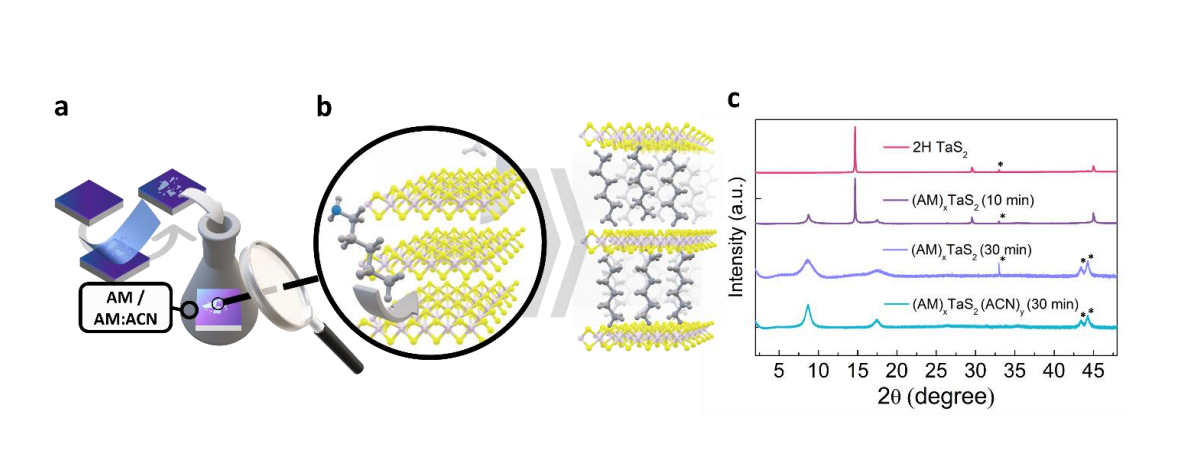
Scientists developed a novel method for enhancing superconductivity in two-dimensional materials by directly inserting organic molecules into the spaces between layers within tens-of-nanometer thick 2H-TaS2 flakes. This work overcomes the longstanding challenge of achieving zero-resistance states in these flakes, previously demonstrated only in bulk crystals, and opens avenues for scalable quantum technologies. The study began with commercially sourced 2H-TaS2 crystals, which researchers then subjected to a carefully controlled chemical intercalation process using amylamine and acetonitrile solutions. They prepared solutions by mixing one part amylamine with two parts acetonitrile, creating a tailored chemical environment for the process.
The team conducted the entire intercalation process inside sealed glass vials under ambient atmospheric conditions, allowing for a straightforward and potentially scalable technique. Researchers exfoliated flakes and rinsed them three times with acetonitrile to ensure a clean surface for subsequent electrical characterization. To confirm successful intercalation and assess structural changes, scientists employed X-ray diffraction, analyzing both bulk crystals and exfoliated flakes supported on silicon dioxide substrates. Electrical characterization of the 2H-TaS2 flakes was performed before and after intercalation, enabling a direct comparison of their transport properties.
Results demonstrate that molecular intercalation successfully suppresses the charge density wave and increases the onset of superconductivity to above 3 Kelvin, a significant improvement over the pristine material’s 0. 8 Kelvin bulk critical temperature. Furthermore, by carefully engineering the conditions of the chemical intercalation, the team achieved a fully developed zero-resistance state in the flakes, confirming the enhancement of superconductivity and paving the way for potential applications in scalable quantum devices.
Amylamine Intercalation Boosts 2D Superconductivity
Scientists achieved a significant breakthrough in enhancing superconductivity in two-dimensional materials by demonstrating a simple method for increasing the superconducting transition temperature in tens-of-nanometer thick 2H-TaS2 flakes. The research team successfully induced superconductivity with an onset temperature exceeding 3 Kelvin through in-situ intercalation, a process involving the insertion of amylamine molecules into the material’s structure. This work enables precise measurement of electrical characteristics before and after intercalation, allowing researchers to directly identify the impact of the introduced molecules on the transport properties of TaS2. Experiments revealed that the intercalation of amylamine molecules suppresses the charge density wave state within the TaS2 flakes while simultaneously increasing the superconducting transition temperature.
X-ray diffraction measurements confirmed an increase in interlayer distance following the molecular insertion, indicating successful intercalation. The team tested three experimental conditions, with the process occurring spontaneously at room temperature and enabling the parallel intercalation of multiple flakes without complex setups. Data shows that the work function of TaS2, approximately 5. 6 electron volts, is closely aligned with the highest occupied molecular orbital of organic amines, around 6 electron volts, facilitating the chemical intercalation. Electrical characterization demonstrates that the amylamine-intercalated TaS2 flakes exhibit superconducting characteristics similar to TaS2 monolayers, but unlike the monolayers, they maintain these properties even when exposed to atmospheric conditions. This breakthrough delivers a straightforward route for integrating chemically tailored intercalation compounds into scalable quantum devices, paving the way for advancements in materials science and nanotechnology.
Amylamine Intercalation Enhances Tantalum Disulfide Superconductivity
This research demonstrates a straightforward technique for enhancing superconductivity in few-layer flakes of tantalum disulfide, a material known to exhibit this property when combined with certain chemical compounds. Scientists successfully induced and improved superconductivity by introducing amylamine molecules into the spaces between the layers of the material, a process known as intercalation. Crucially, the team achieved this directly on the flakes themselves, allowing for precise measurement of the material’s electrical properties before and after the process. The study reveals that carefully controlling the intercalation environment, specifically by using a mixture of amylamine and acetonitrile, leads to a more complete superconducting state with a measurable onset temperature above 3 Kelvin.
The researchers also suggest that this method could be extended to create functional superconducting inks, broadening the potential applications of this material. The authors acknowledge that the intercalation process can induce some structural disorder within the material, and future work will focus on minimizing this effect. They also highlight the potential for exploring different intercalating agents and solvent mixtures to further optimize the superconducting properties of tantalum disulfide. This research provides a reliable and reproducible method for creating superconducting devices from readily available materials, paving the way for integration into advanced quantum technologies.
🗞 Enhanced Superconductivity in 2H-TaS2 Devices Through in-situ Molecular Intercalation
🧠 ArXiv: https://arxiv.org/abs/2510.24627