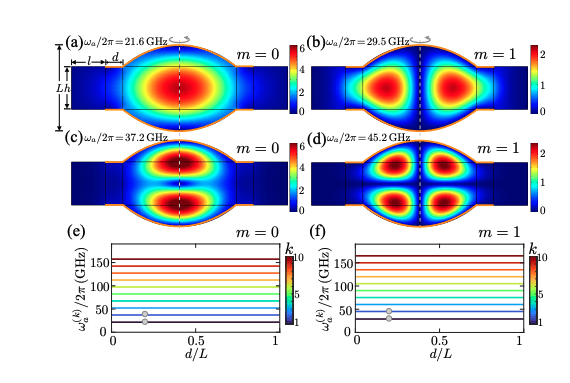
Strongly interacting single atoms represent a crucial building block for future quantum technologies, and researchers are continually seeking ways to amplify this interaction. Qian Bin, Ying Wu, and Jin-Hua Gao, along with colleagues at various institutions, now demonstrate a method for exponentially enhancing the strength of this interaction, known as single-atom cooperativity, by carefully controlling light within cavity electrodynamics systems. The team achieves this enhancement by designing cavities that concentrate light into extremely small volumes, effectively boosting the quality of the light without increasing its size, a feat that overcomes a fundamental limitation of conventional designs. This breakthrough enables ultra-long interactions between atoms and light, paving the way for more stable quantum communication, more precise sensors, and potentially, more powerful quantum algorithms.
Strong Coupling, Cavity QED, and Nanophotonics
This collection of research explores the fascinating intersection of quantum optics, nanophotonics, and quantum information science. A central theme is cavity quantum electrodynamics (Cavity QED), investigating how light and matter interact within optical cavities, particularly in regimes of strong and ultrastrong coupling. Researchers are designing nanoscale optical resonators, such as microcavities and photonic crystals, to achieve high quality factors and small mode volumes, thereby enhancing light-matter interactions. The work also delves into fundamental concepts of quantum optics, including coherence, entanglement, and nonlinear optical phenomena, with a significant focus on harnessing these for advancements in quantum computing, communication, and imaging.
Studies explore superconducting circuits as a means to create artificial atoms and cavities for quantum information processing, utilizing diverse materials like semiconductors and dielectrics. Researchers are employing sophisticated design techniques, including topology optimization, to create novel photonic structures with tailored properties, and leveraging computational tools to simulate and analyze complex quantum systems. This comprehensive effort ultimately strives to develop new quantum technologies for computation, communication, and sensing.
Enhanced Atom-Light Interaction via Wide Cavities
Scientists have engineered a novel cavity quantum electrodynamics (QED) system to dramatically enhance the interaction between single atoms and light. They overcame a fundamental limitation of conventional subwavelength cavities by strategically increasing the wing width of the cavity, maintaining a constant mode volume while significantly improving the quality factor. This innovative design exploits strongly localized light modes, leading to an exponential enhancement of the single-atom cooperativity parameter. Experiments demonstrated that increasing the wing width reduces the cavity decay rate and enhances the effective nonlinearity, simultaneously reducing correlation and improving the steady-state photon number.
The optimized cavity enabled the observation of ultra-long vacuum Rabi oscillations and a strong photon blockade, phenomena indicative of enhanced light-matter interaction. This system represents a significant advancement in coherent manipulation of quantum systems, potentially stabilizing qubits and improving the efficiency of quantum algorithms. Furthermore, this method promises longer-distance quantum communication networks with enhanced security and reach, improved precision and stability for quantum sensors, and high-quality quantum imaging even in low-light conditions.
Enhanced Single-Atom Cooperativity via Cavity Wings
Scientists achieved a breakthrough in cavity quantum electrodynamics (QED) by demonstrating an exponential enhancement of single-atom cooperativity, a crucial parameter for advanced information processing. Through innovative cavity design featuring specially engineered wings, the team exponentially improved the quality factor without altering the mode volume, effectively overcoming a long-standing trade-off in subwavelength Fabry-Pérot cavities. Experiments revealed that increasing the wing width dramatically boosted the quality factor-to-mode volume ratio and, consequently, the single-atom cooperativity parameter, confirmed by finite-element simulations. This research demonstrates that the novel cavity design enables ultra-long vacuum Rabi oscillations and a strong photon blockade effect, signifying a significant leap towards prolonged coherent manipulation of photons. Data confirms that the exponential improvement in single-atom cooperativity is achievable even with experimentally realizable designs, paving the way for advancements in quantum information processing, longer-distance communication networks, and enhanced precision in various sensing applications.
Strong Atom-Light Coupling via Geometry Design
This research demonstrates a method for significantly enhancing the interaction between single atoms and light within cavity quantum electrodynamics systems. By carefully designing the geometry of the cavity to create strongly localized light modes, the team successfully increased the cavity’s quality factor without altering its size, effectively overcoming a common limitation in these systems. This improvement directly leads to a substantial enhancement of the single-atom cooperativity parameter, a key metric for strong light-matter interactions. The enhanced cooperativity enables phenomena such as ultra-long vacuum Rabi oscillations and strong single-photon blockade, paving the way for advanced coherent manipulation of quantum states. These advancements hold promise for several applications, including the development of more stable and efficient quantum computers, the establishment of longer-distance quantum communication networks, and the improvement of quantum sensors and imaging techniques.
👉 More information
🗞 Cavity QED based on strongly localized modes: exponentially enhancing single-atom cooperativity
🧠 ArXiv: https://arxiv.org/abs/2509.04739