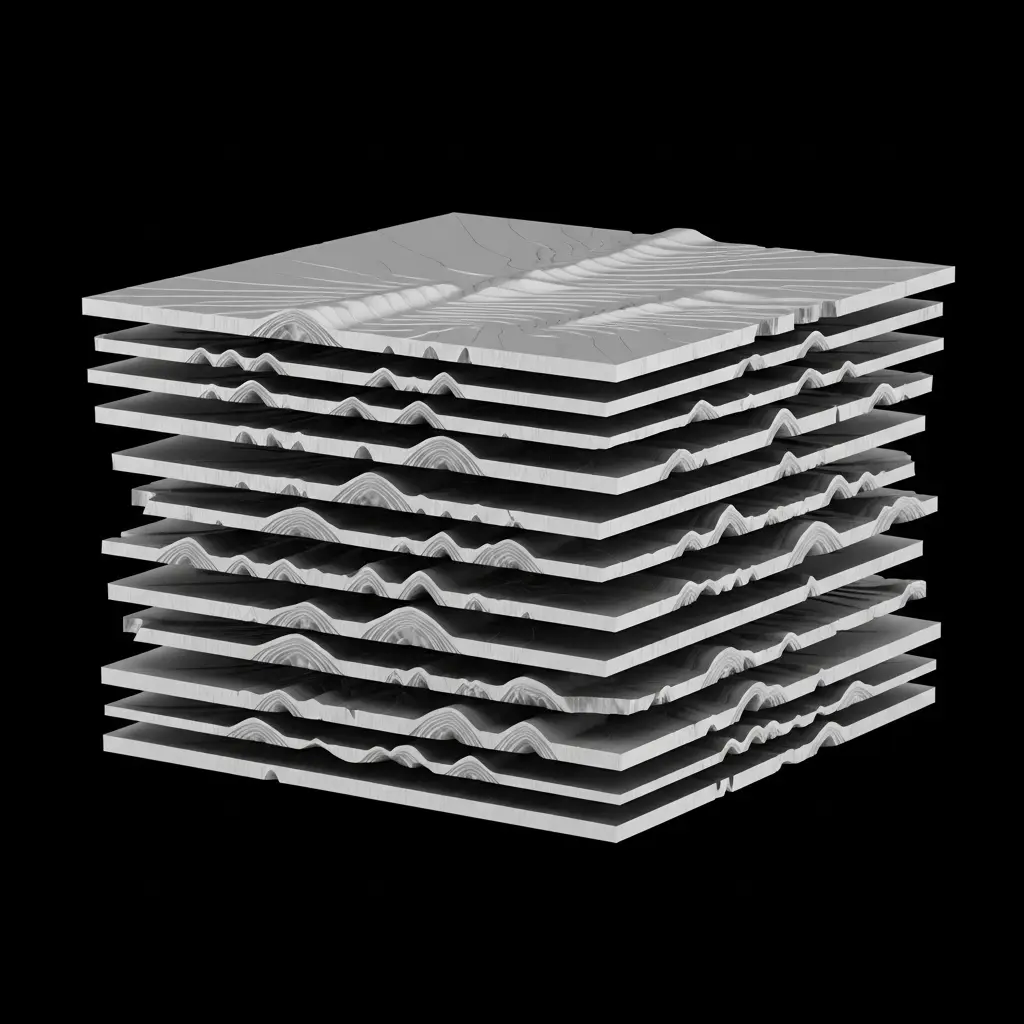
Researchers are unlocking the secrets of two-dimensional materials by cleverly manipulating their structure, and a new study published today details a significant breakthrough in understanding charge-density waves and superconductivity. Huanhuan Shi, Qili Li, and Antoine M. T. Baron, all from the Institute for Quantum Materials and Technologies at Karlsruhe Institute of Technology, alongside Marie-Aude Méasson and Sangjun Kang et al., demonstrate a novel method of ‘molecular intercalation’ to create bulk materials exhibiting properties typically found only in single atomic layers of niobium diselenide. By inserting organic cations between the layers, the team electronically decouples them, effectively recreating monolayer-like physics in a robust, easily studied platform , and crucially, they’ve observed a dramatic enhancement of the charge-density-wave transition temperature to 130K alongside a suppression of superconductivity. This work establishes a scalable route for engineering competing quantum orders within layered materials, potentially paving the way for new electronic devices and a deeper understanding of fundamental physics.
Electrochemical Intercalation Reveals NbSe2 Monolayer Physics
Scientists have demonstrated a groundbreaking method for accessing monolayer-like physics in the bulk material niobium diselenide (NbSe₂), overcoming the limitations of studying atomically thin layers. Distinct dip-hump anomalies were observed in the tunneling spectra, suggesting the presence of collective mode excitations and providing further insight into the altered electronic structure. Experiments show that the intercalation of tetrapropylammonium and tetrabutylammonium cations dramatically alters the electronic properties of NbSe₂, effectively tuning the competition between CDW formation and superconductivity. The research establishes that the expanded interlayer spacing, reaching 1.22nm in tetrapropylammonium-intercalated NbSe₂ and 1.52nm in tetrabutylammonium-intercalated NbSe₂, electronically decouples the NbSe₂ layers. This breakthrough reveals that the observed behaviours closely resemble those of exfoliated monolayers, reinforcing the intrinsic competitive relationship between CDW formation and superconductivity in NbSe₂. The team’s findings not only provide valuable insights into the microscopic mechanisms governing these phenomena but also open up exciting possibilities for designing and engineering novel quantum materials with tailored properties.
Electrochemical Intercalation of NbSe2 for Layer Decoupling enables
The study pioneered the use of Raman spectroscopy to monitor structural changes, initially obtaining reference spectra from pristine 2H-NbSe2 single crystals exhibiting characteristic phonon modes at 234cm−1, 250cm−1, 181cm−1, and 30cm−1. Subsequent Raman analysis of the intercalated compounds revealed a systematic redshift of the A1g mode, softening by 4.2cm−1 in (TPA)yNbSe2 and 5cm−1 in (TBA)xNbSe2, indicative of lattice expansion along the c-axis. Furthermore, a substantial hardening of 9cm−1 in the E1 2g mode and complete suppression of the shear mode mirrored behaviours observed in monolayer NbSe2, strongly suggesting replication of monolayer characteristics. To quantitatively determine interlayer separation, scientists performed X-ray diffraction (XRD) and cross-sectional high-angle annular dark-field scanning transmission electron microscopy (HAADF-STEM).
XRD patterns of pristine NbSe2 displayed sharp (00l) diffraction peaks corresponding to an interlayer spacing of 0.62nm, while intercalated samples exhibited new (00l) peaks at lower 2θ angles, confirming successful intercalation. Analysis of XRD results revealed expanded interlayer distances of 1.22nm for (TPA)yNbSe2 and 1.52nm for (TBA)xNbSe2, representing expansions of approximately 0.6nm and 0.9nm respectively. Cross-sectional HAADF-STEM imaging further corroborated these findings, revealing an ordered lamellar structure with a periodicity consistent with the XRD analysis. Temperature-dependent Raman spectroscopy, conducted between 10 K and 290 K, investigated the impact of intercalation on charge-density-wave (CDW) properties. Pristine NbSe2 exhibited a soft mode redshift upon cooling, saturating at 117.8cm−1 below a CDW transition temperature (TCDW) of 33 K, accompanied by the emergence of additional Raman modes at 28cm−1 and 189cm−1.
Intercalation boosts charge-density-wave temperature in NbSe2 significantly
Scientists have achieved a significant breakthrough in manipulating the properties of niobium diselenide (NbSe2) through controlled molecular intercalation. This innovative approach electronically decouples the NbSe2 layers while simultaneously introducing well-defined charge doping, opening new avenues for materials engineering. These results precisely reproduce the phase diagram observed in mechanically exfoliated monolayers, confirming the successful emulation of 2D behaviour within the bulk material. Measurements confirm that the interlayer spacing expands from 0.62nm in the bulk material to 1.22nm in tetrapropylammonium-intercalated NbSe2 (TPA)yNbSe2 and 1.52nm in (TBA)xNbSe2, as verified by X-ray diffraction (XRD) and high-angle annular dark-field scanning transmission electron microscopy (HAADF-STEM). Raman spectroscopy further corroborated these findings, clearly identifying the characteristic phonon modes and their shifts upon intercalation. The breakthrough delivers distinct dip-hump anomalies in the tunneling spectra, suggestive of collective mode excitations, providing further insight into the electronic structure of the intercalated material.
Intercalation induces monolayer-like behaviour in NbSe2
Intercalation with tetrapropylammonium and tetrabutylammonium expands the space between layers by approximately twofold, electronically decoupling the NbSe₂ layers and introducing controlled charge doping, a crucial step in manipulating material properties. The resulting phase diagram closely resembles that of mechanically exfoliated monolayers, confirming that molecular intercalation offers a robust and scalable method for achieving monolayer-like electronic states in macroscopic crystals, a significant advancement for materials science. The observed effects exceed those reported in exfoliated monolayers, suggesting that intercalation introduces additional tuning parameters, particularly electron doping, which further strengthens CDW order. Dip-hump anomalies detected in tunneling spectra are consistent with collective mode excitations, potentially related to Leggett modes, opening avenues for investigating multiband dynamics and superconducting collective modes in two dimensions.
👉 More information
🗞 Enhanced Charge-Density-Wave Order and Suppressed Superconductivity in Intercalated Bulk
🧠 ArXiv: https://arxiv.org/abs/2601.14902