

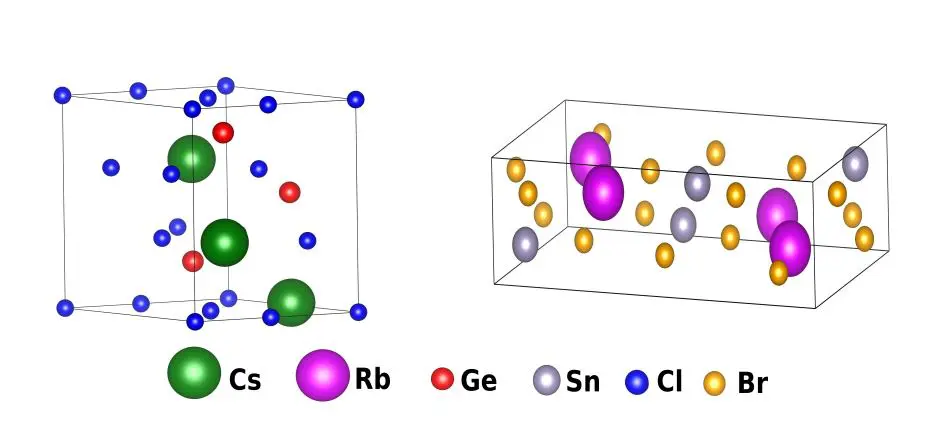
The pursuit of sustainable energy sources drives ongoing materials research, and halide perovskites represent a particularly promising avenue for clean energy conversion. L. Celestine, R. Zosiamliana, and H. Laltlanmawii, alongside colleagues at Pachhunga University College, now demonstrate the potential of lead-free halide perovskites, specifically CsGeCl3 and RbSnBr3, through detailed computational modelling. Their work investigates how the arrangement of atoms at the interface between these materials affects their ability to convert light into electricity and generate piezoelectricity, the ability to produce electrical charge from mechanical stress. The team’s calculations reveal that these materials exhibit remarkable optoelectronic and piezoelectric properties due to their unique atomic structures, offering a pathway towards more efficient and sustainable energy technologies.
Perovskites For Energy Storage And Conversion
Computational Study of Perovskites for Energy Storage
This research program investigates computational materials science, particularly focusing on materials for energy storage and conversion, such as perovskite solar cells and batteries. Researchers employ advanced techniques to predict material behaviour and identify promising candidates for next-generation energy technologies, centering on understanding the properties of perovskite materials and optimizing their performance through computational modelling. Key research themes include perovskite solar cells, defect chemistry, and electronic structure. Scientists are particularly interested in understanding how defects influence material properties and device performance, extending to energy storage mechanisms and interface engineering.
Predicting material properties like electronic structure, optical characteristics, and stability, alongside understanding charge transport, is crucial for optimizing device performance. The research focuses on organic-inorganic hybrid perovskites, employing computational screening to identify materials with improved properties. A key area of investigation is developing strategies to passivate defects and enhance material stability, while also exploring modifying interfaces to improve charge transport and reduce energy loss. The use of first-principles calculations allows for a detailed understanding of the fundamental physics and chemistry governing these materials. This comprehensive approach combines computational modelling with experimental characterization to validate results and discover new materials for energy applications. The ultimate goal is to design and optimize materials for sustainable energy technologies, with a particular emphasis on perovskite solar cells and related devices.
DFT Modelling of Lead-Free Perovskite Structures
Investigating Lead-Free Halides Using Density Functional Theory
Scientists conducted a detailed computational study of lead-free halide perovskites, specifically cesium germanium chloride (CsGeCl3) and rubidium tin bromide (RbSnBr3), to assess their potential for clean energy harvesting. The team employed density functional theory (DFT) to model the materials’ electronic structure and predict their behaviour, meticulously relaxing the materials’ structure to achieve a stable configuration by optimizing cell parameters, volumes, and atomic positions. To ensure accuracy, the team implemented various computational techniques, including generalized gradient approximation and meta-generalized gradient approximation to describe electron-ion interactions. They also utilized a specific optimization algorithm to refine the materials’ structure, adopting PseudoDojo potentials to balance accuracy and computational cost.
Accurate representation of the materials’ behaviour was achieved through the use of Monkhorst-Pack k-point meshes during geometry optimization and ground state property calculations. To assess thermal stability, the scientists performed molecular dynamics simulations, tracking the materials’ behaviour over time. Surface slab models of CsGeCl3 and RbSnBr3 were generated to investigate their surface and interfacial energies, and the team computed piezoelectric tensors using a Berry-phase polarization technique, enabling a thorough investigation of the materials’ structural, electronic, and piezoelectric properties.
Lead-Free Perovskites’ Stability and Optoelectronic Properties
Demonstrating Stability and Optoelectronic Potential of Perovskites
Scientists have achieved a significant breakthrough in the development of lead-free halide perovskites for sustainable energy conversion, focusing on cesium germanium chloride (CsGeCl3) and rubidium tin bromide (RbSnBr3). This work investigates the potential of these materials to harvest clean and renewable energy through detailed theoretical modelling, examining their bulk properties, surface structures, and interfacial characteristics. The study confirms that CsGeCl3 exhibits a hexagonal structure, with a calculated tolerance factor of 1. 11, while RbSnBr3 adopts an orthorhombic crystal arrangement, indicated by a tolerance factor of 0.
- These values validate the structural stability of both materials, further assessed through molecular dynamics simulations tracking potential energy evolution over time. Researchers examined the most probable surface cleavage planes, determining that the (001) direction offers the lowest surface energy and greatest stability for both CsGeCl3 and RbSnBr3. By forming a heterostructure using these surfaces, the team investigated interfacial energies and piezoelectric properties, utilizing Monkhorst-Pack k-mesh schemes with varying densities to determine these characteristics. The Berry-phase polarization technique was employed to compute piezoelectric tensors, demonstrating the potential for these materials to generate electricity from mechanical stress.
Lead-Free Perovskites Show Strong Optoelectronic Properties
Comprehensive Analysis of Bulk, Surface, and Interface Properties
This research presents a detailed investigation into the potential of lead-free halide perovskites, specifically CsGeCl3 and RbSnBr3, for use in sustainable energy conversion. Through computational modelling, scientists have comprehensively analysed the bulk materials, their surfaces, and the interfaces formed when terminated with different elements, revealing that these materials exhibit notable optoelectronic and piezoelectric properties stemming from their unique atomic arrangements. Notably, CsGeCl3 demonstrates particularly strong light absorption in the visible and ultraviolet regions, with a calculated piezoelectric performance relevant for various applications. The team’s analysis of surface properties confirms the viability of the modelling approach and provides insights into the materials’ behaviour at interfaces.
Differences were observed between the two perovskites, with CsGeCl3 exhibiting stronger absorption characteristics compared to RbSnBr3. The modelling accurately predicts material behaviour, validated by comparison with existing literature and careful consideration of parameters like slab thickness and atomic positioning. Further experimental validation is necessary to confirm the predicted properties and assess their performance in real-world devices.
🗞 Interfacial effect on the optoelectronic and piezoelectric properties of Ge-Sn terminated Halide Perovskite heterostructure from first-principles study
🧠 ArXiv: https://arxiv.org/abs/2512.10471


