Superconductivity, the ability of a material to conduct electricity with zero resistance, continues to fascinate physicists, and researchers constantly seek ways to enhance this remarkable property. Xichen Huang, Saisai He, and Jize Zhao from Lanzhou University, along with Zhong-Bing Huang from Hubei University, investigate how subtle changes in material structure can dramatically boost superconductivity. Their work focuses on a specific model system, the extended checkerboard Hubbard ladder, and reveals that introducing a particular type of attraction between electrons significantly strengthens the superconducting effect, even when the material is not perfectly uniform. This enhancement occurs because the attraction alters the behaviour of electrons, shifting them from a state where excitations are readily available to one where they are suppressed, ultimately promoting the flow of current without resistance and potentially paving the way for new superconducting materials.
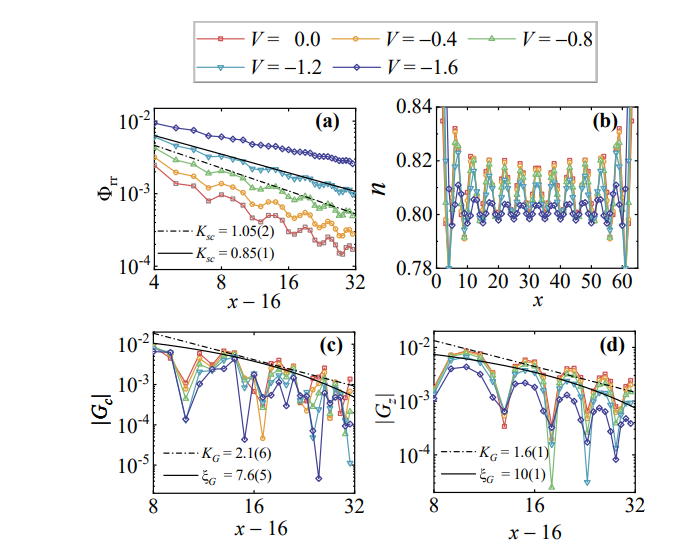
By employing the density-matrix renormalization group method, researchers study an extended checkerboard Hubbard model on the two-leg ladder, which includes an intraplaquette nearest-neighbour attraction V. The simulated results show that V plays a significant role in enhancing d-wave superconductivity when the electron density is close to half-filling. In the homogeneous case where t′ equals t, a large critical value of |Vc| is required to induce the superconducting ground state, but this value diminishes as t’ decreases.
Correlated Electrons and High-Temperature Superconductivity
Research in condensed matter physics focuses on understanding strongly correlated electron systems and high-temperature superconductivity, employing advanced computational techniques like the density matrix renormalization group (DMRG) and quantum Monte Carlo (QMC). DMRG is particularly effective for studying one-dimensional and quasi-one-dimensional materials, allowing scientists to calculate their ground and excited states. Researchers also utilize dynamical mean-field theory (DMFT) to address these systems by simplifying complex lattice problems. A key focus is the calculation of spectral functions, which can be compared with experimental data to reveal electronic structure.
Understanding the pseudogap and the role of charge density waves are also central themes. The Hubbard model serves as a starting point for many studies, with researchers employing DMRG, QMC, DMFT, and the Lanczos method to gain insights into these materials. Significant contributions to DMRG have been made by S. R. White and U.
Schollwock, while H. -C. Jiang, M. Jiang, and T. P. Devereaux actively pursue computational studies and theoretical calculations of strongly correlated systems.
Attraction Boosts Ladder Superconductivity at Low Density
Scientists investigated the extended checkerboard Hubbard model on a two-leg ladder, demonstrating that an intraplaquette nearest-neighbor attraction, V, significantly enhances d-wave superconductivity when the electron density approaches half-filling. Results show that a large critical value of |Vc| is required to induce a superconducting ground state in a homogeneous system, but this value substantially reduces as the interplaquette hopping integral, t’, decreases. Notably, when t’ falls below 0. 2t, the system transitions to a d-wave superconducting phase at V approximately equal to -0. 3t for U=8t and -0.
4t for U=12t, accompanied by a change in spin and single-particle excitations from gapless to gapped. Further analysis demonstrated that the attractive interaction V suppresses charge density waves and enhances superconducting correlations. In the homogeneous case, superconducting correlation exhibits anisotropy, while in the inhomogeneous case, hole pairing displays nearly C4 symmetry, indicating that inhomogeneity drastically amplifies the effect of V on superconductivity and weakens both spin and single-particle correlations.
Inhomogeneity Boosts Superconducting Correlations Significantly
This research systematically investigates the impact of electronic inhomogeneity on superconductivity within the extended checkerboard Hubbard model on a two-leg ladder. Employing the density-matrix renormalization group method, scientists demonstrate that introducing inhomogeneity significantly enhances superconducting correlations, reducing the critical attraction required to induce a superconducting ground state. The team’s findings reveal that both single-particle and spin excitations develop an energy gap in the superconducting phase, regardless of whether the system is homogeneous or inhomogeneous. Importantly, researchers observed a difference in pairing symmetry; hole pairing is asymmetric in homogeneous systems but exhibits C4 symmetry in inhomogeneous systems. Their combined analysis confirms that in strongly interacting systems, the combination of electronic inhomogeneity and nearest-neighbour attraction promotes the formation of d-wave superconductivity. This work provides valuable insight into the mechanisms driving superconductivity in inhomogeneous materials and contributes to a deeper understanding of the conditions necessary for its emergence.
🗞 Strong enhancement of d-wave superconductivity in an extended checkerboard Hubbard ladder
🧠 ArXiv: https://arxiv.org/abs/2509.24415