
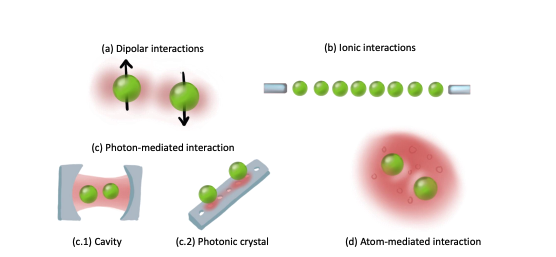
Recent advances enable the engineering of long-range interactions between cold atoms, opening new avenues to investigate many-body physics. This research reviews strategies for inducing these interactions and highlights potential applications in condensed matter physics, lattice gauge theories and modelling electronic configurations, offering a complementary approach to digital computation.
The behaviour of matter at its most fundamental level is dictated by interactions between particles. Understanding and controlling these interactions is central to advances in diverse fields, from materials science to high-energy physics. Recent developments in manipulating cold atoms – atoms cooled to temperatures near absolute zero – offer a novel approach to simulating complex quantum systems and probing the nature of these interactions at unprecedented scales. In a new review, Javier Argüello-Luengo from the Departament de Física, Universitat Politècnica de Catalunya, et al., detail the methods used to engineer long-range interactions between these atoms, and explore the potential applications of these ‘atomic quantum simulators’ in areas such as condensed matter physics, lattice gauge theories and computational chemistry. Their article, ‘Engineering and harnessing long-range interactions for atomic quantum simulators’, provides a comprehensive overview of current strategies and future challenges in this rapidly evolving field.
Engineering Long-Range Interactions: A Review of Cold-Atom Platforms
Researchers are increasingly employing techniques to create and control long-range interactions between atoms trapped in optical potentials, leveraging the unique properties of light and matter. This article reviews recent advances in manipulating these interactions within cold-atom systems, detailing strategies for inducing them and exploring potential applications across condensed matter physics, lattice gauge theory, and computational chemistry. The work presents a comprehensive overview of how engineered interactions expand the study of fundamental many-body problems, offering a versatile platform for investigating complex physical phenomena.
Current research focuses on utilising advances in cold-atom physics to simulate complex systems previously inaccessible to experimental scrutiny. These engineered interactions enable the simulation of complex physical systems, allowing for the creation of tailored potentials and exploration of novel quantum phenomena.
The presented work highlights the potential to simulate condensed matter systems, offering insights into phenomena such as superconductivity and magnetism, while also facilitating the study of lattice gauge theories – a theoretical framework for understanding fundamental forces. Furthermore, the engineered atomic interactions extend to the realm of chemistry, enabling investigations into electronic configurations and molecular dynamics with unprecedented control, offering a unique balance between control and scalability.
Researchers employ several techniques to create and control long-range interactions between atoms trapped in optical potentials, utilising Rydberg excitation, dipole-dipole interactions, and interactions mediated by optical cavities. Rydberg excitation involves raising atoms to highly excited electronic states, dramatically increasing their size and enhancing their interactions with other atoms. Dipole-dipole interactions exploit the electric dipole moments of atoms to create long-range forces. Interactions mediated by optical cavities enhance the interactions between atoms by confining light within the cavity, increasing the effective interaction strength and range. This allows scientists to tailor the interactions between atoms with unprecedented precision.
The ability to precisely control the range and strength of these interactions allows for the creation of tailored potentials and the exploration of novel quantum phenomena, enabling scientists to model condensed matter systems by mimicking the behaviour of electrons in materials.
Researchers are now able to simulate electronic configurations within molecules, offering a new approach to understanding chemical bonding and reaction dynamics. This contrasts with digital and conventional computation methods. This comparison outlines the strengths and limitations of each, underscoring the unique capabilities of cold-atom systems for tackling specific computational challenges in both physics and chemistry. The authors highlight the potential to observe and manipulate geometric phase effects in chemical reactions, representing a significant step towards controlling chemical processes at a fundamental level. Geometric phase, also known as Berry phase, arises from the evolution of a quantum system’s wavefunction and can influence reaction pathways.
The convergence of cold-atom physics, quantum simulation, and computational chemistry promises to accelerate discovery across multiple disciplines, providing a versatile platform for investigating long-range interactions and laying the foundation for a deeper understanding of complex many-body phenomena. This understanding has implications for materials science, fundamental physics, and chemistry, paving the way for the design of novel materials and chemical processes.
Ongoing investigations continue to refine these techniques and expand their application to increasingly complex systems, demonstrating the potential of engineered atomic interactions to become a cornerstone of future quantum technologies.
Future research directions include exploring new methods for creating and controlling long-range interactions, developing more sophisticated theoretical models to describe the behaviour of these systems, and applying these techniques to study a wider range of physical and chemical phenomena. These advancements will further solidify the role of cold-atom systems as a powerful tool for exploring the fundamental laws of nature and developing new technologies. The continued development of these techniques promises to unlock new insights into the behaviour of complex quantum systems and pave the way for discoveries in the years to come.
👉 More information
🗞 Engineering and harnessing long-range interactions for atomic quantum simulators
🧠 DOI: https://doi.org/10.48550/arXiv.2506.07250