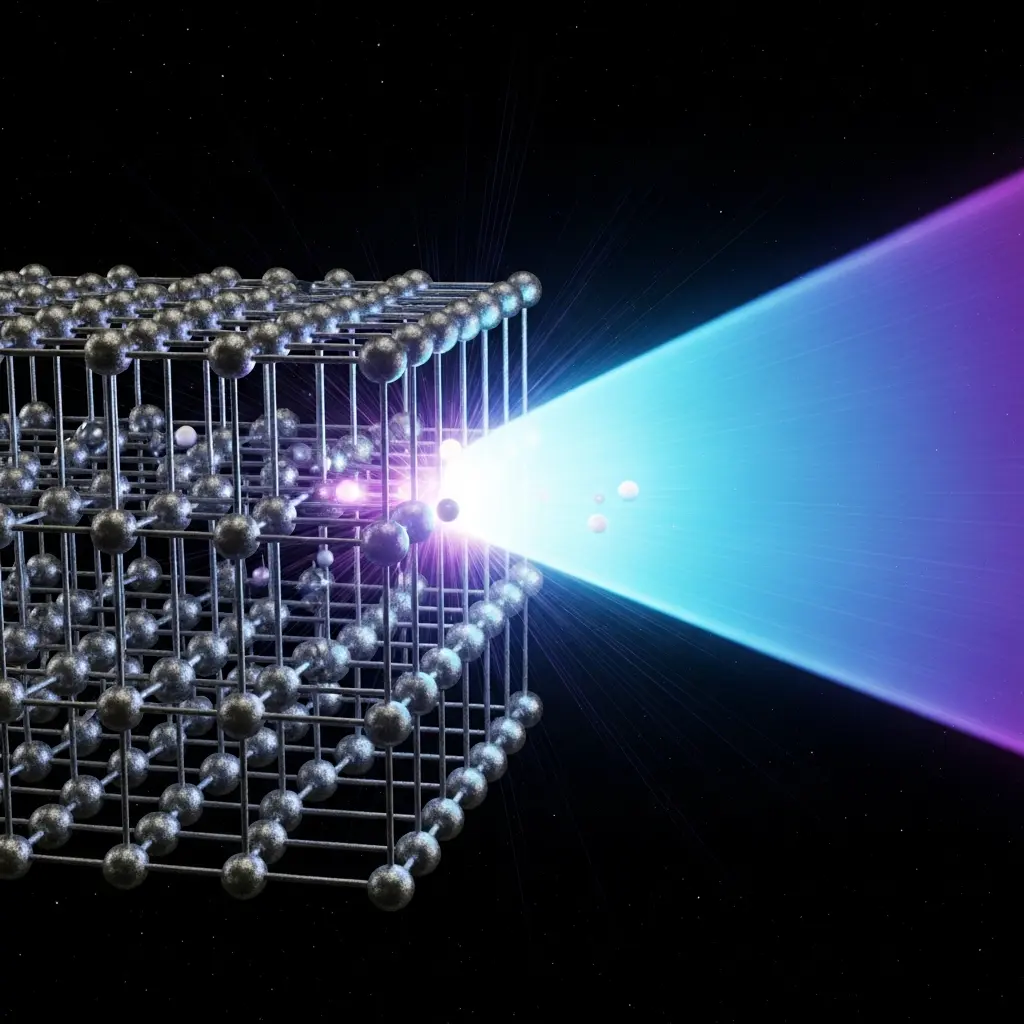
Scientists are increasingly focused on understanding how free electrons interact with light, a field crucial for advancements in ultrafast dynamics and imaging techniques. Fatemeh Chahshouri from the Institute of Experimental and Applied Physics, Kiel University, Sven Ebel from POLIMA, Center for Polariton-driven Light, Matter Interactions, University of Southern Denmark, and colleagues have investigated the stimulated interactions of low-energy free-electrons with light, detailing both free-space and near-field mechanisms. This collaborative research, also involving Mitja Funk and Nahid Talebi from the Institute of Experimental and Applied Physics, Kiel University, is significant because it unifies recent developments in controlling electron beams and engineering light-matter coupling. The work promises versatile routes to precise beam control, tailored light-matter coupling, and has implications for areas ranging from ultrafast spectroscopy to the generation of nonclassical states of light.
For decades, controlling electrons with light has remained a complex challenge in physics. Now, a detailed examination of how slow electrons and light interact reveals a surprising degree of control over these fundamental particles. Opening the door to new technologies from faster imaging to novel sources of light. Scientists are increasingly focused on the interaction between free electrons and light, a relationship fundamental to understanding material excitation and ultrafast dynamics.
Recent advances have shifted towards a fully quantum framework. Revealing the wave-like nature of electrons and opening new avenues for research at the single-electron level. This progression has spurred developments in high-resolution imaging, spectroscopy, and the coherent control of electron wavepackets. Current investigations survey stimulated interactions between slow electrons and light, both in free space and within nanophotonic structures.
To extend studies to slower electrons, those with energies below 30 keV. Introduces a distinct regime where the effects of electron recoil become prominent and interaction times are prolonged. At these lower energies, even relatively weak optical fields can induce measurable energy and momentum exchange with the electron. By understanding these interactions demands a fully quantum-mechanical approach, combiningSchrödinger equation solvers with electromagnetic field models to reveal complex phenomena mirroring observations in cavity quantum electrodynamics.
Scientists are developing methods to manipulate electron wave functions using these confined fields. The coherence of an electron beam, defined by its longitudinal (temporal) and transverse (spatial) components, is central to this manipulation. Longitudinal coherence, inversely proportional to the electron’s energy spread, dictates the wavepacket’s temporal characteristics. Meanwhile, transverse coherence, linked to source size and beam divergence, governs spatial resolution and interference contrast.
By engineering these coherence properties allows for temporal compression, spectral sideband generation, and even the creation of attosecond pulse trains. This focus on slower electrons offers unique opportunities beyond probing strong coupling and recoil-sensitive dynamics, as these beams are well-suited for programmable wavefunction shaping in compact, experimentally accessible systems.
At energies below 30 keV, the reduced electron velocity enhances phase synchronization, extending the interaction time and enabling detailed investigation of quantum-coherent pathways. These developments promise implications for ultrafast spectroscopy, nanoscale metrology, and the generation of nonclassical states of light.
Electron pulse compression via laser field acceleration and the 30 keV energy threshold
Outcomes indicated a prominent energy threshold of 30 keV, below which prolonged interaction times and substantial recoil effects become increasingly apparent in slow-electron experiments. Here, at energies below 30 keV, the interaction between electron momentum, energy modulation. The optical field becomes particularly sensitive to these factors. Analysis of inelastic electron scattering revealed that electrons interacting with pulsed laser fields can gain or lose continuous amounts of energy.
Electrons encountering the leading edge of a laser pulse are accelerated, while those crossing the trailing edge are decelerated, effectively surfing the changing potential of the pulse envelope. In turn, this process, observed at energies ranging from 200 keV down to the 30 keV threshold, allows for temporal compression of electron pulses.
Higher-order nonlinear inelastic interactions between free electrons and optical standing waves imprint a high-frequency, longitudinal energy-momentum modulation onto the electrons, following intensity-scaling laws of E2, E3, and E5, corresponding to two-photon, three-photon, and five-photon processes respectively. Such interactions lead to a strongly enhanced longitudinal velocity modulation of the electron beam.
Asynchronous interactions between electrons and optical gratings were also investigated. Where the electron velocity does not fulfill the phase-matching condition for stimulated Compton scattering, the electron experiences the travelling potential asymmetrically, resulting in a unidirectional energy shift and the formation of electron energy states with a markedly narrow spectral width.
Meanwhile, scientists observed the creation of these narrow linewidth states, demonstrating precise control over electron energy distribution — at the peak of the pulse, electrons experience elastic deflection due to the symmetric ponderomotive potential. A phenomenon initially predicted by Kapitza and Dirac and experimentally demonstrated through Bragg-type diffraction. Further work extended this concept by employing Gaussian, Hermite-Gaussian. Laguerre-Gaussian optical modes, offering enhanced compression capabilities and improved phase stability.
Stimulated Electron-Light Interactions via Free-Electron Momentum Modulation
At the same time, scientists employed free-electron probes with energies ranging from 10 electron volts to 30 kiloelectron volts to investigate stimulated interactions between slow electrons and light. Here, this energy range allows for detailed examination of recoil effects and wavepacket dynamics, phenomena that become prominent at lower energies. In turn, the project builds upon established techniques like low-energy electron diffraction and microscopy, alongside more recent advances in aberration correction and electron interferometry.
Experiments utilised both free-space optical fields and near-field coupling mechanisms to modulate electron momentum and energy. Free-space interactions were induced by coherent photon exchange, generating discrete energy sidebands and enabling diffraction of electrons via the Kapitza-Dirac effect. Near-field coupling, however, relied on nanophotonic and plasmonic structures to achieve strong, phase-matched momentum exchange with the electron wavepacket.
These structures confine optical fields to sub-wavelength volumes, enhancing the interaction strength and enabling multi-photon sideband generation. Characterising the coherence of the electron beam proved essential for optimising these interactions. Longitudinal coherence, defined by the energy spread of the electrons, dictates the temporal coherence of the wavepacket. Meanwhile, transverse coherence, linked to source size and beam divergence, determines spatial coherence.
Through engineering both longitudinal and transverse phases, researchers aimed to mitigate diffraction and space-charge broadening, thereby enhancing spatial resolution and interference contrast — to achieve efficient electron-light coupling necessitated careful compensation for the momentum mismatch between electrons and optical fields. At the same time, at these energies, dielectric and plasmonic nanostructures were employed to provide additional momentum through spatial confinement, and or the optical mode was guided in specifically designed subwavelength geometries. These methods allowed for precise control over quantum electrodynamic interactions, scattering processes, and even Bremsstrahlung emission.
Recoil effects define limits of light-electron beam interaction
Scientists manipulating electron beams with light have long faced a fundamental limit, a threshold below which subtle interactions become swamped by noise. Research demonstrates a clearer understanding of this boundary, revealing how prolonged interaction times and the resulting recoil effects become prominent for electrons experiencing energies around 30 keV.
For years, the challenge lay in achieving sufficient control over these fleeting interactions to observe and then exploit them — previous attempts often struggled with signal degradation and the difficulty of isolating the desired effects from background disturbances. This effort signals a shift towards a more holistic approach to beam control, and instead of viewing electrons merely as particles to be accelerated and focused, researchers are increasingly treating them as quantum objects susceptible to precise optical manipulation. For tailoring light-matter coupling with implications extending beyond improved imaging and spectroscopy, potentially reaching into areas like attosecond pulse generation and even the creation of entangled electron-photon pairs.
Practical hurdles remain before these possibilities fully materialise. To achieve the necessary coherence and stability for many of these applications demands extremely precise control over both the electron source and the optical fields. The complexity of modelling these interactions, particularly within nanophotonic structures, presents a significant computational challenge.
Hybrid optical-electrostatic modulation and laser-based aberration correction appear promising, but future work might explore combining these with advanced wavepacket shaping methods. The ultimate goal isn’t just to control electron beams, but to engineer their quantum states, opening up entirely new avenues for exploring the fundamental properties of matter and light.
🗞 Stimulated interactions of low-energy free-electrons with light
🧠 ArXiv: https://arxiv.org/abs/2602.17463