

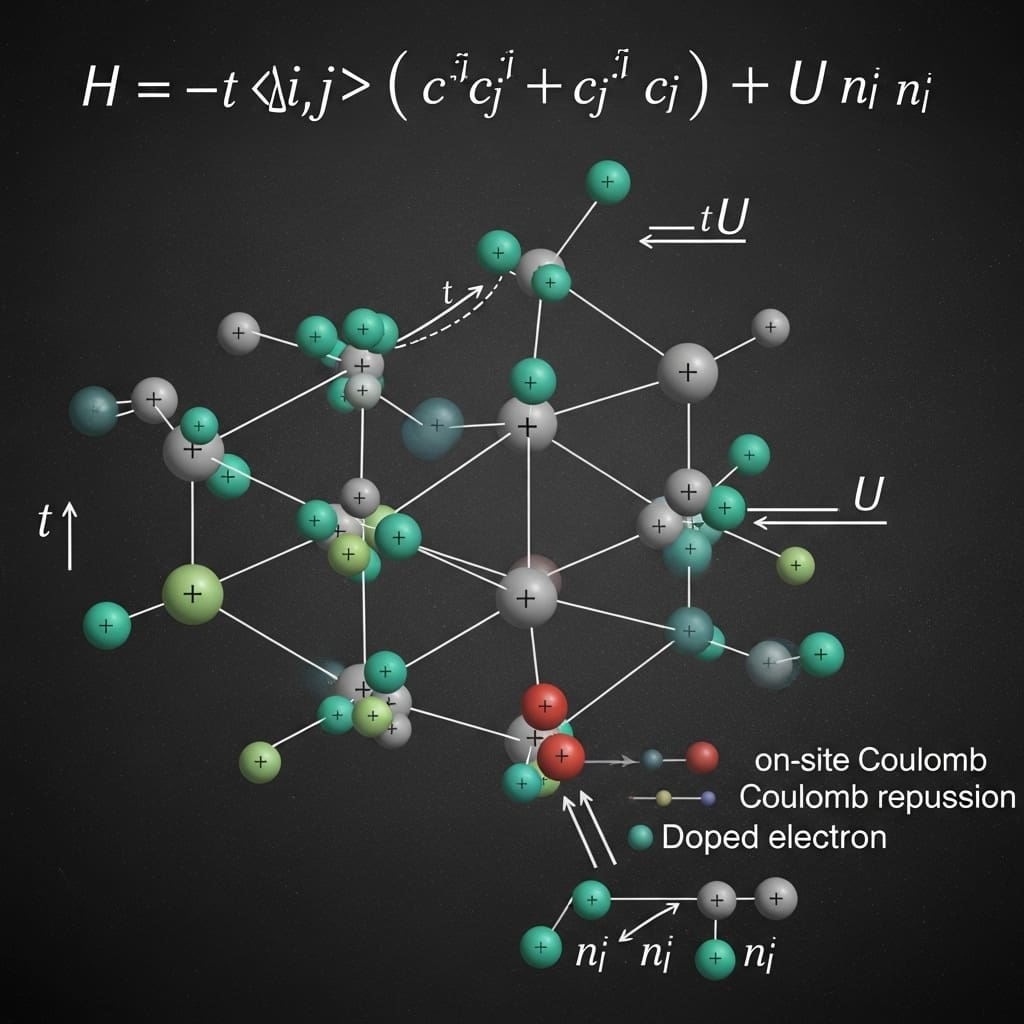
The pursuit of high-temperature superconductivity remains a central challenge in condensed matter physics, and understanding the mechanisms driving this phenomenon requires innovative theoretical approaches. Wen O. Wang, from the Kavli Institute for Theoretical Physics, and Thomas P. Devereaux, at Stanford Institute for Materials and Energy Sciences and Stanford University, and their colleagues now present compelling evidence for superconductivity within the electron-doped Hubbard model, a key theoretical framework for understanding complex materials. The team achieves this breakthrough by employing advanced numerical simulations that reveal clear signatures of superconductivity at elevated temperatures, specifically for electron doping, while finding no such evidence for hole doping. This work represents a significant step forward, offering a practical method to connect simulations performed at different temperatures and ultimately bridging the gap between theoretical models and the search for real-world high-temperature superconductors.
edu. The team performs numerically exact determinant quantum Monte Carlo simulations of the Hubbard model and analyses pairing tendencies by evaluating correlation functions at the imaginary-time midpoint, a technique which emphasizes low-energy physics and suppresses high-frequency noise. This diagnostic allows identification of clear finite-temperature signatures of underlying d-wave superconductivity for electron doping, while revealing no such indication for hole doping. This work enables direct comparison with ground-state calculations, demonstrating consistent behaviour between the two approaches.
Doping and Interaction Effects on Pair Correlations
Scientists investigated the emergence of pairing correlations in a two-dimensional model using detailed simulations, examining how these correlations change with both electron and hole doping and the strength of electron interactions. The research focused on the pair-field susceptibility and the spatial arrangement of paired electrons, revealing how these properties evolve under different conditions. The simulations demonstrate how the spatial extent and shape of pairing correlations change with doping levels, and reveal that interactions significantly affect the temperature evolution of pairing correlations. The team also assessed the impact of finite system size, finding minimal effects for larger lattices, except at higher doping levels. These findings provide valuable insights into the complex interplay between doping, interactions, and pairing correlations in this model system.
Hubbard Model Reveals D-wave Superconductivity Asymmetry
Scientists have achieved a breakthrough in understanding superconductivity using numerical simulations of the Hubbard model. The research team performed highly accurate determinant Monte Carlo simulations, focusing on pairing tendencies by evaluating correlations at an imaginary time midpoint. This innovative approach allows for a direct comparison with ground-state calculations, revealing consistent spatial pairing patterns. Experiments revealed a clear asymmetry between electron and hole doping, demonstrating finite-temperature signatures consistent with a d-wave superconducting instability for electron doping. Specifically, the team measured the inverse d-wave pair-field susceptibility and observed a substantial decrease with lower temperature across a wide range of electron doping levels, hinting at a transition towards superconductivity. Measurements of a related quantity, the vertex factor, further confirmed these findings, revealing stronger interaction effects in the d-wave channel for electron doping.
D-wave Superconductivity in Electron-Doped Hubbard Model
This research presents a detailed analysis of the Hubbard model, employing numerically exact determinant Monte Carlo simulations to investigate pairing tendencies at finite temperatures. The team identified clear signatures of d-wave superconductivity in the electron-doped regime, evidenced by the emergence of interaction-driven pairing correlations as temperature decreases. Notably, this trend contrasts sharply with the hole-doped side, where no such indications of superconductivity were observed under the same conditions. A key methodological advancement lies in the application of a midpoint imaginary-time approach, evaluating correlation functions at half the inverse temperature. This technique effectively suppresses high-frequency contributions, focusing the analysis on the low-energy physics relevant to superconductivity in a controlled and numerically precise manner. The researchers quantified the tendency towards pairing through the negative temperature slope of the pair susceptibility, revealing a dome-like region of enhanced pairing fluctuations near 1/8 electron doping.
👉 More information
🗞 Finite-temperature signatures of underlying superconductivity in the electron-doped Hubbard model
🧠 ArXiv: https://arxiv.org/abs/2510.16616

