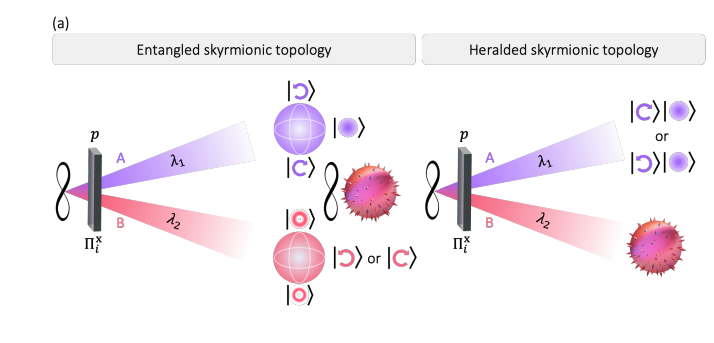
The creation of stable, controllable topological structures represents a significant challenge in modern physics, with potential applications ranging from advanced computing to novel optical devices. Mwezi Koni, along with colleagues at the University of Oxford and the Max Planck Institute for the Structure and Dynamics of Matter, now demonstrates a novel method for generating dual-wavelength quantum skyrmions, structures previously unexplored in either theory or experiment. The team achieves this by coupling pairs of photons to an electrically controlled defect within a liquid crystal, effectively creating skyrmions that exist at two distinct wavelengths or as heralded single photons. This breakthrough not only expands the possibilities for engineering topological states but also highlights the untapped potential of liquid crystals as a reconfigurable platform for manipulating light and matter at the quantum level.
Liquid Crystal Spatial Entanglement Generation
Researchers are pushing the boundaries of quantum entanglement by creating complex states of light that utilise multiple properties simultaneously. This work moves beyond simple two-photon entanglement, such as manipulating polarization or orbital angular momentum, to harness several degrees of freedom for quantum information processing, simulation, and fundamental studies of quantum mechanics. The team focuses on creating and controlling topological states of light, specifically skyrmions, which offer inherent robustness against disturbances.
Multiple Wavelength Skyrmion Control in Light
Researchers have achieved a significant breakthrough in quantum optics by creating and controlling light particles, known as skyrmions, at multiple wavelengths simultaneously. These skyrmions, possessing a unique twisted structure, were generated in both entangled photon pairs and as single photons, a feat previously unaccomplished within a single experimental setup. This research expands the possibilities for manipulating quantum states of light and opens new avenues for advanced optical technologies. The team engineered these skyrmions by coupling photons to a specially designed liquid crystal device, allowing precise control over their properties.
This device, responsive to electrical voltage, enables the creation of both “local” and “non-local” skyrmions, differing in how the twisted light structure is distributed. Crucially, the researchers demonstrated the ability to switch between these different skyrmion configurations, and between entangled and single-photon states, all within the same system, showcasing a versatile platform for quantum optics. The ability to generate skyrmions at distinct wavelengths is particularly noteworthy, as it allows for the encoding of information across multiple spectral channels, potentially paving the way for more robust and high-dimensional quantum communication protocols.
Dual-Wavelength Skyrmions Enable Robust Quantum Control
This research demonstrates the generation of dual-wavelength skyrmions, representing a novel approach to manipulating light with unique properties, realised as entangled photon pairs or heralded single photons. The team successfully coupled two-photon states to liquid crystal defects, creating both nonlocal and local skyrmionic topologies within a reconfigurable platform. Importantly, the wavelength of light is intrinsically linked to the skyrmionic structure, unlike prior work. These findings expand the toolkit for optical skyrmion research and open new possibilities for quantum technologies, particularly due to the robustness of the scheme and its compatibility with wavelengths used in fibre optics and bio-imaging. The researchers uniquely leverage the topological richness of true liquid crystal defects, extending their established use in classical structured light into the quantum realm.
🗞 Dual-wavelength quantum skyrmions from liquid crystal topological defect
🧠 ArXiv: https://arxiv.org/abs/2507.22815