

The quest for reliable quantum technologies hinges on the creation of indistinguishable single photons, essential components for quantum communication and computation, yet achieving this is often hampered by environmental disturbances. Priyabrata Mudi, Avijit Barua, and Kartik Gaur, all from Technische Universität Berlin, alongside colleagues from several other institutions, present a significant advance in overcoming this challenge. Their research focuses on suppressing charge noise, a common source of decoherence in semiconductor quantum dots, through a novel device architecture and electrical control. The team demonstrates a method for stabilizing the quantum environment within these tiny structures, achieving exceptionally high photon indistinguishability, reaching nearly 97 percent at optimal conditions, and extending the exciton dephasing time to 6.8 nanoseconds, a value approaching the theoretical limit without complex corrective measures. This breakthrough paves the way for more robust and practical quantum devices by offering a simple yet effective means of controlling a key source of quantum decoherence.
Electrical Control Stabilizes Quantum Dot Photons
The promise of quantum technologies, including secure communication and powerful quantum computers, relies on the ability to generate and control single photons with exquisite precision. A key challenge lies in the inherent instability of many single-photon sources, particularly those based on quantum dots (QDs). These nanoscale semiconductors are excellent candidates, but their performance is often limited by random fluctuations caused by unwanted electrical charges, known as charge noise. Researchers have demonstrated a method for actively suppressing this charge noise in gallium arsenide (QDs), paving the way for more reliable quantum light sources.
Current quantum dot-based single-photon emitters suffer from limitations stemming from spectral jitter and exciton dephasing, both consequences of charge noise. This noise introduces randomness in the emitted photons’ energy and timing, hindering predictable interactions, crucial for quantum operations. By carefully designing a novel structure that minimizes unwanted effects and maximizes control over the QD’s electrical environment, the team addressed this challenge. The team fabricated droplet-etched GaAs quantum dots embedded within a specially designed diode structure and integrated them into a nanoscale optical cavity.
This cavity, incorporating a tiny ridge for electrical connection, enhances photon extraction efficiency, achieving approximately 37%, and allows for precise control of the electrical field surrounding the QD. By applying an external voltage, the researchers actively stabilize the charge environment within the QD, suppressing the detrimental effects of charge noise and tuning the QD’s emission characteristics. The results demonstrate a significant improvement in the coherence of the emitted photons, as measured by the exciton dephasing time. At an optimal bias voltage, the team achieved a dephasing time of approximately 6.8 nanoseconds, approaching the theoretical limit for such systems. Furthermore, the visibility of interference patterns created by pairs of photons, a crucial indicator of their indistinguishability, dramatically improved with voltage control. This level of control and stability represents a significant step forward in the development of practical, high-performance quantum light sources for future quantum technologies.
Minimizing Charge Noise in GaAs Quantum Dots
This work focuses on reducing charge noise in GaAs quantum dots, with the aim of advancing scalable photonic quantum technology. Researchers addressed the presence of deep donor levels, known as DX centers, which contribute significantly to charge fluctuations. Techniques were employed to minimize these effects and improve device performance, enabling the generation of high-quality single photons. Characterization of the quantum dots involved detailed optical spectroscopy to assess their emission properties and coherence times. The team investigated the relationship between quantum dot size, emission wavelength, and spectral broadening, noting the impact of surface charge on spectral diffusion. Measurements were performed to evaluate the performance of the quantum dots as sources of entangled photon pairs and single photons with controlled temporal wave packets. The resulting devices were then characterized to assess their suitability for quantum communication and computation applications.
Bias Controls Single Photon Indistinguishability and Noise
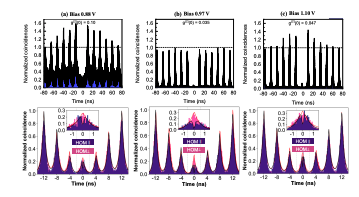
Researchers investigated how electrical bias affects the performance of a single quantum dot as a source of single photons. Measurements revealed three distinct regions of behaviour depending on the applied bias. Region I (0.850V , 0.925V) was characterized by charge fluctuations, causing the quantum dot to switch between states and resulting in blinking of the emitted light. This instability led to a broadened emission spectrum and reduced photon indistinguishability. Region II (0.925V , 1.020V) represented an optimal operating range where charge fluctuations were minimized, leading to enhanced photon indistinguishability and coherence, reaching a visibility of 97% at 0.97V.
This performance is comparable to that of high-quality quantum dots without blinking. Region III (1.02V , 1.10V) showed stable emission intensity but exhibited increased diode current and a reappearance of charge noise, leading to a decrease in both visibility and coherence. The researchers developed a theoretical model to explain these observations, incorporating the effects of charge noise and current-dependent fluctuations. The model accurately predicted the measured values of photon indistinguishability and coherence in regions II and III. The findings demonstrate that careful control of electrical bias can significantly improve the quantum optical properties of a quantum dot, paving the way for applications in quantum technologies.
Electric Field Stabilises Quantum Dot Coherence
This work presents an approach to suppress charge noise-induced decoherence in droplet-etched GaAs quantum dots embedded within an n-i-p diode structure and integrated into an electrically controlled Bragg grating nanocavity for emission enhancement. Application of an external electric field stabilizes quantum dot coherence, offering a pathway towards robust quantum light sources.
🗞 Enhancement of Indistinguishable Photon Emission from a GaAs Quantum Dot via Charge Noise Suppression
🧠 DOI: https://doi.org/10.48550/arXiv.2507.12641


