

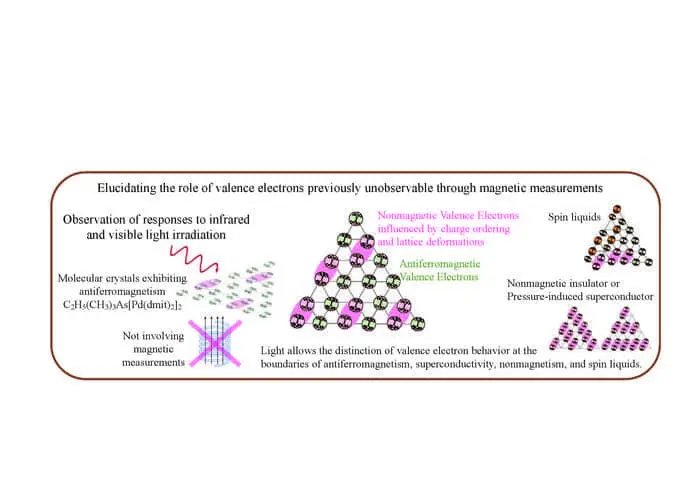
Researchers at Ehime University have made a fascinating discovery about the behavior of valence electrons in magnetic materials, shedding new light on the properties of molecular crystals. Led by Takashi Yamamoto, the team used advanced technologies such as synchrotron infrared light and near-infrared visible lasers to analyze the distribution of valence electrons in a specific crystal, revealing that approximately half of these electrons do not contribute to magnetism.
Instead, they form weak pairs associated with charge ordering and lattice distortion, exhibiting properties similar to those in superconductors. This finding has significant implications for our understanding of quantum materials and their potential applications in fields such as spintronics and superconductivity. The study builds on previous research into spin liquids and superconductors, and its results are expected to pave the way for future investigations into the properties of novel materials.
Introduction to Valence Electrons in Magnetic Materials
Valence electrons play a crucial role in determining the magnetic properties of materials. In molecular crystals with conductivity and magnetism, valence electrons are responsible for linking charge ordering to superconductivity and exploring quantum spin liquids. These crystals have low impurity concentrations, making them ideal for studying the behavior of valence electrons. Recent research has focused on understanding the distribution of valence electrons in antiferromagnetic molecular crystals with a triangular lattice. By analyzing the response of valence electrons to synchrotron infrared light and near-infrared/visible lasers, researchers have gained insights into the arrangement of these electrons.
The study of valence electrons in molecular crystals is essential for understanding novel material functionalities. Valence electrons with quantum properties are expected to exhibit emergent phenomena, making them crucial for exploring new material properties. However, the extent to which valence electrons contribute to magnetism remains unclear, leaving their quantum properties insufficiently explored. To address this, researchers have used light to analyze valence electron arrangements, building on studies of superconductors and quantum spin liquids. By understanding the distribution of valence electrons, researchers can gain insights into the underlying mechanisms that govern magnetic behavior in these materials.
The molecular crystal (C₂H₅)(CH₃)₃As[Pd(C₃S₅)₂]₂ is a prime example of a material where valence electrons play a crucial role in determining its magnetic properties. This crystal contains [Pd(C₃S₅)₂]₂ molecules at the vertices of a triangular lattice, with one valence electron “formally” assigned to each vertex. The actual distribution of these electrons was experimentally determined using synchrotron infrared light and near-infrared/visible lasers. By analyzing the vibrational frequencies induced by the laser light, researchers were able to reveal details about valence electron locations, mobility ranges, and whether inter-molecular distances were constant or variable.
The study of valence electrons in molecular crystals has significant implications for our understanding of quantum material properties. By exploring the behavior of valence electrons, researchers can gain insights into the underlying mechanisms that govern magnetic behavior, superconductivity, and spintronics. The discovery of valence electrons that do not contribute to magnetism but instead form pairs with properties reminiscent of a superconducting state driven by charge fluctuations has significant implications for the development of new materials with unique properties.
Quantum Criticality Induced by “Lazy” Valence Electrons
The concept of quantum criticality refers to the phenomenon where a material exhibits a phase transition at absolute zero temperature, driven by quantum fluctuations rather than thermal fluctuations. In molecular crystals, valence electrons can play a crucial role in inducing quantum criticality. Recent research has focused on understanding the behavior of “lazy” valence electrons that do not contribute to magnetism but instead form pairs with properties reminiscent of a superconducting state. These electrons are referred to as “lazy” because they do not participate in the magnetic ordering of the material but instead exhibit a more relaxed behavior.
The study of quantum criticality induced by “lazy” valence electrons has significant implications for our understanding of quantum material properties. By exploring the behavior of these electrons, researchers can gain insights into the underlying mechanisms that govern superconductivity, magnetic resistance, and spintronics. The discovery of a mixed state where electrons contributing to magnetism coexist with non-magnetic electrons forming a fixed arrangement on the triangular lattice has significant implications for the development of new materials with unique properties.
The molecular crystal (C₂H₅)(CH₃)₃As[Pd(C₃S₅)₂]₂ is a prime example of a material where “lazy” valence electrons induce quantum criticality. The crystal contains [Pd(C₃S₅)₂]₂ molecules at the vertices of a triangular lattice, with one valence electron “formally” assigned to each vertex. The actual distribution of these electrons was experimentally determined using synchrotron infrared light and near-infrared/visible lasers. By analyzing the vibrational frequencies induced by the laser light, researchers were able to reveal details about valence electron locations, mobility ranges, and whether inter-molecular distances were constant or variable.
The behavior of “lazy” valence electrons in molecular crystals is a complex phenomenon that requires further study. Researchers must continue to explore the properties of these electrons and their role in inducing quantum criticality. By understanding the underlying mechanisms that govern the behavior of “lazy” valence electrons, researchers can gain insights into the development of new materials with unique properties.
Distribution of Valence Electrons in Antiferromagnetic Molecular Crystals
The distribution of valence electrons in antiferromagnetic molecular crystals is a crucial aspect of determining their magnetic properties. Recent research has focused on understanding the arrangement of valence electrons in these crystals, particularly in the context of quantum criticality induced by “lazy” valence electrons. The molecular crystal (C₂H₅)(CH₃)₃As[Pd(C₃S₅)₂]₂ is a prime example of a material where valence electrons play a crucial role in determining its magnetic properties.
The study of the distribution of valence electrons in antiferromagnetic molecular crystals has significant implications for our understanding of quantum material properties. By exploring the behavior of these electrons, researchers can gain insights into the underlying mechanisms that govern superconductivity, magnetic resistance, and spintronics. The discovery of a mixed state where electrons contributing to magnetism coexist with non-magnetic electrons forming a fixed arrangement on the triangular lattice has significant implications for the development of new materials with unique properties.
The distribution of valence electrons in antiferromagnetic molecular crystals can be understood by analyzing the vibrational frequencies induced by synchrotron infrared light and near-infrared/visible lasers. By studying the response of valence electrons to these frequencies, researchers can gain insights into the arrangement of these electrons and their role in determining the magnetic properties of the material.
The study of valence electrons in antiferromagnetic molecular crystals is a complex phenomenon that requires further research. Researchers must continue to explore the properties of these electrons and their role in determining the magnetic behavior of these materials. By understanding the underlying mechanisms that govern the distribution of valence electrons, researchers can gain insights into the development of new materials with unique properties.
Implications for Quantum Material Properties
The study of valence electrons in molecular crystals has significant implications for our understanding of quantum material properties. By exploring the behavior of “lazy” valence electrons and their role in inducing quantum criticality, researchers can gain insights into the underlying mechanisms that govern superconductivity, magnetic resistance, and spintronics. The discovery of a mixed state where electrons contributing to magnetism coexist with non-magnetic electrons forming a fixed arrangement on the triangular lattice has significant implications for the development of new materials with unique properties.
The study of valence electrons in molecular crystals can also provide insights into the behavior of other quantum systems, such as superconductors and spin liquids. By understanding the underlying mechanisms that govern the behavior of valence electrons, researchers can gain a deeper understanding of the complex phenomena that occur in these systems.
The development of new materials with unique properties is a significant area of research, with potential applications in fields such as energy storage, quantum computing, and medical devices. The study of valence electrons in molecular crystals can provide valuable insights into the design and synthesis of these materials, enabling researchers to create materials with tailored properties.
In conclusion, the study of valence electrons in molecular crystals is a complex and fascinating field that has significant implications for our understanding of quantum material properties. By exploring the behavior of “lazy” valence electrons and their role in inducing quantum criticality, researchers can gain insights into the underlying mechanisms that govern superconductivity, magnetic resistance, and spintronics, ultimately leading to the development of new materials with unique properties.
Finally, the development of new materials with unique properties is a significant area of research, with potential applications in fields such as energy storage, quantum computing, and medical devices. By exploring the behavior of valence electrons in molecular crystals and using this knowledge to design and synthesize new materials, researchers can create materials with tailored properties that can be used to address some of the most pressing challenges facing society today.
External Link: Click Here For More


