
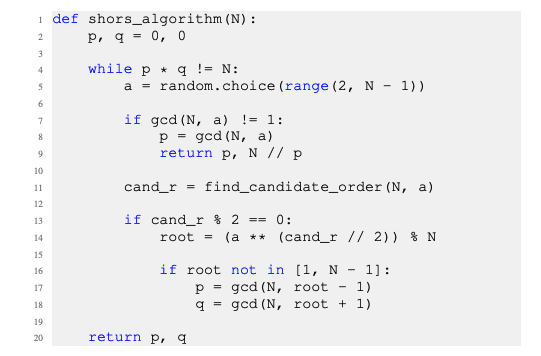
On April 16, 2025, researchers David Ittah, Jackson Fraser, Josh Izaac, and Olivia Di Matteo published Constant-time hybrid compilation of Shor’s algorithm with quantum just-in-time compilation, detailing a novel approach to optimising the implementation of Shor’s factoring algorithm using quantum just-in-time (QJIT) compilation.
The research demonstrates the implementation of Shor’s factoring algorithm using PennyLane and Catalyst for just-in-time compilation. The algorithm was compiled into elementary gates and tested up to 32-bit integers, showing constant program size and compilation time under 3 seconds. This approach enables efficient code generation even for realistic problem sizes, highlighting advancements in hybrid quantum-classical programming frameworks.
Recent progress in quantum computing is bringing the field closer to practical applications. Innovations in algorithms, hardware, and software frameworks are enabling quantum systems to tackle problems that remain intractable for classical computers. This article examines key developments and their implications for the future of computing.
Shor’s Algorithm and Quantum Circuit Optimization
Peter Shor’s algorithm, introduced in 1994, is at the core of many quantum breakthroughs. It provides a polynomial-time solution to prime factorization and discrete logarithms—problems that are computationally intensive for classical computers. A notable advancement has been the development of more efficient implementations of Shor’s algorithm. For example, Stephane Beauregard proposed a circuit design that reduces the number of qubits required, making it more practical for near-term quantum devices. This optimization is particularly important given the current limitations on qubit numbers in quantum computers.
Another significant area of progress involves hybrid quantum-classical frameworks, which combine classical and quantum computing to address complex problems more efficiently. Tools like Pennylane, an open-source software library, enable automatic differentiation of hybrid computations, simplifying the optimization of quantum circuits. Similarly, IBM’s Qiskit and Google’s Cirq provide developers with tools to design, simulate, and run quantum algorithms. These platforms are essential for bridging the gap between theoretical research and practical implementation, allowing researchers to test their ideas on real quantum hardware.
To enhance the performance of quantum computations, researchers have adopted just-in-time (JIT) compilation techniques. Tools like Numba, a JIT compiler for Python, are being adapted to optimize quantum algorithms by compiling them into machine-readable code on-the-fly. This approach reduces computational overhead and improves runtime efficiency, making quantum algorithms more accessible to a broader audience.
The intersection of quantum computing and machine learning is another promising area of research. Frameworks like PyTorch and JAX are being extended to support quantum operations, enabling the development of hybrid models that leverage both classical and quantum processing. These advancements could lead to breakthroughs in optimization problems, drug discovery, and materials science.
Behind these innovations lies a robust ecosystem of compiler infrastructure designed to optimize quantum computations. Projects like MLIR (Multi-Level Intermediate Representation) and LLVM play a crucial role in translating high-level quantum algorithms into low-level instructions that can be executed on quantum hardware. These tools ensure that quantum programs are efficient, scalable, and compatible with a wide range of quantum devices.
The rapid pace of innovation in quantum computing is driving the field toward practical applications. From optimized implementations of Shor’s algorithm to hybrid quantum-classical frameworks and advanced compiler infrastructure, researchers are addressing key challenges that stand in the way of realizing the full potential of quantum systems. As these technologies continue to evolve, they will unlock new possibilities for solving complex problems across various industries.
The journey toward practical quantum computing is still in its early stages, but the progress made so far reflects the ingenuity and collaboration within the scientific community. With continued investment and research, a quantum-powered future is becoming increasingly tangible.
👉 More information
🗞 Constant-time hybrid compilation of Shor’s algorithm with quantum just-in-time compilation
🧠 DOI: https://doi.org/10.48550/arXiv.2504.12449