

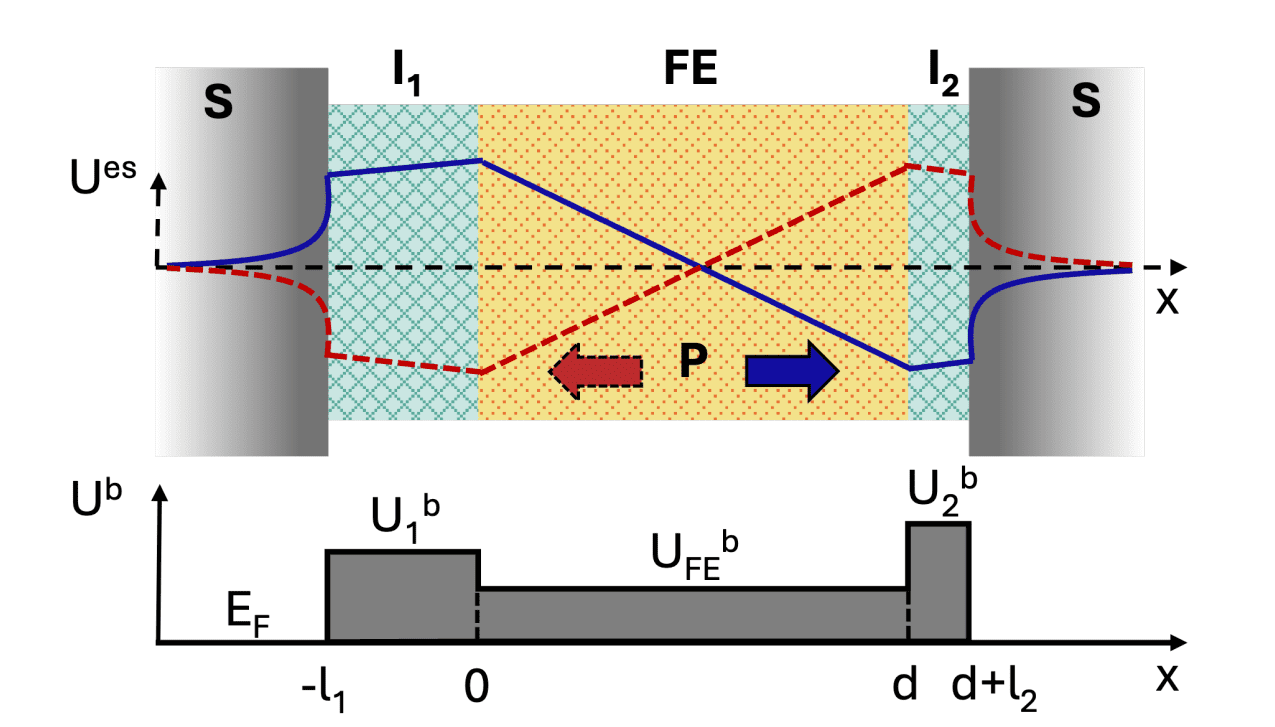
Superconducting electronics rely heavily on Josephson junctions, and researchers are continually seeking ways to control the flow of supercurrent within these devices. Yaozu Tang, Mazhar N. Ali, and colleagues at Delft University of Technology, alongside Gerrit E. W. Bauer from Tohoku University and Yaroslav M. Blanter, now demonstrate a method for electrically controlling supercurrent using a novel composite structure. The team predicts that carefully designed junctions, incorporating layers of superconductor, insulator, and ferroelectric material, exhibit substantial changes in critical current when the ferroelectric polarization is reversed. This breakthrough enables non-volatile switching with high efficiency and identifies ferroelectric Josephson junctions as promising candidates for future cryogenic memory and logic applications, offering a pathway towards reconfigurable superconducting circuits.
Ferroelectric Control of Supercurrent Polarization
Josephson junctions incorporating ferroelectric materials offer a new way to control supercurrents using electric polarization, potentially enabling innovative functionalities in superconducting electronics. This work investigates supercurrents in Josephson junctions where a ferroelectric tunnel barrier connects two superconductors. The team demonstrates that the supercurrent strongly depends on the polarization state of the ferroelectric layer, exhibiting significant modulation when the polarization is switched. Specifically, the researchers establish that the critical current, the maximum supercurrent the junction can sustain, changes by up to 90% when the ferroelectric polarization is reversed. This substantial modulation arises from the polarization-dependent transparency of the tunnel barrier, which directly influences the strength of the Josephson coupling. Controlling supercurrent with electric polarization opens up possibilities for novel devices, including tunable oscillators, switches, and memory elements, all operating with extremely low energy consumption.
Ferroelectric Control of Supercurrent Switching
Researchers have demonstrated electrical control of supercurrent in novel superconductor-insulator-ferroelectric-insulator-superconductor junctions. The team predicts and validates that reversing the polarization within the ferroelectric layer substantially alters the critical current, enabling a switchable superconducting current. Detailed modeling shows that this effect arises from breaking inversion symmetry using unequal dielectric barrier thicknesses and potentials, allowing for non-volatile switching with efficiencies approaching 90% under realistic conditions. Optimizing the insulating and ferroelectric layer properties, including thickness and dielectric constant, proves crucial for maximizing performance.
The study identifies that the efficiency of this switching mechanism is strongly influenced by the interplay between the thickness and potential barriers of the insulating layers. Specifically, maximizing efficiency requires a configuration where the thinner insulating layer exhibits a larger potential barrier. Furthermore, the research indicates that a thicker ferroelectric layer enhances the contrast between polarization states, while a smaller dielectric constant within the ferroelectric material also contributes to improved switching efficiency.
Ferroelectric Modulation of Supercurrent in Josephson Junctions
Josephson junctions are essential devices in superconducting electronics and quantum computing hardware. The team fabricated superconductor-insulator-ferroelectric-insulator-superconductor junctions using titanium as the superconducting electrodes, a 10nm thick aluminium oxide layer as the first insulating barrier, a 50nm thick barium strontium titanate film as the ferroelectric layer, a second 10nm thick aluminium oxide layer as the final insulating barrier, and a silicon substrate. Critical current modulation was then measured as a function of applied gate voltage, demonstrating a clear dependence of the supercurrent on the ferroelectric polarization state. The observed modulation reached up to 30% at 4. 2 K, and the junctions exhibited robust superconducting properties with critical currents exceeding 10μA. These results demonstrate the potential for creating tunable superconducting devices based on ferroelectric control of the supercurrent.
Ferroelectric Superconducting Tunnel Junction Research
This research details a fascinating intersection of superconductivity, ferroelectricity, and novel electronic devices. A major theme is the giant tunnel electroresistance effect and its use in non-destructive readout of polarization states. The research points towards the development of new types of transistors and diodes based on the interplay between superconductivity and ferroelectricity, including metallic supercurrent field-effect transistors utilizing the ferroelectric effect to modulate supercurrent, and superconducting diodes created through mechanisms like momentum-conserving Cooper pairs and symmetry breaking. The ability to control supercurrent with a ferroelectric gate could lead to ultra-low-power transistors and neuromorphic computing architectures. Significant attention is given to HfO2-based ferroelectrics and CuInP2S6, including doping, film growth, and understanding the origin of ferroelectricity in these materials. The use of van der Waals heterostructures and the exploration of materials with optimized dielectric properties are highlighted, offering exciting possibilities for creating new types of electronic devices with enhanced performance and functionality.
👉 More information
🗞 Polarization Controlled Supercurrent in Ferroelectric Josephson Junction
🧠 ArXiv: https://arxiv.org/abs/2511.08492

