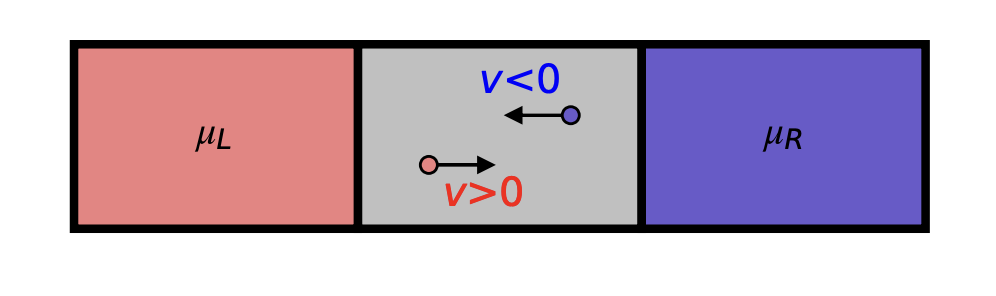
Quantum transport calculations, essential for modelling electron behaviour in nanoscale devices, present significant computational challenges. Yi-Cheng Lin, Ken-Ming Lin, and Yu-Chang Chen address these challenges with a novel effective medium theory (EMT) implemented within the Vienna Ab initio Simulation Package (VASP). Their approach, utilising plane-wave basis sets and pseudopotentials within the Projector Augmented Wave (PAW) method, offers an alternative to established techniques like nonequilibium Green’s function (NEGF) formalisms. The researchers validate their EMT-PW framework – which avoids the computational difficulties of overcompleteness often found in transport theories – by comparing transmission coefficients with those derived from NEGF-DFT calculations, and demonstrate its utility in analysing current characteristics in nanodevices through the incorporation of an effective gate model. This allows for detailed investigation of electron statistics and current correlations, crucial for understanding device performance.
Yi-Cheng Lin, Ken-Ming Lin, and Yu-Chang Chen present an effective medium theory, termed EMT-PW, for calculating electric current in nanoscale systems. The method leverages density functional theory implemented within the Vienna Ab initio Simulation Package (VASP), utilising a plane-wave basis set to describe electron transport. Crucially, the transmission coefficient is derived through three complementary approaches – the current density relation, the field operator method, and the non-equilibrium Green’s function (NEGF) formalism – ensuring robustness and validation.
Comparisons between EMT-PW and established NEGF-DFT calculations, utilising the NanoDCAL package with a linear combination of atomic orbitals basis, demonstrate a high degree of accuracy, with minor discrepancies attributed to differences in basis sets and pseudopotentials. A key advantage of EMT-PW lies in its avoidance of the overcompleteness issues often encountered in non-equilibrium transport theories. Furthermore, the method facilitates decomposition of the total transmission coefficient into contributions from individual eigenstates, offering detailed insight into electron behaviour. When combined with an effective gate model, EMT-PW proves to be a powerful tool for analysing current characteristics in nanodevices, specifically atomistic field-effect transistors, under applied gate voltages.
This work establishes EMT-PW as a viable and efficient alternative to conventional NEGF-DFT methods for investigating quantum transport properties. Future research could focus on extending the method to incorporate many-body effects, exploring its application to more complex device architectures, and developing efficient algorithms for high-throughput calculations. The ability to accurately model electron transport with a plane-wave basis opens avenues for investigating quantum correlations and statistical behaviour within nanoscale systems, potentially leading to advancements in device design and materials discovery.
More information
Advancing Quantum Transport Calculations: An Effective Medium Theory with Plane-Wave Basis and PAW Potentials in Eigenstates
DOI: https://doi.org/10.48550/arXiv.2507.07366