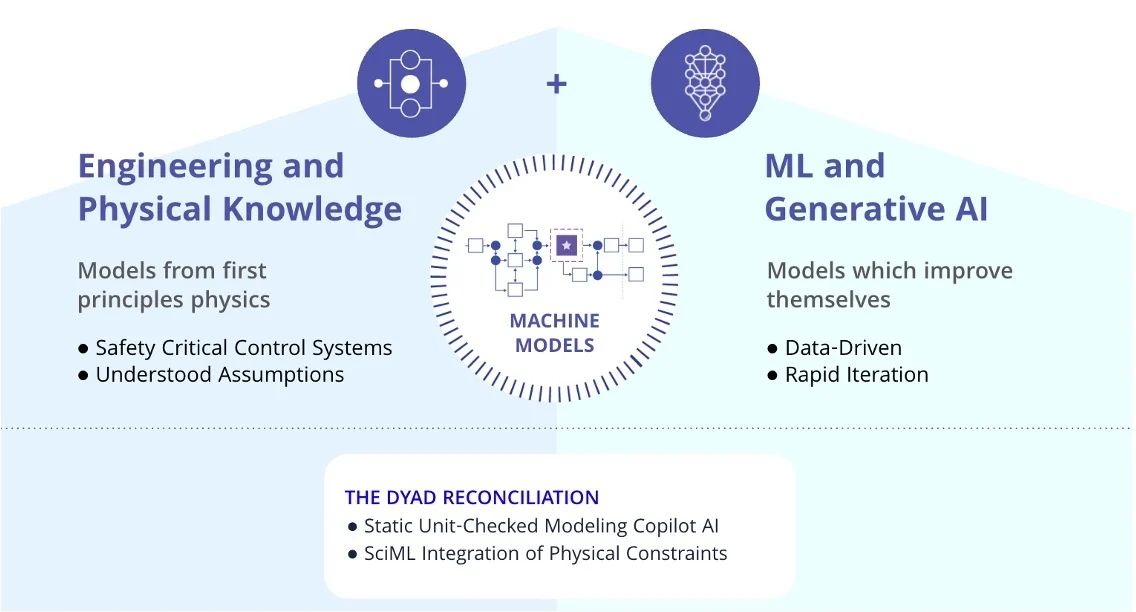
Dyad is a new modeling system designed to accelerate hardware engineering by uniting physical modelling with modern software development practices. Developed to address the increasing demand for both speed and safety in complex systems design, Dyad combines a declarative physical modelling language with tools for continuous integration and deployment (CI/CD). The system, built upon the Julia programming language and its SciML ecosystem, facilitates the creation of verifiable models from first principles, integrates data-driven scientific machine learning, and supports both graphical and text-based workflows. Dyad aims to bridge the gap between traditional engineering expertise and the capabilities of generative AI, targeting a range of applications from initial design through to hardware implementation and real-time data analysis via integration with Internet of Things (IoT) infrastructure. A VS Code extension, Dyad Studio, has been released under a source-available license for educational and non-commercial use.
Dyad: A New Approach to Hardware Engineering
Dyad addresses a critical need for a unified system capable of handling both the precision of physical modelling and the agility demanded by modern software development workflows. Users design custom analyses of models, creating APIs to add functionality such as neural surrogate generation and symbolic model discovery, all exposed through the graphical interface. The system establishes a direct correspondence between graphical user interface views and textual representations through a declarative physical modelling language, facilitating analysis and integration with generative AI and continuous integration/continuous delivery (CI/CD) pipelines. This facilitates the creation of extensive data warehouses for digital twin development.
The architecture of Dyad is constructed to integrate with contemporary DevOps tools, managing libraries as Git repositories to ensure dependency tracking and reproducibility. Tooling operates seamlessly within CI/CD pipelines, bridging the gap between established proprietary modelling practices and the velocity of open-source projects. Dyad is also available as VS Code extensions, allowing developers to utilise familiar keyboard shortcuts and integrate the system into existing local workflows, maintaining code base consistency across different development environments.
Dyad leverages the Julia programming language and its SciML ecosystem, including DifferentialEquations.jl and ModelingToolkit.jl, alongside the Lux deep learning stack, providing native support for differentiable programming, neural networks, scientific machine learning, and hardware acceleration via GPUs. The modelling language targets both physical modelling through differential-algebraic equation (DAE) formalisms – a system of equations describing the relationships between variables in a physical system – and embedded hardware/control systems via synchronous compilation, offering versatility across diverse applications.
Dyad libraries enhance the performance of generative AI tooling by automatically utilising existing resources to improve predictive accuracy and facilitate translation from other languages. Integration with cloud compute provides access to scalable hardware for AI training, while cloud storage and streaming data endpoints enable connectivity with Internet of Things (IoT) devices. This combination facilitates the development of complex systems and data-driven applications.
More information
External Link: Click Here For More