Algorithmic cooling presents a fascinating possibility, locally reducing the entropy of quantum systems such as molecular nuclear spins or diamond defects. Now, Mohammed Alghadeer and Khanh Uyen Giang, from the University of Oxford and Nanyang Technological University respectively, alongside Shuxiang Cao, Simone D. Fasciati, Michele Piscitelli and Nelly Ng, demonstrate a significant advance with a technique called double-bracket algorithmic cooling. This new protocol systematically suppresses the coherence of quantum states by simulating a process akin to imaginary-time evolution, and crucially, operates without requiring measurements of the system. The team achieves this through a dynamic algorithm that utilises information stored in copies of the input states, creating circuits independent of the specific quantum state being cooled, and importantly, enhances cooling performance as more qubits are included, opening new avenues for thermodynamic tasks.
Researchers demonstrate that local entropy reduction is possible for a qubit belonging to an isolated ensemble, such as nuclear spins in molecules or nitrogen-vacancy centres in diamonds. Within this physical setting, they introduce double-bracket algorithmic cooling (DBAC), a protocol that systematically suppresses quantum coherence of pure states. DBAC achieves this by simulating quantum imaginary-time evolution through recursive unitary synthesis of Riemannian steepest-descent flows, and it utilises density-matrix exponentiation as a subroutine, establishing it as a concrete instance of a dynamic quantum algorithm that operates using quantum information stored in copies of the input states.
Quantum Computation, Circuits and Early Approaches
This body of work encompasses a broad range of research papers and topics related to quantum computing. Foundational work in quantum computation and information, including the seminal textbook by Nielsen and Chuang, provides the theoretical basis for the field. Early approaches to quantum computation using ensemble quantum computing, pioneered by Cory and colleagues and Gershenfeld and Chuang, laid the groundwork for later developments. Research into quantum circuits, led by Vatan and Williams and Vidal and Dawson, focuses on the building blocks of quantum algorithms and the development of universal gate sets.
Furthermore, studies on quantum state purification, conducted by Cirac and colleagues, aim to improve the fidelity of quantum states. A significant theme within this research is error mitigation and characterization, reflecting the practical challenges of building real quantum computers. Randomized benchmarking, developed by Chow and colleagues and Gambetta and colleagues, serves as a standard technique for characterizing gate errors. More advanced process tomography techniques, such as symmetrized characterization developed by Emerson and colleagues, provide deeper insights into quantum system performance.
Understanding and mitigating crosstalk, a critical issue in multi-qubit systems, is addressed by researchers including Ketterer and Wellens, Tripathi and colleagues, Murali and colleagues, Zhao and colleagues, and Pettersson Fors and colleagues. Techniques for error suppression and elimination, such as those developed by Motzoi and colleagues and McKay and colleagues, aim to reduce errors through methods like DRAG pulses. Machine learning approaches to state characterization, pioneered by Lumbreras and colleagues, offer new avenues for improving quantum state knowledge. This research also explores the physical realization of qubits and their control.
Studies on superconducting qubits, led by Koch and colleagues, Place and colleagues, and Yan and colleagues, investigate transmon qubits, materials, and coherence times. Research into tunable coupling, conducted by Yan and colleagues, focuses on controlling interactions between qubits. Reset protocols, developed by Geerlings and colleagues and Magnard and colleagues, aim to initialize qubits to a known state. All-microwave control, investigated by Magnard and colleagues, explores using microwave pulses for qubit control. Algorithmic cooling, investigated by Rodríguez-Briones and colleagues, uses computation to cool down a system, with correlation-enhanced cooling and heat-bath algorithmic cooling offering further refinements.
Quantum state purification, investigated by Childs and colleagues and Hou and colleagues, provides techniques to improve the fidelity of quantum states. Simulation and software play a crucial role, with Psitrum, an open-source quantum computer simulator, developed by Alghadeer and colleagues. Self-driving laboratories, pioneered by Cao and colleagues, utilize automation and machine learning to optimize quantum experiments. Foundational work, such as the connection between thermodynamics and quantum computation explored by Schulman and Vazirani, provides valuable insights. Emerging trends, including agent-based labs developed by Cao and colleagues, streaming purification developed by Childs and colleagues, and quantum machine learning for state characterization, offer promising new directions for the field.
Algorithmic Coherence Control Without Measurement
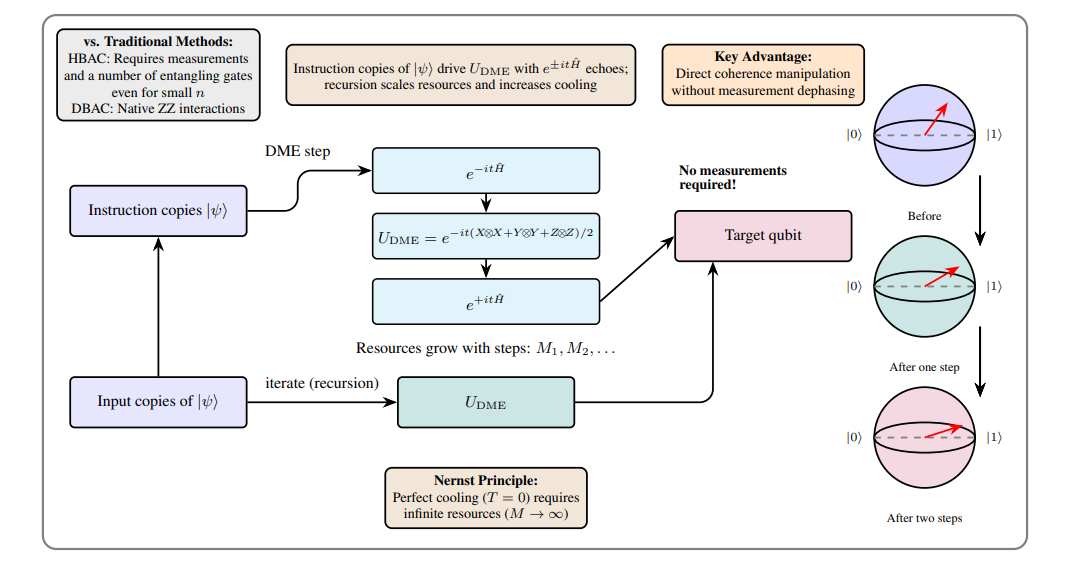
Scientists have demonstrated a new quantum algorithm, double-bracket algorithmic cooling (DBAC), capable of reducing the quantum coherence of a selected qubit within an isolated system. This work builds upon previous algorithmic cooling techniques, but crucially achieves coherence reduction without relying on measurements that typically collapse quantum superpositions. The team successfully implemented DBAC, demonstrating a process where multiple qubits, all prepared in the same initial state, can be used to manipulate the coherence of a target qubit. The core of DBAC involves applying a series of unitary operations, specifically a density-matrix exponentiation, between the target qubit and copies of the initial state, bracketed by echoes to create a “double-bracket” step that effectively rotates the target qubit’s state closer to a ground state, represented as |0⟩.
Importantly, the algorithm operates “on the fly”, meaning the cooling dynamics are programmed by the input qubits themselves, eliminating the need for mid-circuit measurements and preserving quantum coherence. Experiments confirm that DBAC can reduce quantum coherence without resorting to tomography, a process that requires extensive measurements and feedback loops. The team showed that the algorithm functions by mimicking imaginary-time evolution, a process that naturally drives a quantum state towards its ground state. The number of input qubits required to achieve convergence increases with each step, mirroring the Nernst unattainability principle, which states that perfect cooling requires infinite resources. Measurements demonstrate that the algorithm’s performance scales with the number of instruction qubits used, effectively increasing cooling performance as more qubits are included. This breakthrough delivers a new approach to quantum state manipulation, opening possibilities for advanced thermodynamic tasks and quantum information processing.
Dynamic Algorithmic Cooling of Superconducting Qubits
This research demonstrates a new method for reducing quantum coherence, termed double-bracket algorithmic cooling (DBAC), which operates by systematically suppressing the coherence of quantum states. Unlike traditional approaches that rely on measurements and increasing resource demands to approach ground states, DBAC employs a dynamic algorithm utilizing density matrix exponentiation, effectively encoding quantum information into a quantum operation. This dynamic aspect directly aligns with the objective of coherence removal. The team implemented and experimentally validated DBAC on a superconducting lattice of qubits, demonstrating its utility in cooling operations and establishing the first instance of quantum dynamic programming in this context.
Notably, DBAC proves more experimentally accessible than established protocols like HBAC, requiring fewer gates and avoiding the need for initial dephasing steps. The algorithm’s performance is rooted in principles of Riemannian gradient flows and imaginary-time evolution, with analytical formulas defining the limits of cooling achievable in each step. The authors acknowledge that increasing the number of qubits used in DBAC, while enhancing performance, also increases circuit depth and demands longer pulse durations, potentially limiting scalability. Future work will likely focus on optimizing circuit depth and pulse fidelity to further improve the algorithm’s efficiency and explore its application to more complex quantum systems. This research establishes a promising new direction for quantum thermodynamics, offering a potentially powerful tool for manipulating and controlling quantum coherence.