The emergence of complex electronic states remains a central challenge in understanding superconductivity, and recent attention has focused on Kagome materials as potential platforms for these phenomena. Linwei Huai, Zhuying Wang, and Huachen Rao, alongside colleagues, investigate the interplay between electronic interactions and lattice structure in a Kagome superconductor, CsV Sb, doped with tin. Their work reveals a surprising new form of order, short-range charge stripes, that appears when the material’s original electronic order is suppressed, demonstrating a pathway to emergent electronic states. This discovery highlights the crucial role of cooperative interactions between the material’s atomic lattice and its electrons, offering new insights into the development of unconventional superconductivity and potentially paving the way for novel electronic devices.
A central mystery in high-temperature cuprate superconductors concerns the coexistence of multiple exotic orders, potentially unlocking the mechanisms behind their remarkable properties and guiding the design of even higher-temperature superconductors. Researchers investigate the interplay between charge density waves, spin density waves, and nematicity, all of which emerge in these complex materials and often compete with superconductivity itself. Understanding how these different orders interact and influence each other presents a significant challenge, requiring sophisticated experimental techniques and theoretical modelling to provide a more complete picture of the underlying physics.
Kagome Metal CsV3Sb5, CDW and Superconductivity
Research focuses intensely on Kagome metals, particularly CsV3Sb5, and their charge density wave behaviour, superconductivity, and related electronic properties. Studies explore the formation of charge density waves in CsV3Sb5, investigating the transition temperature, modulation, and impact on the electronic structure, as well as the relationship between these waves and superconductivity. A central goal is to understand the emergence of superconductivity in this material, determining the transition temperature, the nature of the superconducting gap, and factors that enhance this state. Investigations focus on the electronic band structure of CsV3Sb5, the role of electron correlations, and the emergence of novel electronic phases, seeking to understand how charge density waves and superconductivity coexist or compete within the material. Doping and applying pressure are used to tune the electronic structure and potentially enhance superconductivity, while theoretical calculations, including density functional theory and Wannier function methods, are used to understand the electronic structure, predict charge density wave modulation, and investigate the superconducting gap.
Short-Range Charge Order Emerges in Superconductor
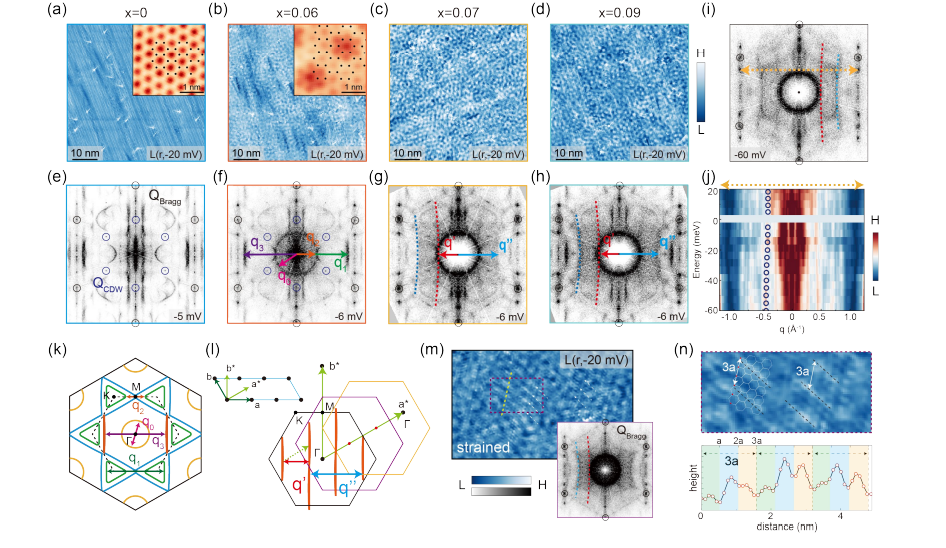
Scientists have revealed a new electronic state within tin-doped CsV₃Sb₅ Kagome superconductors, demonstrating a sudden emergence of short-range charge stripe order when long-range charge density order is suppressed. Combining angle-resolved photoemission spectroscopy, nuclear magnetic resonance, scanning tunneling microscopy, and first-principles calculations, the team discovered this new order arises at a critical doping level of approximately x = 0. 07, coinciding with the collapse of the existing charge density wave order. Measurements confirm a distinct modulation vector characterizes this short-range stripe order, inducing significant scattering of quasiparticles and reducing the electron density of states.
Photoemission data shows an energy difference between bands, previously discernible in pristine CsV₃Sb₅, vanishes at x = 0. 07, while nuclear magnetic resonance measurements reveal a characteristic peak structure transforms into a single peak at x = 0. 07, accompanied by a jump in the average Knight shift. Scanning tunneling microscopy further supports these findings, revealing tin dopants preferentially occupy specific sites. The team observed a suppression of the superconducting transition temperature at x = 0.
07, followed by a gradual increase with further doping, indicating a complex interplay between superconductivity and the emerging charge stripe order. Calculations demonstrate this supermodulation represents a hidden instability within pristine CsV₃Sb₅, enhanced by the chemical pressure induced by tin substitution and coupled to electronic correlations. This work establishes a new route toward emergent electronic orders driven by cooperative interactions between lattice and electronic degrees of freedom.
Tin Doping Reveals Hidden Charge Stripe Order
This research reveals a new route to emergent electronic orders in Kagome superconductors, specifically in a tin-doped compound of caesium, vanadium, antimony, and sulphur. Scientists discovered that suppressing the long-range charge density order typically observed in the pristine material leads to the sudden emergence of a distinct, short-range charge stripe order, featuring a unique modulation pattern and significantly altering the behaviour of electrons within the material. Detailed investigations using spectroscopic measurements and computational modelling demonstrate that this short-range order arises from a hidden instability within the original material, enhanced by the chemical pressure induced by tin substitution and coupled with electronic correlations. This suggests a fundamental interplay between the material’s lattice structure and its electronic properties, driving the emergence of novel electronic states.
🗞 Electronic-correlation-assisted charge stripe order in a Kagome superconductor
🧠 ArXiv: https://arxiv.org/abs/2509.17467