Supersolids, materials exhibiting both crystalline and superfluid properties, currently attract considerable scientific attention, and researchers are now beginning to explore their mechanical behaviour in detail. Qiaomei Zhao from Guangzhou University and Henan Normal University, alongside Xingdong Zhao and Jieli Qin, investigate the transition from elastic to inelastic deformation in these unusual materials. Their work examines how a dipolar supersolid responds to compression or expansion, revealing a critical point beyond which the material’s internal crystal structure breaks down. By determining this threshold, both through analytical calculations and numerical simulations, the team provides fundamental insight into the dynamical responses of supersolids and opens up new avenues for exploring their potential applications in advanced materials science and related technologies.
Supersolid matter, possessing a unique combination of crystalline order and superfluidity, has attracted considerable research interest. This work investigates the transition from elastic to inelastic deformation in a dipolar supersolid Bose-Einstein condensate confined within a box-shaped potential, effectively a finite-sized system. Researchers determined the stable states of the supersolid, both its lowest energy ground state and excited states, and examined how the size of the supersolid relates to the number of repeating structural units it can accommodate.
Dipolar BEC Exhibits Supersolid Transition and Elasticity
This research provides a detailed investigation into the properties of a dipolar Bose-Einstein condensate as it transitions into a supersolid state. The study explores how this condensate responds to stretching and compression, revealing the interplay between its superfluid and crystalline characteristics. Understanding supersolidity, a state of matter exhibiting both crystalline order and superfluidity, presents a fundamental challenge in condensed matter physics, and dipolar Bose-Einstein condensates offer a promising platform for realizing and studying this phenomenon due to the long-range interactions between the constituent atoms. The elastic properties of these condensates are also relevant to potential applications in emerging quantum technologies, such as highly sensitive sensors and quantum information processing.
Supersolid Elasticity and Inelastic Transition Points
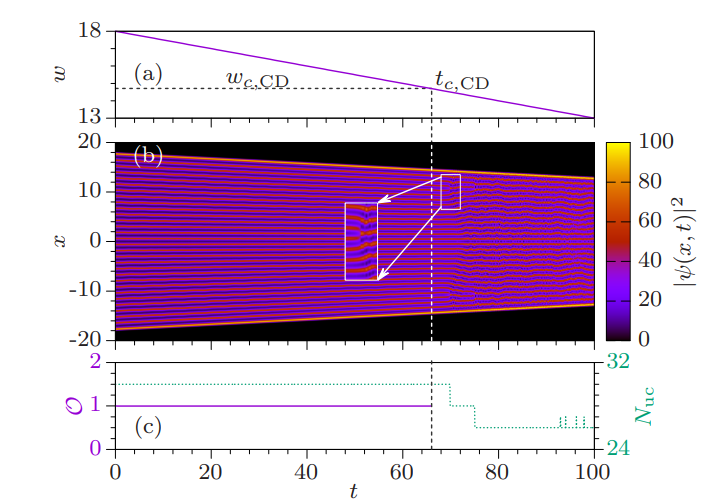
This research significantly advances understanding of supersolid materials by exploring their mechanical properties beyond the purely elastic regime. Scientists have investigated how dipolar supersolids respond to both compression and dilation, discovering a clear distinction between elastic deformation, where the material returns to its original shape, and inelastic deformation, where the internal crystal structure is permanently altered. Through a combination of analytical calculations and numerical simulations, the team mapped out a diagram detailing the transition point between these two behaviours, identifying the critical extent of compression or dilation that triggers inelasticity. The findings demonstrate that, similar to conventional solids, supersolids exhibit elastic behaviour up to a certain point, but unlike many materials, the deformation process in supersolids involves the emergence of new unit cells. While the research focused on parameters within the supersolid phase, the results extend knowledge into the previously unexplored inelastic region, offering new insights into the fundamental mechanical characteristics of these exotic materials.
👉 More information
🗞 From elastic to inelastic deformation of a dipolar supersolid
🧠 ArXiv: https://arxiv.org/abs/2510.13086