

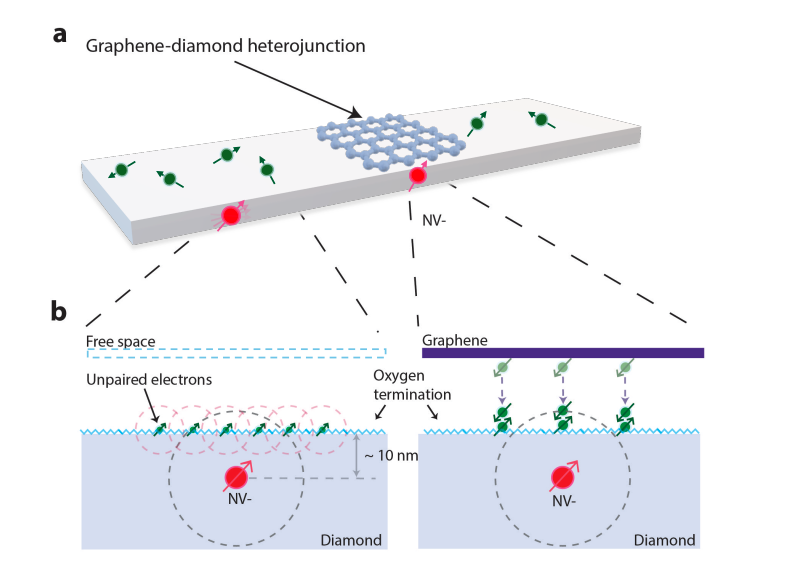
The pursuit of stable quantum states, essential for applications ranging from advanced sensing to quantum computation, frequently encounters limitations imposed by environmental noise. Researchers are actively investigating methods to shield delicate quantum systems from disruptive influences, particularly in solid-state qubits, which offer potential for scalability. Wing Ki Lo, Yaowen Zhang, and colleagues from the Department of Physics at The Hong Kong University of Science and Technology detail a novel approach to extending quantum coherence in nitrogen-vacancy (NV) centres within diamond, as presented in their article, ‘Enhancement of quantum coherence in solid-state qubits via interface engineering’. Their work focuses on manipulating the diamond surface with oxygen termination and graphene patching, demonstrably increasing coherence times to over one millisecond and enabling the detection of individual nuclear spins with nanoscale precision. This interfacial engineering not only mitigates noise arising from impurities but also enhances the platform’s robustness and compatibility with other materials, representing a significant step towards practical quantum sensing devices.
Researchers have demonstrated a novel sensing platform utilising shallow nitrogen-vacancy (NV) centres in diamond, achieving extended coherence times and enhanced sensitivity through precise interfacial engineering and heterostructure fabrication. NV centres are point defects in the diamond lattice, exhibiting quantum mechanical properties that make them ideal for sensing applications. The team successfully extends NV centre coherence to over 1 millisecond, approaching the theoretical limit dictated by the NV centre’s longitudinal relaxation time (T1), by employing oxygen termination and graphene patching, addressing a long-standing challenge in quantum sensing.
This research establishes that graphene patching, facilitated by surface termination, induces charge transfer, effectively reducing spin noise and enhancing the sensor’s performance. Raman spectroscopy, a technique analysing vibrational modes, and density-functional theory, a computational quantum mechanical modelling method, confirm this mechanism, revealing that the charge transfer leads to the pairing of surface electrons, thereby diminishing the density of unpaired spins that contribute to decoherence. Double electron-electron resonance (DEER) spectroscopy further validates this finding, corroborating the reduction in unpaired spins and solidifying the understanding of the underlying physics.
The enhanced sensitivity of the platform enables the
The enhanced sensitivity of the platform enables the detection of individual, weakly coupled 13C nuclear spins, and external 11B spins originating from a hexagonal boron nitride (h-BN) layer, representing a significant leap forward in nanoscale sensing capabilities. This achievement constitutes nanoscale nuclear magnetic resonance, opening possibilities for high-resolution material characterisation and biological sensing, and allowing scientists to probe matter at an unprecedented level of detail. The ability to resolve individual nuclear spins demonstrates the platform’s capacity for precise and localised measurements, offering insights previously inaccessible with conventional techniques.
A protective layer of h-BN integrates into the device architecture, providing robust stabilisation and ensuring compatibility with a diverse range of target materials and harsh treatment conditions, crucial for real-world applications. This design feature safeguards the sensitive NV centre from environmental degradation and facilitates repeated use without compromising performance, making the platform a versatile tool for various scientific and technological applications. The combination of extended coherence, improved sensitivity, and device durability positions this platform as a powerful instrument for advancing research in multiple fields.
Researchers meticulously manipulate the surface environment to reduce spin noise, employing oxygen termination and graphene patching to create a stable and sensitive sensing platform. Raman spectroscopy and density functional theory calculations reveal that oxygen termination induces charge transfer within the graphene layer, effectively pairing surface electrons and diminishing the density of unpaired spins. DEER spectroscopy corroborates this finding, confirming a reduction in the number of unpaired spins present and validating the theoretical model.
This improved coherence directly translates to enhanced sensing
This improved coherence directly translates to enhanced sensing capabilities, allowing scientists to detect individual, weakly coupled 13C nuclear spins and resolve external 11B spins originating from a hexagonal boron nitride (h-BN) layer. The researchers successfully demonstrate nanoscale nuclear magnetic resonance, achieving a substantial increase in sensitivity and opening new avenues for materials science and biology. The h-BN layer serves a dual purpose, both protecting the NV centre and providing a stable platform for sensing applications, ensuring reliable and consistent measurements.
Future research will focus on further optimising the device performance and exploring new applications for this versatile sensing platform. The team plans to investigate different materials and device architectures to enhance the sensitivity and resolution of the sensor, paving the way for further discoveries. They also aim to develop new techniques for analysing the data obtained from the sensor, unlocking even more valuable insights into the properties of matter.
🗞 Enhancement of quantum coherence in solid-state qubits via interface engineering
🧠 DOI: https://doi.org/10.48550/arXiv.2507.02312


