The collective behaviour of multiple light emitters presents opportunities for enhanced precision in sensing applications, and a team led by Diego Zafra-Bono, Oriol Rubies-Bigorda, and Susanne F. Yelin investigates how to harness ‘subradiant’ states to achieve this. These states, which arise when closely spaced emitters interact with light, naturally produce exceptionally narrow spectral features in transmitted light, offering a pathway to significantly improve the detection of external disturbances. The researchers demonstrate that this enhanced sensitivity has broad implications, potentially revolutionising the operation of atomic clocks, enabling high-resolution imaging of atomic arrangements, and facilitating the precise measurement of subtle environmental changes like electromagnetic fields or gravitational gradients. This work establishes a new approach to precision sensing by exploiting the unique properties of collective atomic states, paving the way for more sensitive and accurate measurement technologies.
Subradiant States Enhance Precision Sensing Analysis
When an ensemble of quantum emitters interacts with light, they can exhibit collective behaviour that dramatically alters their optical properties. This work investigates exploiting subradiant collective states for precision sensing, focusing on analysing transmission spectra. The research demonstrates that these states, characterised by suppressed decay rates, enhance the sensitivity of spectroscopic measurements, leveraging their narrow linewidths to detect weak perturbations in the surrounding environment. The approach involves a theoretical framework combining quantum electrodynamics with many-body physics to model the collective interactions and predict the resulting transmission spectra. The analysis reveals that sensitivity to external fields scales with the number of emitters, offering a pathway towards highly sensitive sensors. Furthermore, the study identifies optimal configurations for maximising sensing performance, considering factors such as emitter spacing and excitation conditions, establishing a promising platform for novel sensors with applications in materials science, biophysics, and environmental monitoring.
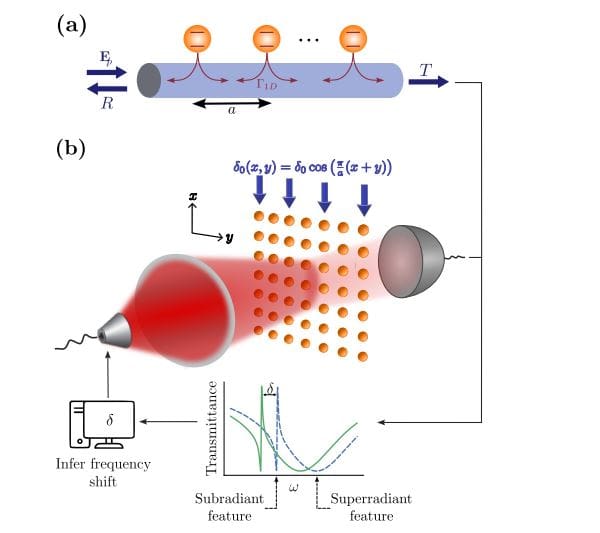
When atoms are arranged in arrays, their emission becomes collective, giving rise to superradiant and subradiant states. This work proposes harnessing subradiant states for quantum metrology, as such states naturally arise in subwavelength-spaced atomic arrays and in small ensembles of emitters coupled to one-dimensional waveguides. The team demonstrates that their collective optical response yields sharp, narrow features in the transmittance spectrum, enhancing sensitivity to external perturbations and enabling precise detection for applications such as atomic clock operation and spatially resolved imaging of emitter positions.
Atomic Array Sensitivity, Discontinuity and Atom Number
This research focuses on the behaviour of sensitivity in two-dimensional atomic arrays, particularly examining non-smooth behaviour and the influence of atom number. The analysis reveals a discontinuity in the maximum sensitivity of a two-dimensional array as a function of the spacing between atoms. This discontinuity arises from the energy difference between the bright and dark collective modes of the array, directly influencing the maximum sensitivity. The research also investigates how the sensitivity of a finite two-dimensional array changes with the number of atoms present. The findings show that finite arrays exhibit lower sensitivity than infinite arrays, but the sensitivity approaches the infinite array case as the number of atoms increases. However, increasing the number of atoms does not always lead to better sensitivity, as the relationship is complex and exhibits oscillations, with sensitivity sometimes larger for even numbers of atoms.
Subradiant Arrays Enhance Optical Sensing Precision
This research demonstrates the potential of subradiant states, arising in precisely arranged atomic arrays, to significantly enhance the precision of optical sensing. Scientists have shown that these arrays exhibit narrow spectral features, allowing for highly sensitive detection of external perturbations such as variations in laser frequency or subtle changes in the surrounding environment. The team successfully modelled how these systems can be used to improve atomic clock operation and enable spatially resolved imaging of atomic positions with increased accuracy. Importantly, this enhanced sensitivity is maintained even when realistic experimental imperfections are considered, suggesting practical viability.
Calculations indicate that current experimental setups utilising subwavelength arrays already achieve meaningful precision, with the potential to match leading atomic clock performance through the use of ultranarrow atomic transitions. Researchers acknowledge that the time required for the system to stabilise depends on its initial state, and future work could focus on identifying initial states that minimise this delay, improving measurement rates. Further investigations could also explore sensing protocols beyond low excitation limits and incorporate phase-resolved detection methods to potentially improve sensitivity still further.
👉 More information
🗞 Subradiant collective states for precision sensing via transmission spectra
🧠 ArXiv: https://arxiv.org/abs/2512.09050