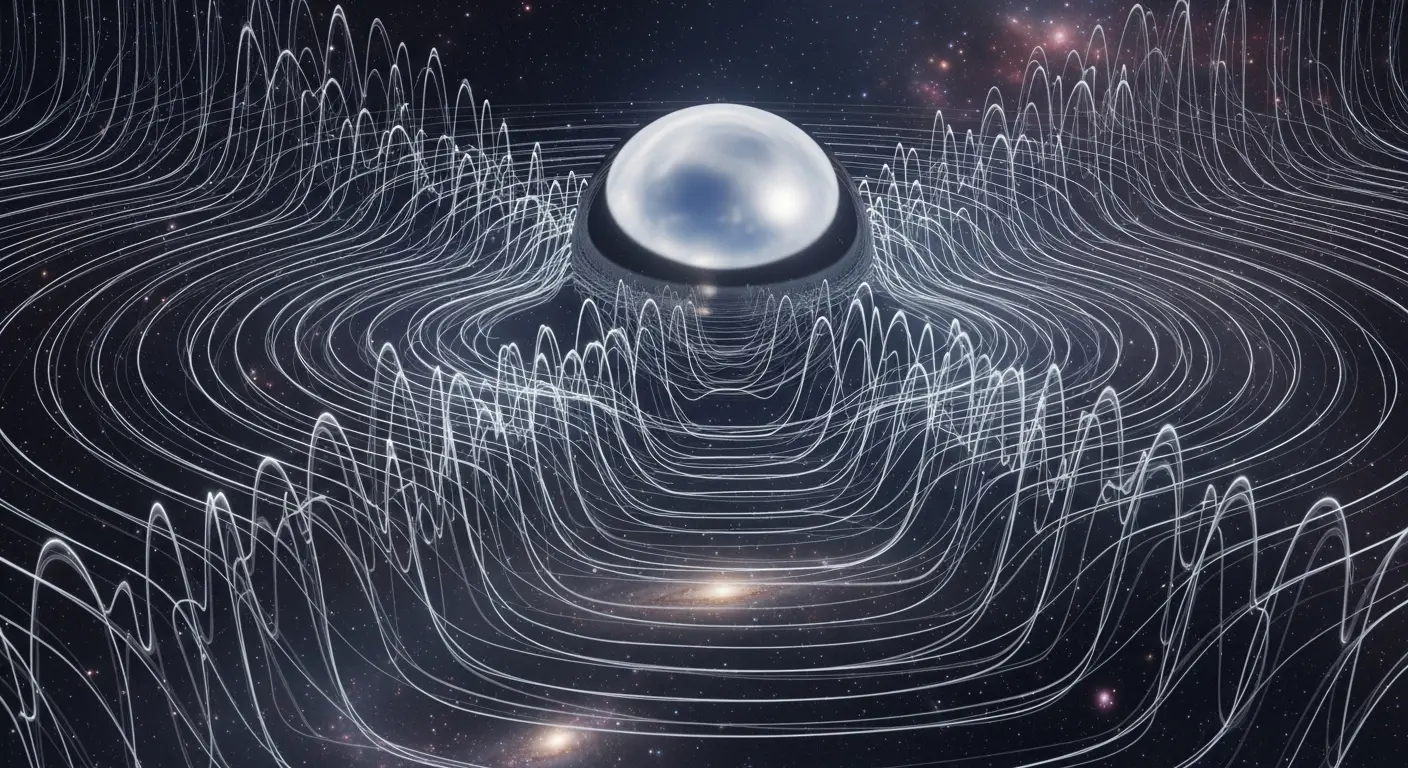
Scientists are pioneering a novel approach to detecting gravitational waves, moving beyond traditional methods by focusing on the fundamental interaction between photons and gravitons! K. Hari and S. Shankaranarayanan, researchers currently unaffiliated, detail a fully field-theoretic framework where gravitational waves induce energy exchanges with light, akin to Raman spectroscopy, and propose a detection scheme utilising Hong-Ou-Mandel interference! This research is significant because it offers a completely new way to sense these ripples in spacetime by encoding the gravitational wave signal in the subtle modulation of photon coincidence rates , a technique that complements existing detectors and promises a unique probe of the cosmos.
Photon-graviton scattering via HOM interference is a challenging
This groundbreaking research, published recently, moves beyond the conventional semi-classical approach by treating both electromagnetic radiation and gravity as quantized dynamical degrees of freedom. Crucially, the study proposes a detection scheme leveraging Hong-Ou-Mandel (HOM) interference, a uniquely quantum effect, to sensitively measure this microscopic interaction. Experiments show that this method could potentially enhance sensitivity and provide insights into the quantum nature of gravity itself. To establish the feasibility of HOM-based detection, the scientists derived the effective photon dynamics induced by its interaction with the graviton field, working within the interaction picture and tracing out the graviton degrees of freedom to obtain the reduced electromagnetic density matrix.
The total Hamiltonian comprises free electromagnetic, free graviton, and interaction terms, with the interaction described by the coupling between the EM stress-energy tensor and the metric perturbation. This interaction, simplified using the linearized gravity regime and the Transverse-Traceless (TT) gauge, reveals a graviton-photon energy exchange, mirroring Raman spectroscopy where photons undergo inelastic scattering with molecular vibrations. The study demonstrates that, just as in Raman spectroscopy, photons gain or lose energy by absorbing or emitting a graviton, resulting in minute frequency shifts, an accumulative phase shift. By assuming an initial product state for photons and gravitons, and evaluating the time-evolution operator, the researchers arrived at a reduced photon density matrix central to their analysis. This equation highlights that the interaction introduces an additional, purely imaginary phase to the photons, and also reveals a gravitational decoherence effect arising from entanglement between photons and the graviton environment. In the weak-field limit, the coupling constant is extremely small, ensuring the evolution remains largely unitary for practical purposes, and allowing for precise measurement of the gravitational signal.
Photon-graviton scattering via Hong-Ou-Mandel interference offers a potential
The study pioneered a novel interferometer design, detailing how the differential response for one detector (Detector 1) incorporates terms like c ∆τeff L D1 = 1 4 (hxx + hyy) + 3 √ 3 4 (hxx −hyy) + r 3 2 (hyz −hxz) + 1 2hxy, where L represents the characteristic arm length. This sensitivity to the hxz and hyz components of the metric tensor offers a significantly more isotropic antenna pattern, reducing blind spots and enhancing source localization compared to conventional planar detectors. Researchers meticulously calculated this sensitivity, revealing a substantial improvement in the ability to pinpoint GW origins. Experiments employed a 3D pyramidal configuration with three individual interferometers, each possessing a unique antenna pattern as illustrated in Figure 5.
Crucially, the orientations of these patterns are mutually complementary, ensuring that the maxima of one detector cover the minima of others. When operating as a network, the combined response, averaged across the three detectors, approximates a monopole-like sensitivity, as depicted in Figure 6, guaranteeing full-sky coverage without blind spots for continuous monitoring of transient sources. The simultaneous measurement of distinct linear combinations of the strain tensor components (hij) by the three detectors breaks typical degeneracy found in single-detector observations, substantially improving source localization and polarization resolution. The team engineered a detection scheme reliant on second-order coherence, specifically Hong-Ou-Mandel interference, rather than the first-order coherence used in classical fringe locking.
This approach shifts the measurement basis from field amplitude quadratures to photon distinguishability, potentially offering resilience against specific low-frequency laser noise. Scientists harnessed the principles of quantum mechanics, distinguishing their framework from previous analyses by Caves, which focused on classical tidal forces modifying boundary conditions; instead, this work addresses the microscopic origin of the signal itself through a scattering process between quantized electromagnetic and gravitational fields. The. Researchers defined the free electromagnetic Hamiltonian as Hph = X k,λ ħωk a† k,λak,λ, where ak,λ annihilates a photon with wave vector k, polarization λ, and frequency ωk = c|k|.
Similarly, the free graviton Hamiltonian is HGW = X q,σ ħωq b† q,σbq,σ, with bq,σ annihilating a graviton of wave vector q and polarization σ. The interaction between the electromagnetic stress-energy tensor and the metric perturbation is given by Hint = 1 2 Z d3x hij(x, t) T ij EM(x, t), where T ij EM = F iμF j μ −δijFμνF μν/4. Measurements confirm that expanding the fields in terms of creation and annihilation operators simplifies the interaction Hamiltonian to Hint ≈1 2X k,q X σ,λ,λ′ ωk (2π)32√ωq gσ,λ,λ′ k,q h nk,λ,λ′ bq,σeiΩqt + b† q,σe−iΩqti, where Ωq = ωq(1 −k · q) and gσ,λ,λ′ k,q = εi (k,λ)εi (k,λ′) + (k × ε(k,λ))i(k × ε(k,λ′))j ε(q,σ) ij is the geometric factor. Data shows this interaction reveals a graviton-photon energy exchange, mirroring Raman spectroscopy where photons undergo inelastic scattering; here, photons gain or lose energy by absorbing or emitting a graviton.
For GW detection, where ωk ≫ωq, this manifests as a frequency shift, which the team treated as an accumulative phase φk(t). Scientists evaluated the time-evolution operator and traced out the graviton field, arriving at the reduced photon density matrix: ρph(t) = X n,n′ ρnn′ |n⟩ n′ e2i Im{ P q(eαn−eαn′)β∗}e−1 2 |eαn−eαn′|2. The research highlights that the term 2i Im nP q(eασ q,n −eασ q,n′)β∗ q leads to an additional phase in photons due to interaction with gravitons, causing the photon state |n⟩ to evolve as |n⟩→e2i Im{ P q eασ q,nβ∗ q} |n⟩. Furthermore, the exponential decay factor e−1 2 |eαn−eαn′|2 represents gravitational decoherence, arising from entanglement between photons and the graviton environment. In the weak-field limit, the coupling constant is extremely small, and the team found that the accumulated phase is mathematically identical to the phase shift induced by variations in optical path length in classical interferometry: φk(t) = −ωk 1 2 Z t 0 dt′heff(t′). The team proposes leveraging Hong-Ou-Mandel interference as a probe, exploiting the fact that graviton-induced phase shifts render photon pairs distinguishable.,.
Photon Distinguishability Reveals Gravitational Wave Signals through quantum
The proposed detection scheme utilises Hong-Ou-Mandel interference to identify these microscopic interactions, revealing GW signals through modulations in photon coincidence rates rather than traditional intensity measurements. This shifts the measurement basis from field amplitude to photon distinguishability, potentially mitigating certain low-frequency laser noise issues. The authors acknowledge a limitation in that the current model relies on specific gauge choices for the gravitational and electromagnetic fields, which could influence the interaction Hamiltonian. Future research directions include exploring the practical implementation of the proposed detection scheme and investigating its sensitivity to different gravitational wave sources. This work presents a complementary modality for GW detection, offering a potentially valuable addition to existing technologies and opening new avenues for probing the gravitational universe.
.
👉 More information
🗞 Gravitational wave detection via photon-graviton scattering and quantum interference
🧠 ArXiv: https://arxiv.org/abs/2601.20553