

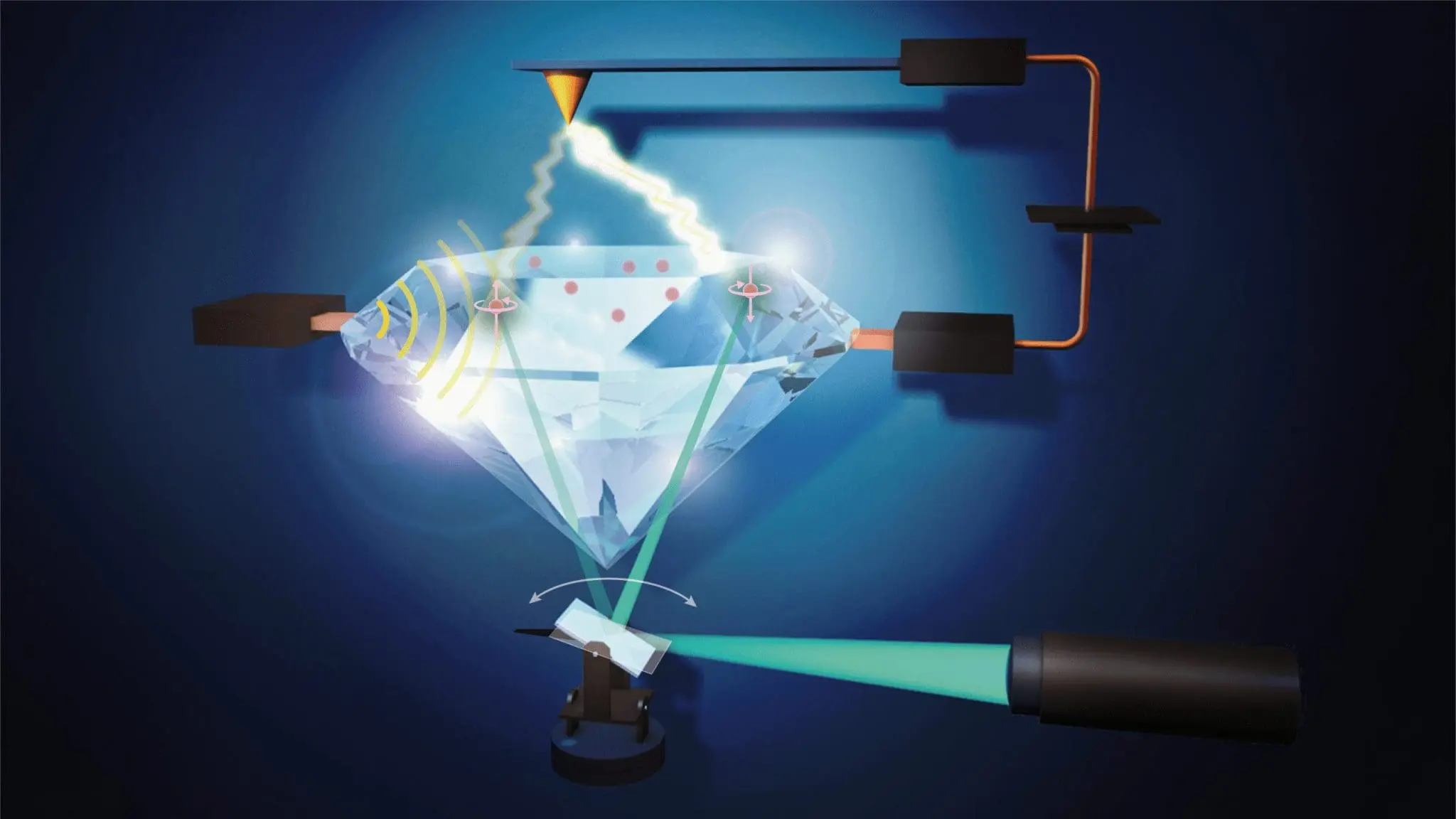
A team at Helmholtz-Zentrum Berlin (HZB) has developed a novel method using photovoltage to detect spin states in nitrogen vacancy (NV) centers within diamonds. This approach employs Kelvin probe force microscopy (KPFM), where a green laser excites charge carriers in the NV centers, generating measurable voltage changes that depend on their spin state. The method simplifies detection by eliminating the need for complex optical setups and single-photon detectors, potentially leading to more compact quantum sensors. Researchers Dr. Boris Naydenov and Sergei Trofimov contributed to this advancement, which also holds promise for applications beyond diamond-based systems in solid-state physics.
Challenges in Optical Detection of Spin States
The detection of spin states in nitrogen-vacancy (NV) centres within diamonds traditionally rely on optical methods, where photons emitted from these colour centres are measured to determine their spin state. This approach, while foundational, presents significant challenges due to the inherently weak signal generated by single-photon emissions when spins flip. The experimental setup required for such measurements is complex, often necessitating intricate optics and specialized single-photon detectors.
The reliance on optical detection introduces practical limitations, particularly in terms of scalability and device compactness. The need for elaborate optical systems complicates efforts to develop smaller, more integrated devices, which are crucial for advancing quantum technologies. These challenges underscore the necessity for alternative methods that can simplify the detection process while maintaining precision.
In addressing these issues, researchers have explored innovative approaches such as photovoltage measurement using Kelvin probe force microscopy (KPFM). This method circumvents the limitations of optical detection by focusing on charge carriers generated by laser excitation in NV centers. By measuring the resulting photovoltage, which is influenced by the electron spin state, this technique offers a more straightforward and compact solution for single spin detection.
Novel Photovoltage Method Using KPFM
The novel photovoltage method developed by researchers at HZB leverages Kelvin probe force microscopy (KPFM) to detect single spin states in nitrogen vacancy (NV) centers within diamonds. By exciting NV centers with a green laser, charge carriers are generated and subsequently captured by surface states, creating a measurable voltage around the NV center. This photovoltage is directly influenced by the electron spin state of the NV center, enabling precise detection of individual spins without the need for complex optical setups.
The method further allows for the manipulation of spin states using microwave excitation, providing researchers with the ability to coherently control and measure spin dynamics. This capability not only enhances the precision of single spin detection but also opens new possibilities for studying spin interactions in solid-state systems. The approach represents a significant advancement in simplifying the experimental requirements for spin state measurement, potentially leading to more compact and scalable diamond-based devices.
The development of this photovoltage-based technique addresses key challenges associated with traditional optical detection methods, particularly the weak photon signals emitted during spin flips. By focusing on electrical measurements rather than optical ones, the method reduces the complexity of the required instrumentation, making it more practical for integration into quantum technologies. This innovation could pave the way for the development of highly sensitive and compact diamond-based sensors and qubits, with applications extending beyond quantum computing to other areas of solid-state physics research.
Implications for Compact Diamond-Based Devices
The novel method developed by researchers at HZB for detecting single spins in nitrogen vacancy (NV) centers within diamonds represents a significant advancement toward creating compact diamond-based devices. By utilizing photovoltage measurements through Kelvin probe force microscopy (KPFM), the team has eliminated the need for complex optical setups traditionally required for spin state detection. This approach relies on the generation of charge carriers by laser excitation in NV centers, which are then captured by surface states to produce a measurable voltage. The resulting photovoltage is directly influenced by the electron spin state, enabling precise detection of individual spins.
The ability to manipulate spin states using microwave excitation further enhances the precision of single spin detection and opens new possibilities for studying spin interactions in solid-state systems. This method represents a significant advancement in simplifying the experimental requirements for spin state measurement, potentially leading to more compact and scalable diamond-based devices.
The implications of this innovation extend beyond quantum computing to other areas of solid-state physics research. By focusing on electrical measurements rather than optical ones, the method reduces the complexity of required instrumentation, making it more practical for integration into quantum technologies. This could pave the way for the development of highly sensitive and compact diamond-based sensors and qubits, with applications in a wide range of fields.
More information
External Link: Click Here For More


