

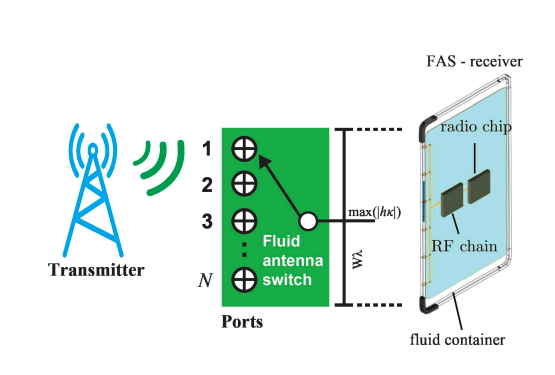
Fluid antenna systems represent a potentially transformative technology for future wireless networks, promising improvements in reliability, data rates, and energy consumption, but current research often fails to account for the fluctuating nature of wireless channels and its impact on critical applications. Irfan Muhammad, Priyadarshi Mukherjee, and Wee Kiat New, along with their colleagues, address this gap by developing a new theoretical framework grounded in dependability theory to guarantee a specific level of service quality for these systems. Their work delivers crucial mathematical tools to predict the reliability and operational lifespan of fluid antenna systems operating under realistic conditions, specifically when transmitting limited amounts of data, and introduces novel metrics to assess both reliability and energy efficiency. The resulting insights, validated through extensive simulations, offer valuable guidance for designing ultra-reliable, low-latency communication systems essential for demanding applications like industrial internet-of-things networks.
Reliable Wireless QoS for Critical Communications
This extensive collection of references details research into wireless communication systems, specifically focusing on reliability, quality of service (QoS), and performance analysis for applications like industrial IoT (IIoT) and ultra-reliable low-latency communication (URLLC). A central theme is ensuring consistent and dependable connections, moving beyond simply achieving high speeds to guaranteeing uninterrupted operation for critical applications. The research delves into key areas such as fading channels, diversity combining, and channel modeling to understand how wireless signals propagate and how to mitigate interference. It also investigates mathematical tools and optimization techniques to improve system performance and efficiency, with a significant focus on the impact of finite blocklength coding, crucial for low-latency and high-reliability applications.
Furthermore, the research addresses the critical need for energy efficiency in IIoT devices, exploring techniques to minimize power consumption while maintaining reliable communication. This body of work demonstrates a rigorous analytical approach, utilizing advanced mathematical models and optimization techniques to analyze and improve wireless system performance. By focusing on practical applications with stringent requirements, the research aims to develop and analyze wireless communication systems that can reliably support demanding industrial and communication scenarios, providing a foundation for building robust and dependable wireless networks for the future.
Fluid Antenna Reliability Through Dependability Theory
Researchers have developed a new method to assess the dependability of fluid antenna systems (FAS), a promising technology for next-generation wireless networks, particularly within industrial environments. Recognizing that wireless channels constantly change, the team focused on quantifying how reliably FAS maintains connections over time, moving beyond maximizing data rates to ensuring consistent, uninterrupted operation for critical applications. The core of this methodology is a dependability-theoretic framework, which mathematically defines and measures the probability of successful operation over a specific period. Instead of focusing solely on average performance, the researchers developed new mathematical expressions to characterize how the signal fluctuates, specifically calculating how often the signal drops below a usable level and how long these interruptions last, providing a more nuanced understanding of channel behavior than traditional measures.
Building on these statistical foundations, the team defined key dependability metrics, including mission reliability and mean time-to-first-failure, to quantify the likelihood of uninterrupted operation. They extended the concept of effective capacity to incorporate mission reliability, creating a “mission effective capacity” that reflects the system’s ability to maintain connectivity throughout a task, and developed a metric for “mission effective energy efficiency” to address energy conservation under fluctuating data demands. Simulations validated this approach, identifying optimal configurations for ultra-reliable, low-latency, and energy-efficient IIoT systems, providing valuable insights for designing future wireless networks.
Mission Reliability of Fluid Antenna Systems
Fluid antenna systems (FAS) offer a promising advancement for next-generation wireless networks, particularly for demanding industrial applications, by dynamically adjusting antenna configuration to improve signal quality and reliability. Recent research focuses on quantifying the dependability of these systems, moving beyond traditional measures of throughput to consider sustained, uninterrupted operation over extended periods, a concept termed “mission reliability. ” The research team developed new mathematical models to predict key performance indicators, specifically the rate at which signal fades and the duration of those fades, for FAS operating in challenging wireless environments. These models allow for the calculation of mission reliability and mean time-to-first-failure (MTTFF), providing a clear measure of how long a system can operate without interruption, crucial for applications like automated manufacturing and logistics.
Furthermore, the study extends the concept of “effective capacity” to incorporate mission reliability, creating a “mission effective capacity” that accounts for the probability of sustained connectivity. This metric, combined with a new measure of “mission effective energy efficiency,” allows researchers to optimize FAS performance for both reliability and energy consumption, even when dealing with unpredictable data traffic. The adaptability of FAS offers a significant advantage over traditional wireless systems, paving the way for more robust and dependable industrial communication networks.
Fluid Antennas Guarantee Reliable IIoT Operation
This work presents a comprehensive dependability analysis of fluid antenna systems (FAS), tailored for mission-critical industrial internet-of-things (IIoT) applications. By deriving expressions for level-crossing rate and average fade duration under fading conditions, the researchers defined metrics to quantify mission reliability and mean time-to-first-failure, crucial for uninterrupted operation. They extended the concept of effective capacity to incorporate mission reliability, guaranteeing failure-free operation over a specified duration, and formulated a metric for mission effective energy efficiency, addressing energy consumption under realistic traffic conditions. Numerical results demonstrate fundamental trade-offs between reliability, latency, and energy efficiency, highlighting the importance of port diversity and careful signal-to-noise ratio optimization for sustaining high energy efficiency under stringent ultra-reliable low-latency communication requirements. Achieving high mission reliability requires increased energy consumption, which in turn reduces energy efficiency, suggesting a need for optimized energy balancing in safety-critical systems. Future work could explore the application of these findings to specific IIoT scenarios and investigate methods for further optimizing the trade-offs between dependability and resource consumption.
🗞 Dependability Theory-based Statistical QoS Provisioning of Fluid Antenna Systems
🧠 ArXiv: https://arxiv.org/abs/2507.19984


