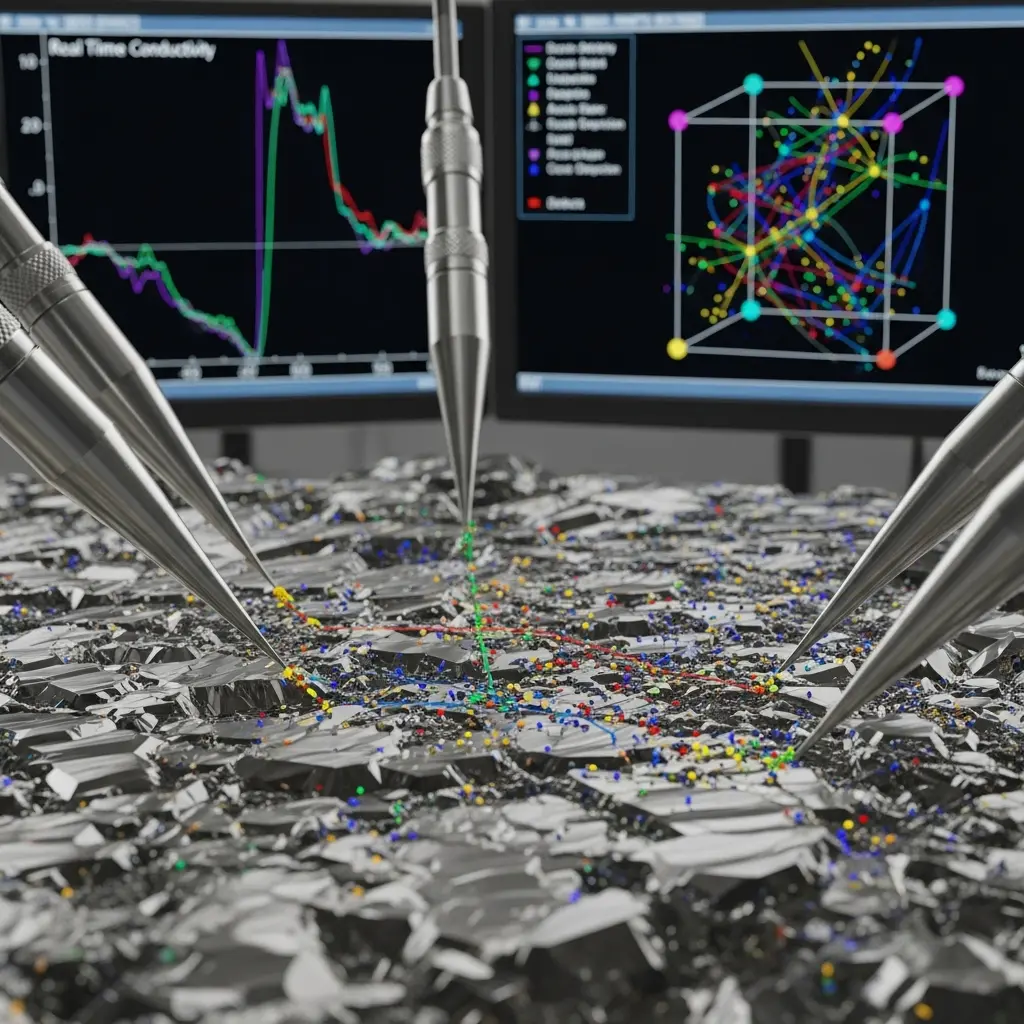
Ramp reversal memory, a promising mechanism for next-generation non-volatile data storage, arises from repeatable resistance changes in certain materials when subjected to temperature cycles, and researchers are actively seeking to understand and improve this effect. Y. Sun, M. Alzate Banguero from ESPCI Paris and the University of California-San Diego’s Ivan K. Schuller, along with colleagues, investigate how interactions between different material phases and the movement of defects within the material influence this memory effect. The team extends existing models by incorporating the behaviour of interacting metallic and insulating regions, accurately simulating the observed hysteresis and predicting a strong link between domain interactions and memory performance. Their simulations reveal that stronger interactions between neighbouring regions enhance the memory effect, offering a clear pathway to optimise materials for improved data storage, and suggest that this phenomenon is likely to be widespread in materials exhibiting similar phase separation.
Current-Driven Domain Wall Dynamics in Nanowires
Researchers investigate the movement of magnetic domain walls within patterned nanowires, focusing on how applied electrical currents influence their behaviour. The team aims to understand how these domain walls move and reverse their magnetization under varying current conditions, which is crucial for developing advanced magnetic storage and logic devices. The method involves fabricating nanowires with precisely defined geometries and then applying short current pulses while monitoring the magnetization state using magneto-optical techniques. The team demonstrates that the speed of domain wall movement depends non-linearly on the applied current, exhibiting a distinct threshold and slowing down at high current densities. Furthermore, the nanowire geometry significantly influences domain wall dynamics, with narrower wires switching more rapidly and requiring less current. These findings contribute to a more complete understanding of spin-transfer torque effects and provide valuable insights for designing efficient and reliable magnetic nanodevices.
Correlated Random Field Modelling of Ramp Reversal Memory
Scientists have developed a sophisticated model using Correlated Random Fields to understand Ramp Reversal Memory (RRM) observed in vanadium dioxide, a material that changes between a metallic and insulating state depending on temperature. This model simulates the spatial distribution of the material’s transition, acknowledging that the location of these transitions are correlated, mirroring the material’s real behaviour. The researchers employ Cholesky decomposition, a mathematical technique, to generate these realistic spatial correlations. The model accounts for limitations in experimental measurements, specifically Gaussian blurring, which averages out values and affects observed correlations. The team demonstrates that spatial correlation is essential for understanding RRM and that accounting for Gaussian blurring in optical measurements is crucial for accurate modelling. The model closely matches experimental results, validating the approach and providing insights into the mechanism behind RRM.
Defect Interactions Explain Memory Effect in Vanadium Dioxide
Scientists have developed a model based on interacting defect motion to explain Ramp Reversal Memory (RRM) observed in metal-insulator transition metal oxides, a phenomenon crucial for non-volatile memory devices. This work extends previous research by incorporating interactions between metallic and insulating domains, accurately modelling hysteresis and predicting the relationship between RRM and these domain interactions. Simulations demonstrate that the maximum RRM effect occurs when the temperature reaches a specific point during the warming process, a finding consistent with experimental observations on vanadium dioxide. The team’s model integrates a Correlated Random Field Ising Model with defect diffusion, enabling reproduction of the width of the hysteresis loop and prediction of the maximum RRM effect based on interaction strength. Researchers created theoretical maps of local transition temperature, statistically mirroring experimental data obtained through high-resolution optical microscopy, and eliminated dependence on experimental inputs.
Domain Interactions Maximise Memory Effect
This research significantly advances understanding of Ramp Reversal Memory (RRM) effects observed in metal-insulator transition metal oxides, a phenomenon with potential applications in non-volatile memory devices. Scientists developed a model that combines defect motion with interactions between metallic and insulating domains, successfully reproducing key experimental observations, including the complete hysteresis width and avalanche behaviour not captured by previous approaches. The team discovered that increasing the strength of interactions between neighboring domains directly enhances the maximum RRM effect, providing a clear pathway for optimizing device performance through material design. Notably, the model predicts that the strongest memory effect occurs at a specific point during the warming process, a prediction confirmed by optical measurements on vanadium dioxide. By incorporating both defect dynamics and inter-domain interactions, this work establishes a robust theoretical framework for understanding the underlying mechanisms driving RRM. The minimal assumptions employed by the model suggest that RRM is not limited to specific materials, but rather a widespread phenomenon likely to occur in any material exhibiting local electronic phase separation, potentially extending to cuprate superconductors, graphene, and other complex materials.
🗞 Effects of Interactions and Defect Motion on Ramp Reversal Memory in Locally Phase Separated Materials
🧠 ArXiv: https://arxiv.org/abs/2511.15147