

Calculating how electrons move through nanoscale materials presents a significant challenge for modern physics, hindering the design of next-generation electronic devices. Zili Tang, Xiaoxin Xie, and Guanwen Yao, along with colleagues at their institutions, now demonstrate a powerful new approach using deep learning to accelerate these complex simulations. Their work introduces DeepQT, a framework that combines graph neural networks and transformer architectures to predict electronic structure and transport properties with unprecedented efficiency. By learning the fundamental principles governing electron behaviour, DeepQT accurately simulates electron flow in materials, even extrapolating from small systems to much larger ones, and achieves a dramatic reduction in computational cost while maintaining first-principles accuracy. This scalable and transferable framework represents a major advance in AI-assisted quantum transport, offering a transformative tool for the future of nanoelectronics.
Deep Learning Predicts Quantum Material Transport
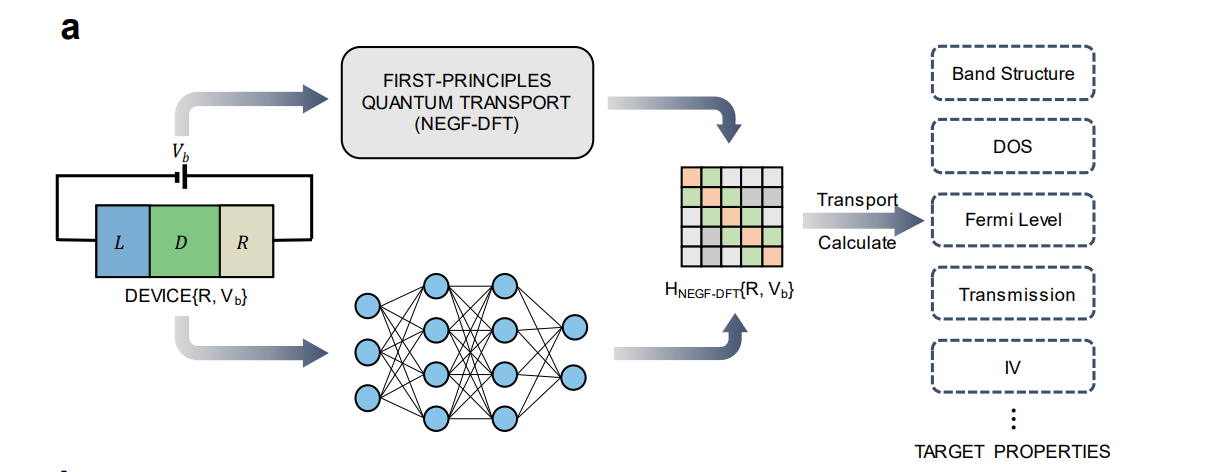
Scientists have developed DeepQT, a new deep-learning framework that dramatically accelerates the prediction of quantum transport properties in materials, a critical step in designing nanoscale electronic devices. Traditional methods, like Non-Equilibrium Green’s Function combined with Density Functional Theory, demand significant computational resources, especially when modeling complex systems with defects or doping. DeepQT overcomes this limitation by learning the relationship between a material’s structure and its transport behavior, bypassing computationally intensive calculations. The framework operates in two stages, first predicting the equilibrium Hamiltonian, which describes the electronic structure at zero bias, and then predicting the correction to this Hamiltonian when a bias voltage is applied.
These predicted Hamiltonians are then used with a separate tool to calculate key transport properties. Demonstrations on complex systems, including graphene with defects and nanoporous graphene nanoribbons, show that DeepQT achieves high accuracy while significantly reducing computation time. DeepQT takes as input the atomic structure of a material, representing each atom and its bonds as numerical data. This data is processed into representations that the deep-learning model can understand, capturing information about individual atoms, the bonds between them, and their spatial orientation. The model then uses these representations to learn the relationship between structure and electronic behavior, accurately predicting the equilibrium Hamiltonian.
A subsequent stage predicts how the Hamiltonian changes under an applied bias, enabling efficient calculation of transport properties. The framework’s versatility has been demonstrated on a range of materials and devices, including graphene with defects, nanoporous graphene nanoribbons, and silicon Esaki diodes. In each case, DeepQT accurately predicts the material’s electronic structure and transport characteristics. This speed and scalability allow researchers to explore a much larger design space, potentially leading to the discovery of new materials and devices with improved performance.
Deep Learning Accelerates Quantum Transport Simulations
Researchers have created DeepQT, a novel deep-learning framework that dramatically accelerates first-principles quantum transport simulations. Recognizing the computational limitations of traditional methods, the team engineered a system that learns key intermediate quantities, rather than directly predicting final physical properties. This approach bypasses computationally intensive steps, enabling faster and more efficient simulations of nanoscale materials. DeepQT predicts both the equilibrium Hamiltonian and the non-equilibrium total potential difference, essential components for reconstructing the full Hamiltonian under various conditions.
By decomposing the Hamiltonian into these components, the framework allows for a modular approach to prediction. The team leverages the principle of electronic nearsightedness, enabling DeepQT to learn from smaller training systems and accurately predict the behavior of much larger ones. The framework integrates graph neural networks with transformer architectures, creating a powerful system capable of capturing the complex relationships within quantum mechanical systems without manual feature engineering. Benchmarks on graphene, molybdenum disulfide, and silicon diodes, incorporating varied defects and dopants, demonstrate that DeepQT achieves first-principles accuracy while reducing computational cost by orders of magnitude.
This advancement offers a significant step forward for the design of next-generation nanoelectronic devices. By accurately predicting the Hamiltonian correction, specifically the total potential difference, DeepQT enables efficient computation of transport properties. This scalable and transferable framework reduces computational cost dramatically, offering a powerful tool for analyzing and designing advanced nanoelectronic devices. The ability to accurately predict Hamiltonian blocks from local atomic structures, guided by the principle of electronic nearsightedness, is a key achievement, enabling generalization to large-scale systems.
Deep Learning Accelerates Nanoscale Transport Simulations
This research introduces DeepQT, a groundbreaking deep-learning framework that significantly accelerates simulations of nanoscale electronic transport, a crucial capability for designing next-generation electronic devices. By integrating graph neural networks with transformer architectures, DeepQT accurately predicts both the electronic structure and transport properties of materials without requiring extensive manual feature engineering. DeepQT overcomes limitations of existing AI approaches by achieving atomic resolution, generalizing effectively to larger systems, and predicting multiple properties simultaneously. The framework learns key intermediate quantities, the equilibrium Hamiltonian and the non-equilibrium total potential difference, to reconstruct Hamiltonians under various conditions, achieving first-principles accuracy while dramatically reducing computational cost.
The team demonstrates that DeepQT accurately simulates the behaviour of materials including graphene, molybdenum disulfide, and silicon diodes, even with complex defects and doping configurations. This advance is based on the principle of electronic nearsightedness, allowing the model to learn from smaller systems and reliably apply that knowledge to much larger, more complex ones. Future work will focus on expanding the training dataset to encompass a wider range of materials and device configurations, further enhancing the model’s generalizability and robustness. This research provides a powerful and scalable tool for accelerating first-principles quantum transport simulations, paving the way for more efficient design and analysis of advanced nanoelectronic devices.
🗞 Deep Learning Accelerated First-Principles Quantum Transport Simulations at Nonequilibrium State
🧠 ArXiv: https://arxiv.org/abs/2510.16878


