Scientists are now able to create a highly focused and controlled beam of excited sulfur atoms, a breakthrough with significant implications for understanding chemical reactions. Alexandra Tsoukala, Saskia Bruil, and Niek Janssen, along with colleagues at the Institute for Molecules and Materials, Radboud University, have developed a method to produce these beams using a sophisticated technique called a multistage Zeeman decelerator. This innovative approach allows researchers to not only manipulate the speed of sulfur atoms, but also to isolate those in a specific excited state, creating a uniquely pure and well-defined beam. The resulting beam’s intensity is sufficient for detailed studies of collisions, paving the way for a deeper understanding of how sulfur atoms interact with other molecules and ultimately, how crucial chemical processes occur.
Researchers demonstrate the manipulation of both excited and ground-state sulfur atoms using a decelerator, achieving temporal separation between these states. This capability generates sulfur atom beams with well-defined velocity, narrow velocity spreads, and enhanced quantum-state purity. The team validated the beam’s suitability for scattering studies with an elastic collision experiment involving sulfur and argon atoms, confirming sufficient beam density for detailed investigations and establishing a foundation for future research into reactive and quenching processes.
Excited Sulfur Beams via Zeeman Deceleration
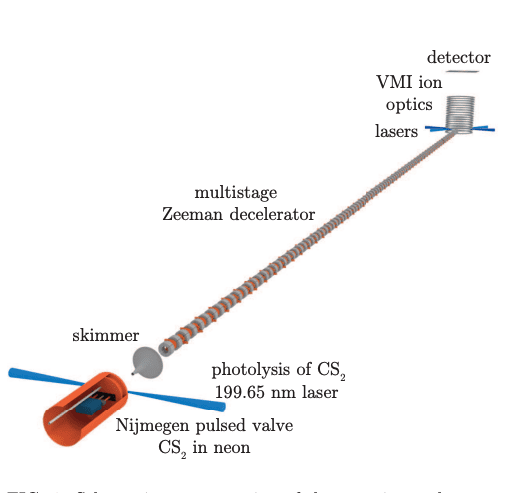
Researchers developed a highly innovative approach to study atomic collisions by creating a precisely controlled beam of excited sulfur atoms. Recognizing the limitations of traditional molecular beam experiments, which suffered from broad velocity distributions and insufficient quantum-state control, the team sought to produce a beam with narrow velocity spreads and defined quantum properties. Their method centers on a multistage Zeeman decelerator, a device previously used with other atomic and molecular species, but adapted here for sulfur atoms, a challenging feat given the atom’s electronic structure. The process begins by generating sulfur atoms through the photolysis of carbon disulfide gas, a common technique in these types of experiments.
This carefully orchestrated magnetic field sequence acts on the magnetic moment of the sulfur atoms, slowing them down and sharpening the velocity distribution. Crucially, the decelerator selectively manipulates different quantum states of sulfur, allowing for the creation of a beam enriched in the desired excited state. A key innovation lies in the ability to temporally separate the excited and ground-state sulfur atoms within the beam. By carefully tuning the deceleration process, the researchers can manipulate the two states independently, effectively creating pulses of either excited or ground-state atoms on demand. This unprecedented level of control opens new avenues for studying specific reaction dynamics. To confirm the effectiveness of their method, the team conducted an elastic collision experiment between the sulfur beam and argon atoms, demonstrating sufficient beam density for detailed scattering studies.
Slowed Sulfur Atoms Enable Precise Studies
Researchers have successfully created a controlled beam of excited sulfur atoms, a significant advancement for studying fundamental chemical processes. These atoms, produced by breaking down carbon disulfide with ultraviolet light, are crucial in a variety of environments, from combustion to atmospheric chemistry and even interstellar space. The team’s innovative approach utilizes a specialized device called a Zeeman decelerator to manipulate the speed and quantum state of these sulfur atoms with unprecedented precision. Traditionally, generating beams of excited sulfur atoms has been challenging, often resulting in broad velocity ranges and limited control over the atom’s quantum properties.
This new method overcomes these limitations by not only creating the atoms but also slowing and refining the beam, resulting in a narrow velocity spread and enhanced purity of the desired excited state. This level of control is vital for detailed studies of how these atoms interact with other molecules, allowing scientists to isolate and analyze specific reaction pathways. The researchers demonstrated the effectiveness of their technique through an experiment involving collisions between the excited sulfur atoms and argon. The clear signals detected in this experiment confirm that the beam’s intensity is sufficient for conducting detailed collision studies, opening the door to investigations of complex chemical reactions. By providing a well-defined beam of excited sulfur atoms, scientists can now investigate fundamental processes like quenching and reactive collisions with greater accuracy and insight.
Excited Sulfur Beam for Scattering Studies
Researchers have successfully created an intense and well-controlled beam of electronically excited sulfur atoms, specifically in the 1D2 state, using a multistage Zeeman decelerator. The method involves generating sulfur atoms through the breakdown of carbon disulfide, and then manipulating both excited and ground-state atoms with the decelerator. Crucially, the team demonstrated the ability to separate these states temporally, allowing for the production of a sulfur atom beam with high purity of the desired excited state. The resulting beam’s density has been confirmed as sufficient for performing detailed scattering experiments, as evidenced by initial elastic collision studies with argon atoms.
This represents a significant step towards investigating fundamental chemical processes involving excited sulfur atoms, such as reactive scattering with hydrogen and quenching processes. The experimental setup provides precise control over collision energies, enabling exploration of these processes under well-defined conditions. Future research will focus on these more challenging, yet fundamentally important, reactions. The team anticipates that this new capability will provide valuable insights into the dynamics of chemical reactions involving excited state species.
👉 More information
🗞 An intense and controlled beam of S(1D2) atoms
🧠 ArXiv: https://arxiv.org/abs/2508.02302