
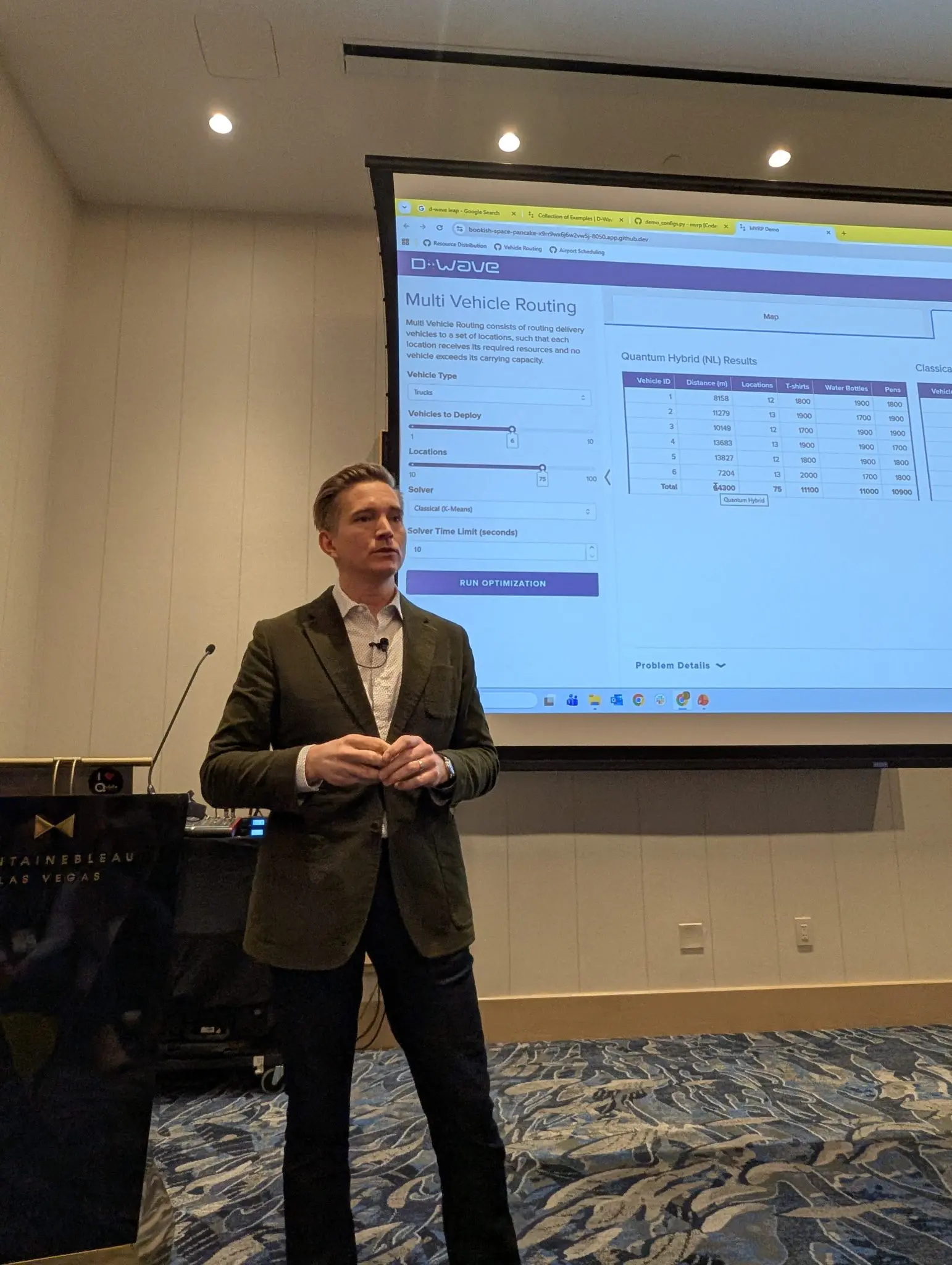
Inside the Fontainebleau Las Vegas, one of CES 2026’s premier venue spaces, attendees packed into every available seat while latecomers lined the walls three deep. Standing room only had given way to standing room barely. The subject drawing such intense interest was not the latest smartphone or autonomous vehicle but something far more fundamental: a live demonstration of quantum computing solving real business problems in real time. Murray Thom, Vice President of Quantum Technology Evangelism at D-Wave Systems, faced this capacity crowd of executives, engineers and technologists. The appetite for practical quantum applications was unmistakable.
The Annealing Approach
Thom opened by polling his audience. Who wanted to hear about practical applications of quantum computing today? Nearly every hand rose. Artificial intelligence intersections? Strong response. Blockchain applications? Solid interest. And who wanted to see a live demonstration on an actual quantum computer? The room responded unanimously. This was not an audience of theorists content with roadmaps and projections. These were practitioners demanding evidence.
D-Wave has spent over two decades developing quantum annealing, a fundamentally different approach from the gate model systems pursued by IBM, Google and most of the quantum computing industry. The distinction matters considerably, and Thom took time to explain it clearly.
Gate model quantum computers draw inspiration from classical computing architecture. They use quantum bits as enhanced memory registers manipulated by quantum logic gates, passing information through calculations in a manner analogous to traditional processors. In this paradigm, quantum mechanics serves primarily as a resource for storing more information. This approach excels at quantum chemistry and molecular simulation, problems where representing quantum states directly provides advantage.
Quantum annealing operates on entirely different principles. Rather than stepping methodically through solutions as classical computers must, quantum annealers exploit quantum mechanical effects to explore vast solution spaces simultaneously. The technique emerged in 1998 from researchers with materials science and optimisation backgrounds who recognised a different way to harness quantum effects.
Thom illustrated the difference with a practical example. Consider scheduling grocery delivery drivers. A classical approach might start with a random schedule, evaluate its quality, then iteratively move to better schedules by checking each modification. This stepping process has a fundamental speed limit determined by classical physics.
Quantum annealing takes a radically different approach. The quantum machine explores every possible solution simultaneously, potentially more solutions than particles exist in the observable universe, and rapidly sheds frustrated states to relax toward high quality answers. The speed limit for these state transitions is set by quantum mechanics rather than classical physics, and quantum mechanics permits faster movement between solutions.
The company’s Advantage2 system, made generally available in May 2025, represents D-Wave’s sixth generation quantum computer. The hardware features 4,400 superconducting qubits arranged in the Zephyr topology with 20 way connectivity, meaning each qubit couples to twenty others. D-Wave reports a 40 percent increase in energy scale compared to its predecessor, which translates to greater separation between high quality and low quality solutions, driving results closer to optimal. Noise has been reduced by 75 percent, improving precision. Coherence time, the duration quantum states remain stable, has doubled, enabling faster time to solution.
The processor itself is roughly the size of a thumbnail, fabricated with precisely patterned layers of metals and dielectrics on silicon. This chip sits at the bottom of a cryogenic refrigerator, cooled to temperatures colder than interstellar space. The refrigerator occupies a space approximately ten feet cubed, with special shielding protecting against electromagnetic interference. Despite the exotic physics involved, the entire system consumes just 12.5 kilowatts of electricity, the same power footprint D-Wave has maintained across all six generations of its quantum computers.
Thom addressed why D-Wave chose superconducting technology over alternatives. Multiple quantum systems can serve as the basis for quantum computers, but superconducting circuits operate approximately one thousand times faster than other architectures of equivalent scale. When D-Wave’s founders surveyed the field in the late 1990s, they concluded superconductivity would lead the industry. The same conclusion has since been reached by several other major players in quantum computing.
Critics have questioned whether quantum annealing can address the broad range of problems that gate model systems target, noting that the approach is optimised for specific problem types rather than general purpose computation. This debate continues within the scientific community, with some researchers arguing that advances in classical algorithms may eventually match annealing performance on many optimisation tasks. D-Wave’s response has been to focus on demonstrable commercial value in production deployments rather than theoretical benchmarks.
The Classical Computing Ceiling
Before demonstrating quantum capabilities, Thom established why classical computing struggles with optimisation problems. A 2025 survey conducted by Wakefield Research found that 81 percent of executives surveyed believed they had exhausted classical computing’s capabilities for optimisation tasks. This finding surprised many attendees, given the continued exponential growth in classical processing power.
The explanation lies in the fundamental nature of optimisation problems. The standard response to computational challenges is parallelisation: deploy more processors, distribute the workload. This approach works brilliantly for many problem types. NVIDIA has built an empire making multiple copies of problems and solving them thousands of different ways simultaneously.
Optimisation problems do not parallelise effectively. The interdependencies between decisions mean that distributing computation across more processors yields diminishing returns. A company might scale from one machine to ten to one hundred to one thousand, seeing consistent improvement, but the gains flatten. Many organisations never notice this ceiling because they never attempted massive parallelisation for optimisation workloads.
The typical organisational response to hitting this ceiling involves creating policies and constraints. Groups are prevented from sharing information or affecting each other’s operations. Problems are artificially decomposed into smaller, independent subproblems. These workarounds lock organisations into suboptimal solutions, sacrificing quality for computational tractability.
Thom used energy grids to illustrate when quantum computing provides decisive advantage. Traditional centralised grids radiated power from single plants down transmission lines. As consumers used more energy, operators ramped up production. The power sent down the western grid did not affect power needed for the eastern grid. Decisions were continuous, involving turning dials rather than throwing switches, and independent, with each choice unaffected by others. Classical computing handles such problems efficiently.
Modern distributed grids look entirely different. Solar panels on rooftops, electric vehicles with large battery banks, bidirectional power flows where nodes sometimes push power and sometimes pull it. Each decision is discrete, either pushing or pulling, not some intermediate state. Each decision affects optimal choices elsewhere in the network. This transformation from continuous independent variables to discrete interdependent ones marks the frontier where quantum computing delivers decisive advantages.
The Energy Efficiency Revelation
The World Economic Forum has estimated that certain artificial intelligence data centres now consume more electricity than entire nations. Projections suggest this consumption will double between 2024 and 2027. AI workloads are becoming a progressively larger proportion of global electricity production, a trajectory that raises serious sustainability concerns.
Against this backdrop, Thom presented what he described as the most significant result in quantum computing over the past twelve months. D-Wave conducted a two year collaborative study with eleven research organisations worldwide, which provided over 100,000 hours of computing time. The study directly compared supercomputer performance against D-Wave’s quantum systems on mathematical problems related to magnetic material simulation.
The findings were extraordinary. At the largest problem sizes, completing the calculations on the supercomputer would have required electricity equivalent to global annual consumption. D-Wave’s quantum computer achieved the same results using less than one dollar of electricity. This was not the maximum problem size D-Wave’s systems can handle; larger scale problems remain tractable for their technology.
The implications extend beyond materials science. D-Wave has demonstrated that blockchain proof of work calculations, when transferred to quantum systems, could reduce energy consumption by approximately three orders of magnitude. For artificial intelligence applications, researchers at NVIDIA have published findings suggesting that discrete latent variables, precisely the computational elements quantum annealers handle natively, could substantially reduce training times for large language models.
Thom drew a biological parallel. Human brains perform extraordinary pattern recognition while consuming approximately twenty watts of power. The neural architecture responsible relies on discrete binary elements: neurons either fire or remain quiescent, connected in networks of excitatory and inhibitory relationships. Pattern recognition emerges not from single neurons but from combinations. A system of 256 binary elements can represent two to the power of 256 distinct patterns, approaching the estimated count of particles in the observable universe. Quantum computers operate on similar principles of discrete, interconnected binary states, making them natural candidates for dramatically more efficient pattern recognition than current classical approaches permit.
D-Wave’s vision for quantum machine learning does not involve fitting entire AI workflows into quantum computers. Instead, quantum processors would be inserted into state of the art algorithms at precisely the points where they provide maximum contribution. Classical computers would continue managing input data and learning to encode information into compressed latent spaces. But when combinations of discrete variables need to change, their interconnections managed and optimised, quantum systems would handle those specific calculations with radically improved energy efficiency.
The company is working with organisations including particle accelerators on reducing energy consumption in machine learning approaches. The key advantage is that classical computing approaches to similar problems either produce models that can be trained but generate data slowly, or models that are fast but cannot be trained effectively and require multiple transformations with additional training overhead.
The Live Demonstration
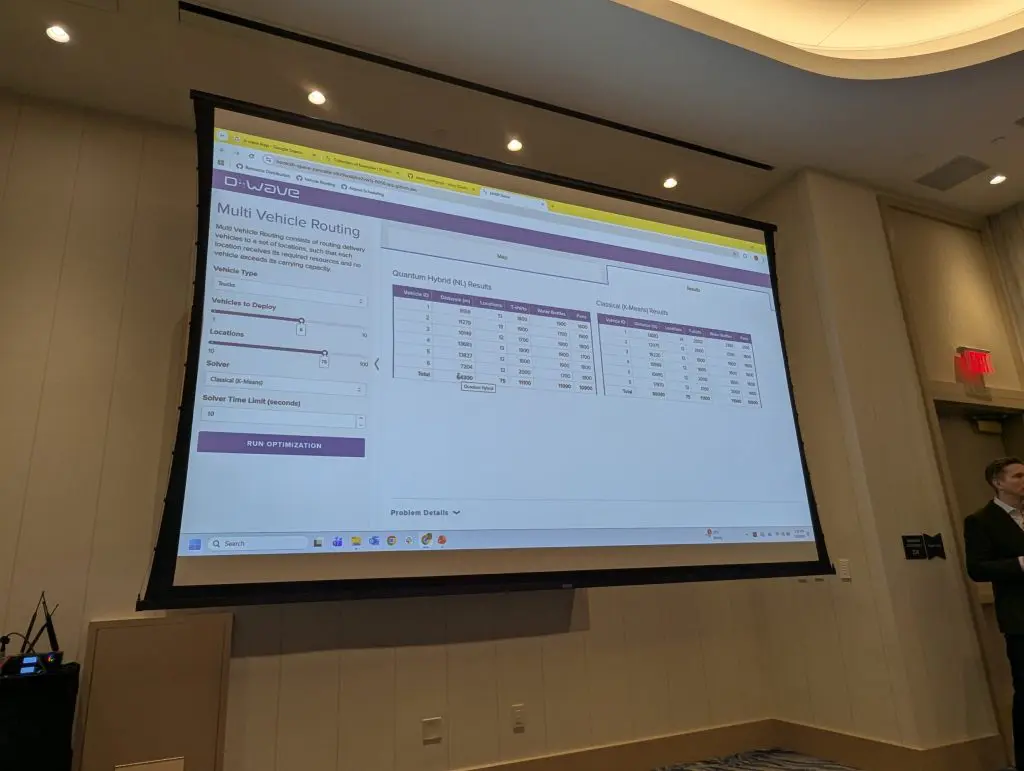
The moment the packed Fontainebleau audience had waited for arrived when Thom prepared his live demonstration. Using software running from his mobile phone, he would execute a direct comparison between classical K means clustering and D-Wave’s quantum solver on a vehicle routing problem.
First, Thom verified connectivity to D-Wave’s quantum cloud infrastructure. A simple test job submitted to either the Los Angeles or Vancouver quantum computer returned results in approximately 675 milliseconds. This was not the hybrid solver he would use for the main demonstration, just confirmation that quantum computers in the cloud deliver real time responses with subsecond latency.
The hybrid solver, which orchestrates classical and quantum resources dynamically based on problem characteristics, introduces additional overhead. Network round trips, classical preprocessing, quantum computation and result integration extend total response time to approximately thirty seconds. But this remains dramatically faster than classical alternatives for problems of equivalent complexity.
Thom launched the demonstration. The classical K means approach began processing the routing problem, its progress visible to the audience. Then the D-Wave hybrid solver tackled the same problem. The contrast was stark. Where classical computation laboured through iterations, the quantum enhanced solution converged rapidly. This was not simulation or pre recorded demonstration. The computation ran in real time, with actual network latency, against actual quantum hardware.
The demonstration illustrated a crucial architectural point. D-Wave does not position quantum computing as a complete replacement for classical systems. Their hybrid solvers use what classical computers do well and what quantum computers do well, throttling the ratio based on problem characteristics. Some problems benefit from heavy quantum involvement. Others require minimal quantum contribution. The hybrid architecture adapts automatically.
The Leap quantum cloud service, through which customers access D-Wave’s systems, offers 99.9 percent availability and uptime with SOC 2 Type 2 compliance for enterprise security requirements. The service operates in over 40 countries. Hybrid solvers support problems with up to two million variables and constraints, enabling large scale business critical applications in production environments.
Enterprise Deployments in Production
Thom moved from demonstration to case studies, presenting customer deployments that have moved beyond pilots into production operations. These examples span manufacturing, retail, telecommunications and pharmaceuticals, illustrating the breadth of optimisation challenges quantum computing can address.
Ford Otosan in Turkey manufactures vehicles on the Ford Transit line. The production challenge involves scheduling vehicles of different sizes, with sliding doors on left or right sides, in various colours. The sequence of manufacturing determines whether the body shop experiences sustained periods of intensive work followed by very low activity, creating inefficiency. The goal is averaging workload across the production line while satisfying all constraints.
Classical methods required approximately thirty minutes to schedule one thousand vehicles, and the results still required manual fine tuning. D-Wave’s hybrid solvers reduced scheduling time to five minutes while producing superior schedules that eliminated the need for further adjustment. The automotive industry faces continuous disruption from tariffs, supply chain challenges and complex manufacturing requirements. Maintaining productivity and efficiency with more agile scheduling provides substantial business value. This application now operates in production, scheduling actual vehicles on actual assembly lines.
Pattison Food Group owns thirteen grocery retail brands in western Canada. Employee scheduling in grocery retail sounds simple but belongs to the most complex mathematical optimisation categories. Multiple departments require staff with different training. Night shift workers cannot work morning shifts the following day. Full time employees need full weeks while part time schedules must accommodate flexibility. Seniority rules, often governed by union agreements, add further constraints.
Traditional approaches required twenty five hours to produce schedules that frequently fell short of optimal. D-Wave achieved equivalent or superior results in two minutes. For at home grocery delivery driver scheduling, which became critical during the pandemic, the company reduced scheduling time by eighty percent. Deployed across their operations, Pattison expects to save their workforce 50,000 hours annually.
The human impact extends beyond time savings. The most senior employees typically handle scheduling, a task few enjoy. Those hours could instead support customers and develop junior staff. When experienced schedulers leave, entire store operations suffer until replacements learn to produce quality schedules. Quantum optimised scheduling provides stability and consistency independent of individual expertise.
NTT Docomo operates telecommunications networks across Japan. Mobile base stations must continuously transmit paging signals to track user locations as they move between coverage areas. This generates substantial network load. Quantum optimised signal routing achieved fifteen percent reduction during peak periods. Deployed across 250,000 base stations nationwide, even modest percentage improvements translate to material capacity gains across the entire network.
BASF tackled a manufacturing challenge involving liquid product filling operations. Scented products followed by unscented products require tank cleaning; the reverse does not. Products have individual deadlines making lateness minimisation critical. Raw materials arrive in tanks that ideally should be emptied by scheduling products using those materials together. These objectives frequently conflict, and optimising one often degrades another.
D-Wave’s approach achieved simultaneous improvements: fourteen percent reduction in lateness, nine percent reduction in setup time and eighteen percent reduction in tank unloading time. Multi dimensional improvement across conflicting objectives demonstrates the power of quantum optimisation for complex manufacturing environments.
Shionogi, following its acquisition of JT Pharma, has begun exploring quantum machine learning for drug candidate identification. Rather than using quantum computers for optimisation followed by separate classical machine learning, they integrated quantum processing directly into the machine learning workflow itself. Early results indicate higher rates of valid drug candidates emerging from the pipeline. This represents a more exploratory application than the production deployments described above, but suggests the direction of near term development.
Thom emphasised that despite the diversity of industries and applications, a common structure unites these problems. Each involves discrete decisions where switches are thrown one way or another, not dials turned to intermediate positions. Amy handles this shift or Bruce does; the schedule does not assign seventeen percent Amy and eighty three percent Bruce. And decisions are interdependent. Each choice affects optimal choices elsewhere. This combination of discrete variables and interdependence defines the problem class where quantum annealing excels.
D-Wave’s customer base includes major enterprises across sectors: one of the world’s largest airlines, one of the world’s largest payment processing companies, one of the world’s leading mobile carriers and one of the world’s largest chemical companies. The technology addresses a form of problem that exists across virtually all businesses, not a single niche application.
The Gate Model Expansion
Days before CES, D-Wave announced its most significant strategic development: the $550 million acquisition of Quantum Circuits Inc., a Yale spinout developing error corrected gate model quantum systems. The deal, comprising $300 million in D-Wave stock and $250 million in cash, is expected to close in late January 2026.
This acquisition expands D-Wave’s capabilities to address applications beyond optimisation. Gate model quantum computers excel at quantum chemistry, molecular simulation and other problems where representing quantum states directly provides advantage. By combining annealing and gate model technologies, D-Wave aims to address the full spectrum of quantum computing applications.
QCI brings dual rail qubit technology with built in error detection, which D-Wave states will enable an order of magnitude fewer physical qubits per logical qubit compared to competing approaches. The technology encodes information across two physical components for greater accuracy, a fundamentally different approach to error correction.
Dr Rob Schoelkopf, QCI’s chief scientist and co founder, will join D-Wave along with QCI’s team of superconducting quantum computing experts. Schoelkopf, a Yale professor who invented both transmon and dual rail qubit technologies, will lead a new research and development centre in New Haven, Connecticut. His nearly three decades of breakthroughs form some of the foundations for superconducting gate model technology across the industry.
D-Wave plans to make an initial dual rail gate model system generally available in 2026. Full details of the updated product roadmap and accelerated path to error corrected gate model quantum computing will be presented at the Qubits 2026 conference on January 27 in Florida.
The company’s published roadmap for annealing systems projects an Advantage2 Performance Update processor in 2026 supporting novel annealing protocols including cyclic annealing, which provides extended user control over the annealing process. Advantage3, based on an entirely new design with analogue digital quantum computing capabilities, is targeted for 2028. This system will allow users to excite specific qubits in situ and move them with SWAP gates, along with readout of qubit states on arbitrary bases. An Advantage3 Performance Update follows in 2030.
Longer term, D-Wave envisions scaling to over 100,000 qubits through increased connectivity and coherence, advances in cryoCMOS controls for next generation digital addressing, multi chip configurations and larger scale cryogenic enclosures.
For gate model development, Thom acknowledged during his CES presentation that commercial scale molecular simulation and quantum chemistry applications remain six to fourteen years away. Revolutionary applications like fluid flow simulation over automotive bodies sit at that horizon. The QCI acquisition is intended to accelerate this timeline, positioning D-Wave to deliver gate model products and services beginning in 2026, though the initial systems will not yet achieve fault tolerant error correction at scale.
D-Wave’s fiscal year 2024 bookings exceeded $23 million, up approximately 120 percent over fiscal year 2023. More than 20.6 million customer problems have run on Advantage2 prototypes since June 2022, with usage up 134 percent in recent months.
Cryptography and Security
Thom addressed audience questions regarding quantum computing and cryptography with notable candour. Shor’s algorithm, which theoretically enables quantum computers to break current encryption standards, receives substantial attention in quantum computing coverage. The algorithm would allow factoring large numbers in polynomial time, undermining the mathematical difficulty that secures bank transactions and internet communications.
Thom expressed personal scepticism that quantum computers will ever be used for cryptographic attacks. The reasoning is commercial rather than technical. Building a quantum computer optimised for factoring large numbers would require entirely different design tradeoffs than systems optimised for customer problems. Quantum annealers like D-Wave’s are architected for optimisation, not the gate operations required for Shor’s algorithm.
More fundamentally, the customer base for encryption breaking is effectively singular. The machine would require massive investment with only one potential buyer. And quantum computers can create the cryptographic problem but cannot provide the solution. New post quantum encryption protocols cannot be designed using quantum computers, eliminating any business model beyond the initial break.
Nonetheless, D-Wave recommends organisations transition to post quantum encryption protocols for which NIST standards already exist. The concern is not that quantum cryptographic attacks are imminent but that sensitive data encrypted today must remain secure for decades. Healthcare data, for instance, requires privacy protections extending twenty years or more. If an adversary harvests encrypted data today, they could theoretically decrypt it using future quantum systems. This harvest now, decrypt later threat makes current protective measures prudent regardless of when or whether quantum cryptanalysis becomes practical.
Conclusion
The standing room only crowd at the Fontainebleau witnessed production quantum computing deployments delivering measurable business outcomes for real enterprises. Ford’s assembly lines run on schedules produced by quantum systems. Pattison’s grocery stores operate with quantum optimised workforce scheduling. NTT Docomo’s network functions more efficiently because of quantum signal routing. BASF’s manufacturing achieves simultaneous improvements across competing objectives.
The live demonstration cut through theoretical debate. Classical K means clustering laboured visibly on a routing problem while D-Wave’s hybrid solver returned results in a fraction of the time. The audience saw quantum computing work, in real time, on a real problem, with real network latency.
For enterprises confronting optimisation challenges, D-Wave offers a technology that works today rather than promises for tomorrow. The hybrid solvers combining classical and quantum resources provide pragmatic solutions without requiring organisations to wait for fault tolerant gate model systems. Eighty one percent of surveyed executives believe they have exhausted classical computing for optimisation. D-Wave presents an alternative.
The quantum industry has reached an inflection point. After decades of theoretical promise, commercial deployments exist. Companies schedule production lines, optimise telecommunications networks and reduce manufacturing inefficiencies using quantum systems. The remaining questions concern which quantum approaches will prove most valuable across different application domains, and whether the energy efficiency advantages demonstrated in controlled studies will translate consistently to diverse real world workloads.
D-Wave is pursuing both annealing and gate model quantum computing, delivering commercial value from optimisation today while building toward molecular simulation and quantum chemistry applications for tomorrow. The packed room at the Fontainebleau demonstrated that appetite for practical quantum computing has never been stronger. The coming years will determine whether that appetite translates into sustained commercial adoption across the enterprise landscape.