

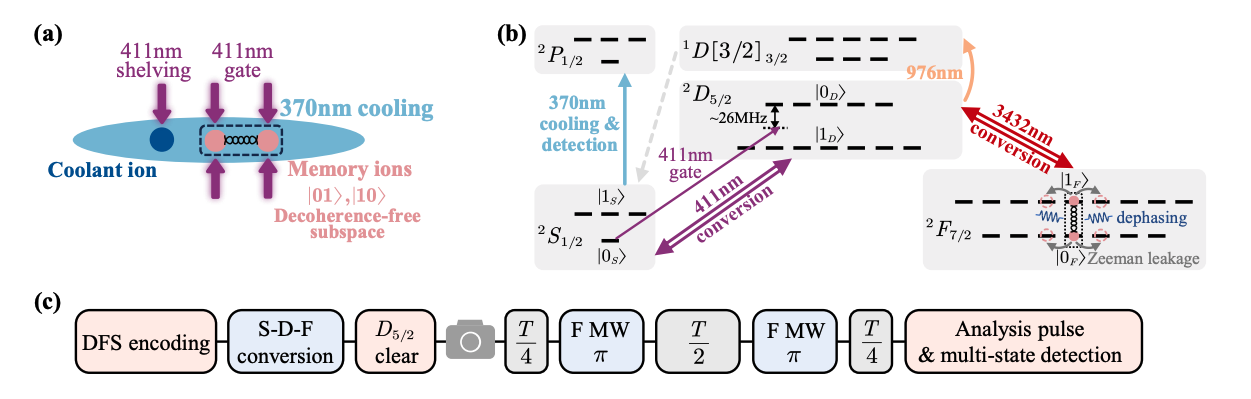
Quantum memories represent a crucial component for advancing quantum technologies, enabling the storage and retrieval of quantum information for computation, networking, and precision measurement. Researchers led by Y.-L. Xu, L. Zhang, and colleagues at Tsinghua University and HYQ Co., Ltd. now demonstrate a significant step forward in this field, achieving stable storage of a quantum bit, or qubit, for over two hours. This breakthrough utilises a novel multi-ion memory based on a ‘dual-type’ scheme within a cryogenic trap, effectively extending coherence times beyond previously established limits for multi-qubit storage. The team’s approach alleviates the need for exceptionally stable frequency references and offers promising scalability, paving the way for more complex and robust quantum systems by employing ions with matching masses for both memory and cooling functions.
Scaling Quantum Memory Beyond Single Qubits
Quantum memory is crucial for advancing quantum technologies, including computers, secure communication, and precise sensors. These technologies rely on qubits, the quantum equivalent of classical bits, but qubits are fragile and lose their quantum properties through a process called decoherence, limiting information storage duration. While single qubits have achieved coherence times around an hour, scaling up to larger amounts of quantum information presents significant challenges. Current approaches often isolate single ions and manipulate their quantum states, but maintaining this isolation is difficult, as collisions with background gas disrupt stored information.
Precisely controlling multiple qubits simultaneously also demands an extremely stable frequency reference for control signals, and mass differences between memory and coolant ions can reduce efficiency as qubit numbers increase. Researchers have now demonstrated a multi-ion quantum memory with a coherence time exceeding two hours. This breakthrough utilizes a cryogenic ion trap, cooled to extremely low temperatures, to minimize ion movement and maintain stable positions. The team employs a dual-type qubit scheme, mapping information onto different energy levels within the same ion species, eliminating mass discrepancies.
By encoding information within a ‘decoherence-free subspace’, the system becomes resilient to external noise and fluctuations. This innovative approach simplifies the control of multiple qubits and alleviates the need for an exceptionally stable frequency reference. The combination of cryogenic cooling, a dual-type qubit scheme, and decoherence-free encoding represents a significant step towards building practical, scalable quantum memories capable of storing quantum information for extended periods, paving the way for more powerful and reliable quantum technologies.
Quantum State Lifetimes and Fidelity Measurements
The team determined characteristic timescales for storing quantum information by fitting exponential decay functions to the data, revealing values relating to the storage of both two-qubit product states and entangled states. These measurements provide insight into how long quantum information can be reliably held within the device. Fidelity measurements for the quantum states were performed directly, using population measurements and coherence information to assess the accuracy of the stored information. Microwave pulses were applied to the memory qubits, allowing the team to measure probability distributions and extract relevant data, crucial for evaluating the quality of the quantum memory.
The device’s logical qubit exhibits a significantly longer coherence time than both a physical qubit and a non-decoherence-free logical state, attributed to the specific encoding scheme used, which makes the system less susceptible to noise. This finding highlights the effectiveness of the chosen approach for preserving quantum information. The research demonstrates that leakage and dephasing errors contribute to the decay of the stored quantum state. By carefully analyzing these errors, the team can identify and mitigate factors that limit the coherence time, essential for improving the quantum memory’s performance. Results show that the leakage rate increases with temperature, coinciding with an increased collision rate between ions and background gas molecules. This suggests that collisions contribute to the error, and maintaining a high vacuum minimizes these collisions and improves coherence time.
Logical State Fidelity Achieved Without Decoding
The research presents data for leakage and dephasing errors, demonstrating that exponential fitting accurately models the leakage-discarded data. Two-qubit measurement probability distributions for the stored logical states are presented after a storage time of one second, and for states with additional rotations applied. State fidelities are calculated from these populations after discarding leakage events. Critically, the extended storage lifetime is achieved by distinguishing leakage errors, leading to heralded successful storage with a higher fidelity. This ability to identify and discard erroneous states is a key innovation, allowing for more reliable quantum information storage.
A multi-state detection is performed to distinguish the different energy levels within the ions, enabling high-fidelity population transfer. Overall, a detection fidelity above 99% is obtained for one state, while the fidelity for another is slightly lower, essential for measuring the storage lifetime. Four representative logical states are prepared, and their fidelity is measured versus different storage times. Without post-selection, the raw fidelities decay exponentially, dominated by leakage error. Once leakage events are discarded, the corrected state fidelities increase, demonstrating the effectiveness of the error mitigation strategy.
Yb+ Ions Enable Long Coherence Times
This research focuses on long-lived quantum memories using Yb+ (Ytterbium ions) as qubits, aiming to create a robust and scalable quantum computing platform by maximizing qubit coherence times and minimizing errors. A significant emphasis is placed on utilizing specific energy levels within Yb+ to achieve this. Key themes and techniques include utilizing Yb+ as a qubit platform, utilizing specific hyperfine and Zeeman sublevels within the Yb+ ion, and mitigating decoherence mechanisms such as magnetic field noise and collisions with background gas. The research also explores quantum error correction codes and techniques for controlling and entangling multiple ions.
Potential contributions include the demonstration of long coherence times, novel qubit encoding schemes, improved control techniques, a scalable quantum architecture, and error mitigation strategies. The research likely contributes to the development of high-fidelity entanglement and practical, scalable quantum computers. In summary, this is a highly specialized and advanced research project pushing the boundaries of trapped-ion quantum computing. The focus on long-lived qubits and error mitigation suggests a strong emphasis on building practical and scalable quantum computers.
🗞 Long-time storage of a decoherence-free subspace logical qubit in a dual-type quantum memory
🧠 DOI: https://doi.org/10.48550/arXiv.2507.13320


