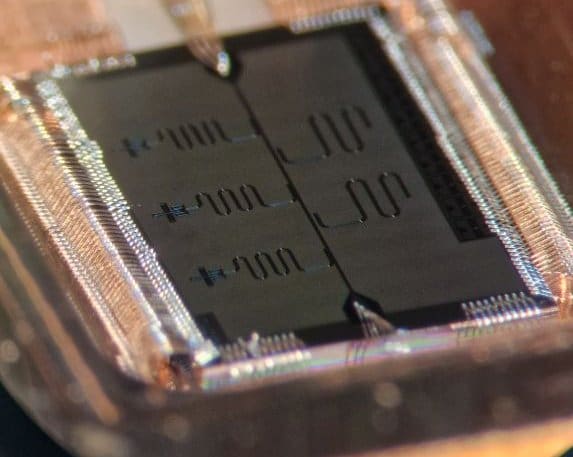
ConScience AB today announced the release of the QiB2, a superconducting qubit platform engineered to accelerate research and education in quantum hardware. Housed within the new Box20 packaging and developed at the company’s facilities in Gothenburg, Sweden, the QiB2 integrates bare coplanar resonators, single and tunable transmon qubits, and coupled-qubit configurations—including fixed-to-tunable and tunable-to-tunable pairings—within a single, deployable device. This comprehensive system enables researchers to benchmark cryogenic setups, validate control software, and directly compare the performance of diverse two-qubit gate families, ultimately streamlining the development of superconducting quantum systems.
QiB2 Platform: Exploring Superconducting Qubit Architectures
The QiB2 platform, recently launched by ConScience AB, offers a versatile superconducting qubit “playground” designed to accelerate quantum hardware research. Housed within a compact Box20 package, the device systematically explores qubit coupling – starting with bare coplanar resonators and single transmon qubits, progressing to multi-qubit interactions. Researchers can investigate fixed- and tunable-frequency qubits, alongside fixed and tunable couplers, enabling experimentation across diverse gate families – crucial for benchmarking performance and noise sensitivity.
This platform’s value lies in its comprehensive, integrated approach. The QiB2 isn’t just about achieving qubit coupling, but understanding it. Configurations include pairs of tunable qubits linked by fixed couplers, or fixed-frequency qubits with tunable links. This allows for direct, side-by-side comparisons of different gate implementations and control strategies, revealing subtle differences in fidelity and robustness—data essential for optimizing quantum circuit design.
Beyond core qubit functionality, the QiB2 serves as a powerful diagnostic tool. Its various configurations react differently to environmental noise and imperfections in cryogenic setups. This makes it ideal for validating microwave wiring, shielding, filtering, and control software—critical components often overlooked. Ultimately, the QiB2 streamlines both quantum research and the establishment of new quantum labs, offering a robust foundation for experimentation and education.
Key Components: Single and Multi-Qubit Configurations
The QiB2 platform from ConScience AB offers a versatile toolkit for superconducting quantum research, beginning with fundamental single-qubit components. Researchers can start with bare coplanar-waveguide resonators – essential building blocks – and progress to transmon qubits. These qubits are available in fixed-frequency or tunable configurations, with options for dedicated drive and flux lines for precise control. This modular approach allows for detailed characterization of individual qubit performance before scaling to more complex multi-qubit systems – a critical step in building practical quantum processors.
Moving beyond single qubits, the QiB2 provides two distinct coupled-qubit configurations. One pairs tunable qubits connected by a fixed coupler, while the other links fixed-frequency qubits with a tunable coupler. This design choice is deliberate; it enables direct comparison of different two-qubit gate families – like on-resonance and parametric gates – allowing researchers to assess performance, control fidelity, and noise sensitivity side-by-side within the same hardware.
The QiB2 isn’t just about qubit types; it’s a powerful benchmarking tool. Varied configurations respond uniquely to environmental noise and imperfections in cryogenic setups (wiring, shielding, filtering). This allows for systematic testing and optimization of the entire quantum system, not just the qubits themselves. This holistic approach is vital for improving the reliability and scalability of superconducting quantum computing, facilitating both academic research and industrial development.
QiB2 as a Benchmarking and Learning Resource
The QiB2 platform, recently launched by ConScience AB, is designed as a versatile benchmarking and learning resource for superconducting qubit research. Housed within a compact Box20 package, it integrates multiple qubit configurations—from single-qubit resonators to coupled-qubit systems—onto a single chip. Researchers can systematically explore architectures, progressing from basic resonator studies through tunable and fixed-frequency transmon qubits, and ultimately to paired-qubit interactions. This systematic approach enables direct performance comparisons and accelerates hardware development.
A key advantage of the QiB2 is its ability to validate and benchmark entire cryogenic setups. The platform features diverse qubit couplings – fixed-to-fixed, tunable-to-tunable, and mixed – allowing users to rigorously test microwave wiring, shielding, and filtering effectiveness. Different configurations exhibit varying sensitivities to noise and imperfections, providing a clear diagnostic tool for identifying and resolving systemic issues. This is crucial for building reliable and high-fidelity quantum systems.
Beyond research, the QiB2 serves as an exceptional educational tool. Its modular design allows students and researchers to progressively learn superconducting quantum circuit principles. By experimenting with different qubit types and coupling schemes—including on-resonance and parametric gates—users gain hands-on experience with the fundamental building blocks of quantum computation. This practical experience is invaluable for accelerating workforce development in the quantum technology sector.