Area-selective atomic layer deposition is a crucial technique in modern semiconductor manufacturing, yet predicting inhibitor behaviour on disordered surfaces presents a significant challenge. Gijin Kim, Purun-hanul Kim, and colleagues from Seoul National University and the Samsung Advanced Institute of Technology address this problem by computationally investigating how inhibitors interact with amorphous and crystalline silicon-based materials. Their work demonstrates that inhibitors exhibit enhanced reactivity towards specific sites on amorphous surfaces compared to their crystalline counterparts, revealing a key difference in surface chemistry. The team identified multiple reaction pathways, and importantly, developed a computational screening approach that accurately predicts inhibitor behaviour by considering the specific interactions at different surface sites, paving the way for the rational design of improved materials for this critical manufacturing process.
Amorphous surface models provide more realistic and accurate reactivity predictions, and the amorphous nature of surfaces enhances inhibitor reactivity. A computational study proposes a screening protocol for the rational design of area-selective atomic layer deposition systems, focusing on identifying high-selectivity inhibitors for use on amorphous surfaces to prevent unwanted deposition and enable precise material patterning. This approach offers a pathway towards improved control and efficiency in advanced manufacturing processes.
Inhibitor Chemistry for Area-Selective Deposition
This text provides an overview of research related to atomic layer deposition (ALD), particularly focusing on area-selective ALD and the crucial role of surface chemistry on materials like silicon dioxide (SiO2) and silicon nitride (SiNx). Understanding how surfaces are terminated, meaning the specific chemical groups present, significantly impacts ALD processes. Studies explore how small molecule inhibitors block deposition on certain surfaces, and understanding their behaviour during ALD, including adsorption, reaction, and desorption, is vital. Researchers are developing realistic models of amorphous silica surfaces, accounting for the arrangement of hydroxyl groups and the thermodynamics of surface dehydroxylation, and are also investigating the role of hydrogen and oxygen content in SiNx films, as it affects surface reactivity and film properties.
Hydroxyl groups are key surface termination groups on SiO2 and play a critical role in precursor binding and ALD reactions. Modifying the SiO2 surface with functional groups can enable area-selective ALD by providing specific binding sites for ALD precursors. The degree of hydroxylation on both SiO2 and SiNx surfaces influences the ALD process. Researchers employ first-principles calculations to model surface chemistry, precursor adsorption, and reaction mechanisms, and increasingly use machine learning to analyze complex surface reactions and predict reactivity. Automated high-throughput calculations enable efficient exploration of surface chemistry on amorphous materials. In essence, the research highlights the importance of controlling surface chemistry and termination to achieve precise control over thin film deposition, particularly in the context of area-selective ALD for advanced microelectronic applications, and emphasizes the crucial role of combining experimental studies and computational modelling.
Amorphous Film Inhibition During Atomic Layer Deposition
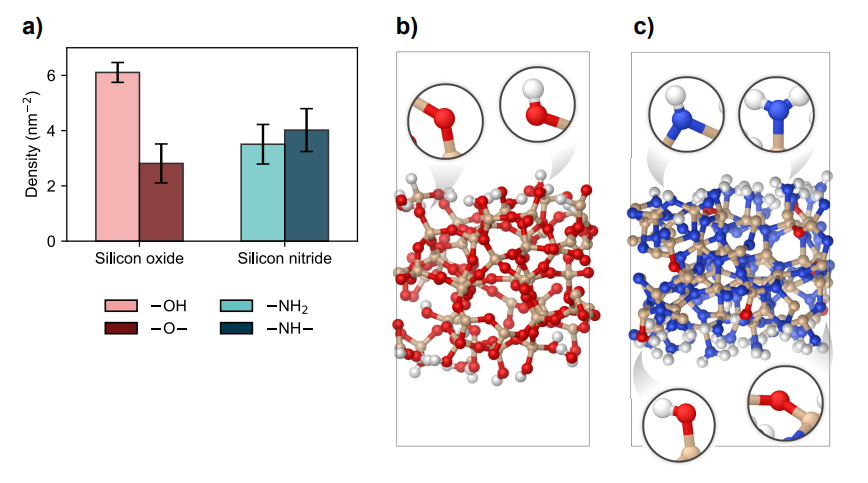
This work details a computational study of area-selective atomic layer deposition (AS-ALD), focusing on understanding inhibitor reactivity on amorphous silicon oxide and silicon nitride surfaces. Researchers developed a modelling protocol to accurately represent these materials, beginning with the creation of amorphous bulk structures using a melt-quench simulation. Crystalline materials were heated and rapidly cooled to eliminate crystalline order, resulting in stable amorphous configurations. To mimic real-world conditions, the team incorporated oxygen into the silicon nitride, acknowledging that these films often contain oxygen during fabrication.
The resulting amorphous slabs were then prepared for surface analysis. Cleavage along specific axes, combined with passivation using functional groups, replicated experimentally determined surface densities. This passivation strategy intentionally included less common chemical groups to promote realistic bridge formation during subsequent annealing. An annealing step allowed for surface rearrangements, converting initial groups into bridging structures and passivating dangling bonds. Surface speciation analysis revealed distinct reactive site distributions: the amorphous silicon oxide surface primarily featured silanol and siloxane groups, while the amorphous silicon nitride surface predominantly contained amine and imide sites, alongside oxygen-containing groups. Vicinal silanol groups on the silicon oxide surface were found at a density aligned with both experimental findings and computational predictions. This detailed modelling approach provides a foundation for understanding inhibitor adsorption and reactivity in AS-ALD processes, enabling the rational design of precursor-inhibitor pairs for advanced semiconductor manufacturing.
Surface Reactivity of Silane Inhibitors Explained
This study investigated the reactivity of two inhibitor molecules on both amorphous and crystalline silicon oxide and silicon nitride surfaces. Researchers employed computational modelling to map reaction pathways and quantify reactivity at various surface sites. The results demonstrate that both inhibitors exhibit greater reactivity towards terminal sites on amorphous surfaces compared to their crystalline counterparts, highlighting the importance of considering surface structure in accurate modelling. Furthermore, the team identified multiple reaction pathways for bridge sites, with bridge-cleavage being the predominant mechanism, except when one inhibitor interacts with nitride surfaces.
Notably, the reactivity of one inhibitor with amine sites was comparable to that with primary amine sites, both yielding volatile products. These findings underscore the critical role of amorphous surface modelling in reliably predicting inhibitor behaviour on realistic semiconductor surfaces. The researchers also outline a computational screening approach that considers site-specific interactions between precursors and inhibitors, offering a pathway for the rational design of area-selective atomic layer deposition precursor-inhibitor pairs.
🗞 A Computational Study for Screening High-Selectivity Inhibitors in Area-Selective Atomic Layer Deposition on Amorphous Surfaces
🧠 ArXiv: https://arxiv.org/abs/2510.17356