Maintaining stable, non-equilibrium states is crucial for both fundamental understanding and practical applications of complex quantum systems, and recent research addresses this challenge with a novel approach to identifying these states. Takanao Ishii and Masahito Ueda, both from the University of Tokyo, alongside Masahito Ueda from the Institute for Physics of Intelligence and RIKEN Center for Emergent Matter Science, demonstrate a general condition for determining when a driven or dissipating quantum system will settle into a stable state where all its constituent parts are independent and identically distributed. The team’s work reveals a set of operators that guarantee this stable, uncorrelated state, and importantly, establishes a principle showing that entanglement and spatial correlations are impossible in a wide range of such systems within a dissipative environment. This discovery not only pinpoints models with readily solvable steady states, but also provides a powerful new tool for predicting and controlling the behaviour of open quantum many-body systems.
Dissipative Phase Transitions and Quantum State Stability
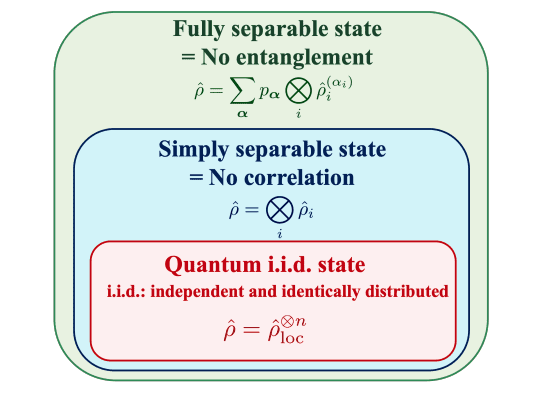
Recent advances allow scientists to precisely control open quantum systems, leading to the experimental realization of phenomena like dissipative quantum phase transitions. Researchers are particularly interested in understanding when a complex quantum system settles into a simple, uncorrelated state, specifically, a quantum independent and identically distributed (i.i.d.) state. Identifying the conditions under which such a state arises is challenging, as it requires determining whether entanglement or spatial correlations are absent in the steady state. This work establishes general conditions and sufficient criteria for determining when an open quantum many-body system will reach a quantum i.i.d.
steady state. The researchers demonstrate that these conditions can also be interpreted as a “no-go theorem,” defining scenarios where entanglement and spatial correlations are fundamentally precluded. The research also identifies a class of open quantum many-body systems for which exact solutions describing the steady state can be obtained. Beyond identifying when i.i.d. states occur, the team investigated the stability of these states over time.
They discovered that certain systems, if initialized in a quantum i.i.d. state, will remain in that form throughout their evolution. This “dynamical stability” is crucial, as it suggests these systems are robust against external disturbances and will consistently exhibit the characteristics of an i.i.d. state.
Identifying Stability Criteria for Quantum Systems
The research centers on understanding how stable, non-equilibrium states emerge in open quantum systems, systems that exchange energy and information with their environment. To address this, the team developed an approach focused on identifying conditions under which a system reaches a steady state where all individual parts are statistically independent and identically distributed, a quantum i.i.d. state. This simplifies analysis considerably. A key innovation lies in the development of criteria to determine when a system will naturally evolve towards such an i.i.d.
steady state. The team demonstrated that if a specific set of operators, related to the system’s Hamiltonian and dissipation, commute with all possible i.i.d. states, then the system is guaranteed to have a stable i.i.d. solution. This provides a powerful tool for predicting and designing systems with predictable, simplified behavior.
They further established that these i.i.d. states form a stable subset of all possible states, meaning the system will remain within this simplified regime if initialized in an i.i.d. state. The methodology involves a detailed analysis of the Gorini-Kossakowski-Sudarshan-Lindblad (GKSL) equation, describing the time evolution of a quantum system interacting with an environment. Importantly, the team also derived a “no-go” theorem, demonstrating that a broad class of steady states in dissipative environments cannot support entanglement or spatial correlations. This result highlights the fundamental trade-off between stability and complexity, suggesting that maintaining a stable, simplified state often requires sacrificing the potential for complex, correlated behavior.
Quantum Stability Through Independent Identical Distribution
Researchers have identified conditions under which complex quantum systems can reach a stable, steady state, even when constantly interacting with their environment. This is crucial because most real-world quantum systems are ‘open’, meaning they exchange energy and information with their surroundings. The team’s work focuses on understanding how to maintain a stable state in these open systems, a fundamental challenge in quantum physics. The research establishes that a key characteristic of these stable states is a property called ‘quantum i.i.d.’, meaning that each part of the system behaves independently and identically to every other part.
This simplifies the overall behavior of the system and makes it easier to predict and control. The team demonstrated that if a system’s governing equations satisfy certain mathematical criteria, this i.i.d. property is guaranteed, leading to a predictable and stable steady state. Importantly, the findings also reveal a ‘no-go’ theorem, demonstrating that these stable, i.i.d. states inherently preclude certain types of complex correlations, specifically entanglement and spatial correlations, within the system.
While entanglement is often seen as a desirable quantum property, this research shows that maintaining a stable steady state in these open systems requires sacrificing these correlations. Furthermore, the researchers proved that if a system starts in one of these stable, i.i.d. states, it will remain in that form over time, regardless of ongoing interactions with the environment. This ‘dynamical stability’ is a powerful result, as it guarantees the robustness of the quantum state and simplifies the analysis of the system’s behavior.
Independent Identically Distributed Quantum Steady States
This research establishes a fundamental understanding of conditions under which open quantum systems reach a stable, steady state where individual parts are independent and identically distributed. The team derived a key condition for determining if a system will exhibit this type of steady state, formulating it in terms of local properties of the system’s Hamiltonian and dissipation. They further identified a set of operators that, when satisfied, guarantee the existence of a quantum i.i.d. steady state, and demonstrated that this condition also implies the absence of spatial correlations and quantum entanglement in the steady state.
The findings demonstrate that many open quantum many-body systems, including those composed of spins and fermions, naturally exhibit these i.i.d. steady states when subject to local dissipation. Importantly, the researchers also proved that if a system initially possesses this i.i.d. form, it will maintain it under specific conditions relating to the interactions between parts and the dissipation processes. This analytical tractability makes these systems valuable models for investigating the principles of nonequilibrium statistical mechanics and exploring the emergence of dissipative quantum phase transitions.
👉 More information
🗞 Quantum i.i.d. Steady States in Open Many-Body Systems
🧠 DOI: https://doi.org/10.48550/arXiv.2507.10319