

The pursuit of new materials often relies on complex computational workflows, yet a significant hurdle remains: the difficulty of seamlessly integrating different software packages. S. K. Steensen, T. S. Thakur, and M. Dillenz, along with colleagues J. M. Carlsson, C. R. C. Rego, and E. Flores, address this challenge by introducing a common standard for input and output data within density functional theory (DFT) calculations. This standard enables different workflow managers to communicate effectively, allowing researchers to run calculations across multiple DFT codes, such as CASTEP, GPAW, and VASP, without manual data conversion. By demonstrating this interoperability with calculations on battery cathode materials, the team not only resolves inconsistencies arising from code-specific behaviours, but also establishes crucial design principles for building robust, automated workflows that accelerate materials discovery and improve the reproducibility of computational results.
This advancement addresses a key challenge in materials science, where variations in computational approaches can hinder accurate assessment of material properties. The research centers around the OPTIMADE API, a powerful tool for accessing, submitting, and analyzing materials science data, and rigorous protocols for performing functional density theory (DFT) calculations. Crucially, the research emphasizes the importance of tracking data provenance, meticulously documenting the origin and history of the data to ensure reproducibility. This holistic approach encompasses all aspects of the workflow, from DFT parameters to data representation and provenance tracking, promoting open science principles by making data and code publicly available. By internally translating data formats, the standard enables engine-agnostic workflow execution and facilitates the analysis of battery cathode materials. The team engineered a unified input/output standard that is both machine- and human-readable, representing a crucial step towards modularity and scalability in complex scientific workflows.
The researchers meticulously analyzed code-specific idiosyncrasies that previously hindered straightforward comparisons, documenting these challenges to inform the development of robust automated workflows. They successfully implemented this workflow across several workflow managers, leveraging the newly developed unified input/output standard to demonstrate cross-code interoperability. This implementation allowed for detailed analysis of open-circuit voltage values across different DFT engines, revealing challenges in ensuring consistent voltage predictions and informing the development of general design guidelines for automated workflow design. This work represents a practical step towards more reproducible and scalable high-throughput materials screening, while highlighting the need for continued efforts to align electronic properties, especially for non-pristine structures.
Universal DFT Workflow Standard Demonstrated for Materials Discovery
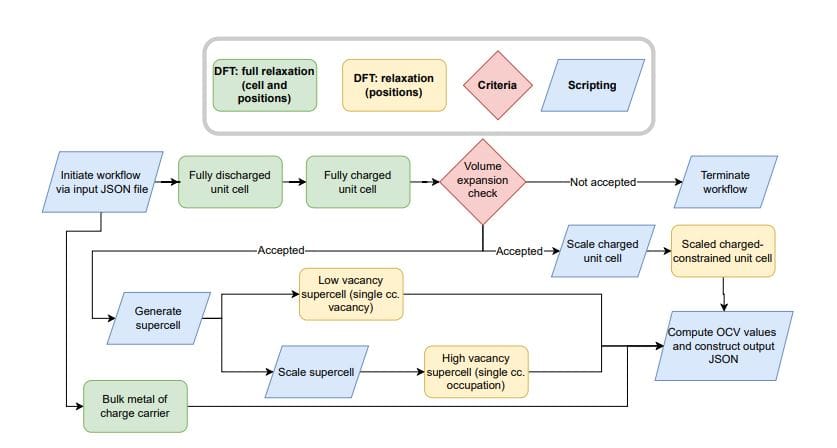
Scientists have created a universal input/output standard to bridge the gap between diverse computational workflow managers and density functional theory (DFT) codes. Researchers implemented this standard within a workflow designed to calculate the open-circuit voltage of several battery cathode materials, demonstrating its practical application. The study meticulously analyzed and resolved challenges associated with reconciling energetics computed by different DFT engines, documenting code-specific idiosyncrasies that previously hindered straightforward comparisons.
This involved establishing principles for robust automated DFT workflows, ensuring greater consistency and reliability in computational results. The team successfully implemented a system where workflow managers internally translate data into engine-specific formats, streamlining the computational process and reducing the need for extensive pre- and post-processing. The results show that voltages computed for pristine battery cathode materials align closely across different implementations, often within a small margin, indicating the potential for reliable cross-validation of results. However, the study also highlights challenges in achieving consistent energetics, particularly when modelling materials with vacancies.
While alignment of OCV values is possible, the team found that defect energetics remain a primary source of disagreement, even when employing coordinated settings and stringent convergence criteria. The authors note a gap in existing benchmark studies, which have largely focused on pristine materials, and propose that systematic comparison of total energy-derived properties for vacancy structures is needed. This work establishes design guidelines for robust automated DFT workflows, emphasizing the value of cross-code implementations for validation, identifying potential issues with local minima, pseudopotential choices, and sensitive parameters.
👉 More information
🗞 The Interoperability Challenge in DFT Workflows Across Implementations
🧠 ArXiv: https://arxiv.org/abs/2511.11524

