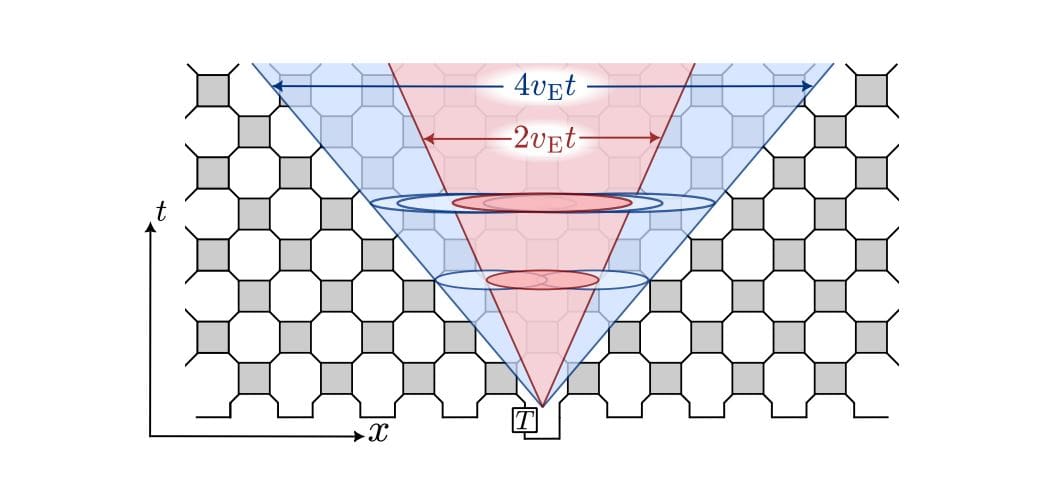
The behaviour of ‘magic’, a crucial resource for advanced quantum computation and error correction, remains a significant challenge in understanding complex quantum systems. Mircea Bejan from King’s College London and the University of Cambridge, along with Pieter W. Claeys and Jiangtian Yao from the Max Planck Institute for the Physics of Complex Systems, investigate how this ‘magic’ spreads within quantum circuits, even though its distribution is difficult to observe directly. The team rigorously demonstrates that the spatial distribution of magic can be determined by analysing how low-magic states are represented, introducing a new framework called the bipartite magic gauge. Their numerical results reveal that magic initially spreads rapidly, then delocalizes, and importantly, the researchers identify two distinct length scales governing this behaviour, offering new insights into the fundamental transport properties of quantum resources and their connection to error correction.
Magic Spreading in Random Quantum Circuits
This study investigates the spreading of “magic”, a vital quantum resource for complex computations and many-body dynamics, within random Clifford circuits, models of scrambling quantum systems. Researchers focused on how locally injected magic disperses under these dynamics, a question relevant to optimizing quantum simulation resources and understanding fundamental quantum phenomena. To explore this, the team engineered quantum circuits comprising qubits evolving over time, populated with both identity gates and randomly selected two-qubit Clifford gates, with a tunable parameter controlling the density of gates. The core of the methodology involved preparing a short-range entangled state and introducing magic via a non-Clifford gate applied to a single qubit.
This localized injection of magic dynamically generates a stabilizer quantum error correcting code, effectively encoding a single logical qubit within the physical qubits. The researchers then evolved this initial state, meticulously tracking the spatial distribution of magic as it spread through the system. A key innovation was developing a method to map the spatial structure of magic to the logical operators of the dynamically generated error correcting code, enabling efficient classical computation of magic within any subsystem. To quantify the non-stabilizerness, or “magic”, of the evolving quantum state, the team employed the second-order stabilizer Rényi entropy, a measure appropriate for characterizing the amount of magic present.
This approach allowed them to precisely track the dispersal of magic over time and identify two distinct magic length scales. These scales represent the size of the smallest contiguous region from which magic can be extracted and the region beyond which operations cannot reduce the magic. Numerical simulations revealed that these length scales grow ballistically at early times, with velocities corresponding to the entanglement velocity and twice that value, respectively. Once these scales reach their maximum values, magic delocalizes, becoming extractable from approximately half the qubits, signifying the approach of a random stabilizer code. This detailed analysis provides insights into the spatiotemporal structure of quantum resources and their transport properties within complex many-body systems.
Magic Distribution and Ballistic Growth in Circuits
Scientists have demonstrated a rigorous method for tracking the distribution and dynamics of “magic”, a valuable resource in quantum error correction and computation, within complex quantum circuits. This work addresses a fundamental challenge, the lack of direct ways to observe magic locally, by introducing the bipartite magic gauge, a canonical representation that allows inference of magic’s spatial distribution. Researchers established two operationally relevant magic length scales, and numerically confirmed that both scales exhibit ballistic growth at distinct velocities during the early stages of quantum circuit evolution. Experiments reveal that the magic length scales grow ballistically, meaning their growth rate remains constant over time, at rates determined by the entanglement velocity within the system.
While one length scale, the logical magic length, saturates at approximately half the system size, the other, the field length of entanglement operator mixing, continues to grow before eventually saturating at the full system size. Remarkably, the early-time velocities of both magic length scales align closely with the entanglement velocity, suggesting a deep connection between these quantum properties, with the field length of entanglement operator mixing growing at roughly twice the entanglement velocity. Further analysis demonstrates that magic spreads faster than the geometric lightcone, the theoretical limit for information transfer, but does not violate causality. This is because magic spreading is influenced by both entanglement growth and the spread of quantum operators, creating an upper bound on its velocity.
Researchers found that the dynamics of purity, a measure of quantum state mixedness, explains the relationship between the magic length scale and entanglement velocity, establishing that a subsystem must be within the causal cone defined by entanglement and operator spreading to host magic. At later times, after a saturation period proportional to the system size, magic delocalizes throughout the quantum circuit. In this regime, any subsystem containing more than half the qubits can unitarily extract the full amount of magic, resembling a random quantum error-correcting code. Measurements confirm that a proxy for the single-copy channel capacity remains at approximately one for subsystems containing less than half the qubits, indicating the preservation of magic, while rapidly dropping to zero for larger subsystems, signifying its loss. These findings provide a crucial step towards understanding and harnessing quantum resources for advanced computation and error correction.
Magic Distribution Reveals Ballistic Expansion Scales
Researchers have developed a new understanding of ‘magic’, a resource crucial for enhancing error correction and computation. This work investigates how magic is distributed and changes within quantum circuits, specifically those built from Clifford operations where the total amount of magic remains constant. Because directly measuring the local concentration of magic is challenging, the team devised a method to infer its spatial distribution from the arrangement of low-magic states, termed the bipartite magic gauge. This approach revealed the existence of two distinct length scales that characterize how magic spreads within the system.
Numerical simulations demonstrate that these scales initially grow at different, predictable rates, indicating ballistic expansion, before eventually leading to the overall delocalization of magic. The findings illuminate the spatiotemporal structure of resources and complexity in quantum systems, offering insights into their transport properties and potential connections to error correction techniques. Future research will likely focus on developing more efficient algorithms for calculating magic and exploring its behaviour in more complex quantum systems and different types of circuits. This work provides a foundation for investigating how to better harness magic as a resource for advanced quantum technologies.
👉 More information
🗞 Magic spreading under unitary Clifford dynamics
🧠 ArXiv: https://arxiv.org/abs/2511.21487