The long-held belief that gravity cannot induce quantum entanglement faces a surprising challenge, as new research reveals a fundamental reason why classical gravity can, in fact, create this connection. Andrea Di Biagio, from the Institute for Quantum Optics and Quantum Information (IQOQI) Vienna, Austrian Academy of Sciences, and colleagues demonstrate that existing theoretical objections to gravity-induced entanglement are not as definitive as previously thought. This discovery explains why several theories predict this phenomenon, despite earlier assumptions to the contrary, and significantly strengthens the case for pursuing experiments designed to detect entanglement arising from gravitational interactions. The work underscores the urgent need for further investigation into gravity-induced entanglement, potentially opening new avenues for understanding the relationship between gravity and quantum mechanics.
Recent work demonstrates the prediction of gravity-induced entanglement (GIE), despite established theory-independent objections which suggested this should not be possible. This research explains how the prediction of GIE is possible and highlights the increased urgency of GIE experiments within the field of quantum gravity.
Entanglement Tests for Quantum Gravity Effects
Experimental Paths to Testing Quantum Gravity
This research explores the possibility of experimentally demonstrating the quantum nature of gravity. For decades, this has largely been a theoretical pursuit, but recent advances, combined with experimental techniques involving entanglement, might finally allow for a laboratory test. The motivation is that a successful experiment would represent a monumental step towards unifying quantum mechanics and general relativity, two pillars of modern physics that remain stubbornly incompatible. The core idea is to use entanglement as a way to detect subtle gravitational effects, entangling two masses and hoping that gravity will act as a mediating force, altering the entanglement in a way uniquely predicted by quantum gravity.
The research delves into several important theoretical concepts and challenges, distinguishing between locally mediated entanglement and the more subtle effects related to the superposition of spacetime geometries. Detecting the latter is far more challenging but potentially more revealing, as some theories predict that gravity itself can exist in a superposition of states, requiring the observation of interference effects in the gravitational field. A major obstacle is decoherence, the tendency of quantum systems to lose coherence and entanglement due to environmental interactions, making maintaining entanglement between macroscopic masses extremely challenging. Careful experimental design and theoretical analysis are needed to rule out classical mimicry, the possibility that any observed effects could be explained by classical physics.
The research reveals an ongoing debate within the physics community, with recent work showing that classical gravity can, in principle, produce entanglement between masses. Other researchers are working on ways to distinguish between classical and quantum entanglement, for example, by looking for specific signatures related to the superposition of spacetime geometries. The success of any experiment will depend critically on the experimental design and the ability to precisely control and measure the entanglement, potentially paving the way for a unified theory of physics.
Gravity’s Quantum Link Avoids No-Go Theorems
Resolving Theoretical No-Go Theorems in Gravity
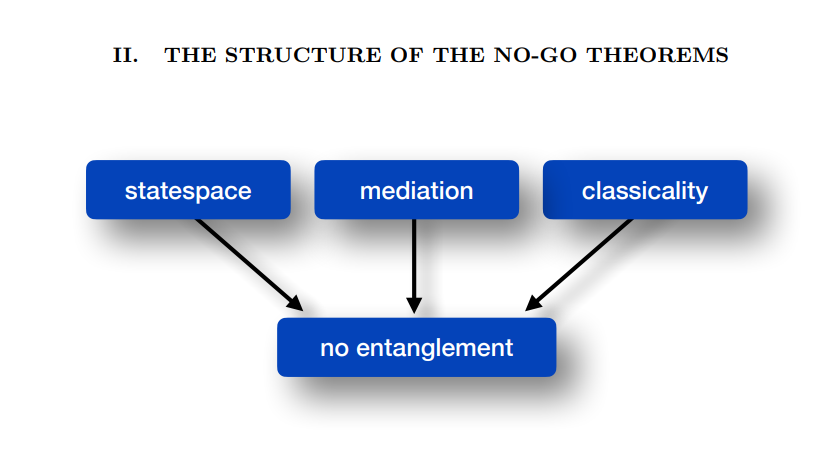
Scientists have clarified why gravity-induced experiments remain a viable path to understanding the fundamental nature of gravity, despite previous theoretical objections. The work demonstrates that assumptions underpinning earlier objections, which predicted the impossibility of observing certain gravitational effects, are not naturally applicable to theories combining gravity with quantum matter. These objections rely on a specific notion of locality, termed “mediation”, which is distinct from the relativistic locality central to established physics. Researchers established that mediation assumes the evolution of two masses and the gravitational field can be broken down into operations acting on the field and only one mass at a time, never both simultaneously.
The analysis reveals that many models of classical gravity coupled with quantum matter do not satisfy this mediation requirement, and therefore can exhibit entanglement without violating fundamental physical principles. This finding directly addresses the previous objections to gravity-induced experiments, opening new avenues for research, highlighting a crucial distinction between spatiotemporal locality and subsystem locality. The objections depend on subsystem locality, specifically mediation, but this form of locality is not inherent in spacetime-based theories. For example, the Coulomb gauge in quantum electrodynamics features direct interparticle interactions that violate the mediation assumption, demonstrating its limited applicability to realistic physical systems. The work confirms the validity of the objections themselves, but emphasizes their limited relevance to the study of gravity, thereby reinforcing the importance of pursuing gravity-induced experiments as a means to probe the quantum nature of gravity.
Utilizing Entanglement to Reveal Quantum Nature
Gravity’s Entanglement Reveals Quantum Nature
Recent research demonstrates that gravity-induced entanglement between massive particles offers a potential pathway to detecting quantum effects in gravity, even in regimes where classical gravity is expected to dominate. Scientists have shown that the rate and magnitude of entanglement generated by gravity could serve as a key indicator of whether gravity itself exhibits quantum behaviour, potentially circumventing previously established theoretical limitations. This work builds upon the understanding that entanglement, a hallmark of quantum mechanics, can be gravitationally induced between objects, and proposes that observing this entanglement provides evidence for quantum gravity. The team’s investigations suggest that detecting this gravitationally-induced entanglement is now within experimental reach, with ongoing experiments employing techniques such as levitated nanoparticles and atom interferometry. While acknowledging the significant technical challenges involved in creating and measuring entanglement between macroscopic objects, researchers are actively pursuing these avenues. Future work will focus on refining experimental setups and improving the sensitivity of measurements to definitively establish the quantum nature of gravity, and further exploration of spin-based entanglement as a promising approach.
🗞 The simple reason why classical gravity can entangle
🧠 ArXiv: https://arxiv.org/abs/2511.02683