

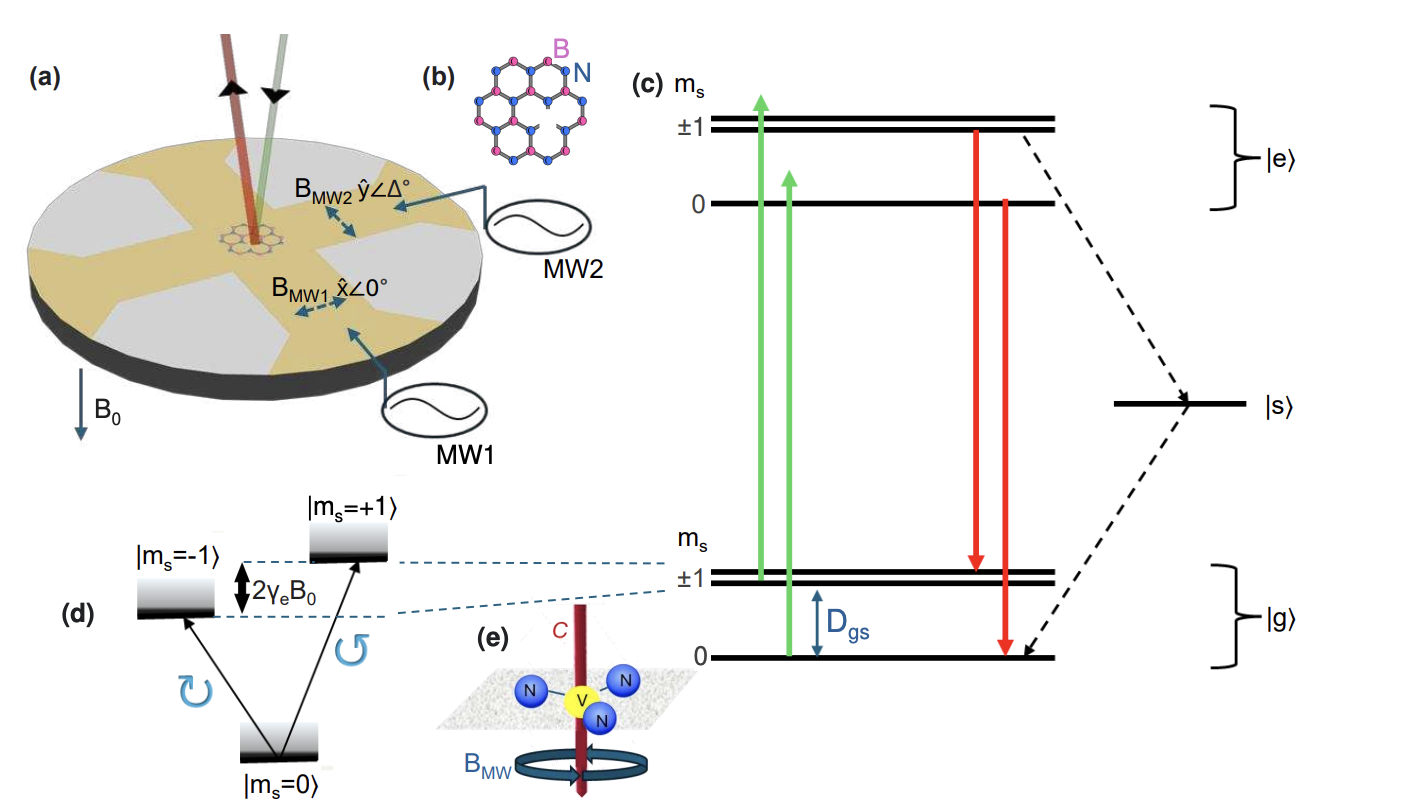
Researchers demonstrated selective excitation of spin defects within hexagonal boron nitride using circularly polarised microwaves generated via a custom waveguide. This technique, validated by optically detected magnetic resonance and computational modelling, improves spin state control and enhances magnetic sensitivity, particularly at low magnetic fields.
The pursuit of materials exhibiting quantum properties with controllable spin states is central to advances in quantum sensing and information processing. Hexagonal boron nitride (hBN), a two-dimensional material, hosts defects – specifically boron vacancies – that possess optically addressable spin states. However, realising the full potential of hBN as a sensitive magnetic sensor has been hampered by spectral congestion arising from interactions between the electron spin and nuclear spins within the defect. A collaborative team, comprising researchers from Purdue University, Sandia National Laboratories, and the University of Iowa, detail a method to selectively excite these spin states using circularly polarised microwaves.
Their work, entitled ‘Spin-State Selective Excitation in Spin Defects of Hexagonal Boron Nitride’, published in a leading peer-reviewed journal, demonstrates enhanced control over hBN spin defects through precise microwave manipulation, potentially improving magnetic sensitivity, particularly at low magnetic fields. The research was led by Mohammad Abdullah Sadi, Luca Basso, David A Fehr, Xingyu Gao, Sumukh Vaidya, Emmeline G Riendeau, Gajadhar Joshi, Tongcang Li, Michael E Flatté, Andrew M Mounce, and Yong P Chen.
Discrepancies Emerge in Control of Quantum Spin States in Hexagonal Boron Nitride
Recent research by Mohammad Chatziefstathiou and colleagues reveals inconsistencies between experimental observations and theoretical predictions when manipulating the spin states of boron-vacancy defects within hexagonal boron nitride (hBN). These findings necessitate a refinement of current models used to describe and control these quantum systems.
hBN is attracting considerable attention as a promising platform for quantum technologies, owing to its structural similarity to graphene and its ability to host defects with controllable quantum properties. Boron Vacancy defects, where a boron atom is missing from the hBN lattice, exhibit spin properties suitable for use as qubits – the fundamental units of quantum information. Precise control over these spin states is essential for realising functional quantum devices.
The team fabricated a bespoke cross-shaped waveguide and employed a radio-frequency system-on-chip (RFSoC) field-programmable gate array to generate circularly polarised microwaves. This setup allowed for selective excitation of individual $V_B$ defects. Researchers systematically investigated the relationship between microwave polarization, external magnetic fields, and the resulting spin state manipulation.
Conventional theory predicts a 180° phase difference between opposing microwave polarization orientations will maximise excitation of the $V_B$ defect spins. However, experiments consistently demonstrated deviations from this ideal phase relationship. To mitigate potential experimental errors, the researchers meticulously characterised the orientation and symmetry of the defects, implemented rigorous shielding against external electromagnetic interference, and employed computational modelling to account for lattice distortions and refined polarization analysis.
Expanding the investigation to encompass a broader range of magnetic field strengths and defect densities further highlighted the discrepancies. The observed behaviour suggests that the current theoretical framework inadequately captures the complex interplay of factors governing spin manipulation in hBN.
The team proposes that a more comprehensive theoretical description, incorporating factors such as lattice distortions around the defects, variations in the local magnetic environment, and potential misalignment of microwave polarization, is crucial for accurately predicting and optimising spin state control. Addressing these limitations will be vital for unlocking the full potential of hBN in applications including quantum sensing and quantum information processing. Further research will focus on elucidating the underlying mechanisms and developing more robust control techniques.
👉 More information
🗞 Spin-State Selective Excitation in Spin Defects of Hexagonal Boron Nitride
🧠 DOI: https://doi.org/10.48550/arXiv.2506.04448


