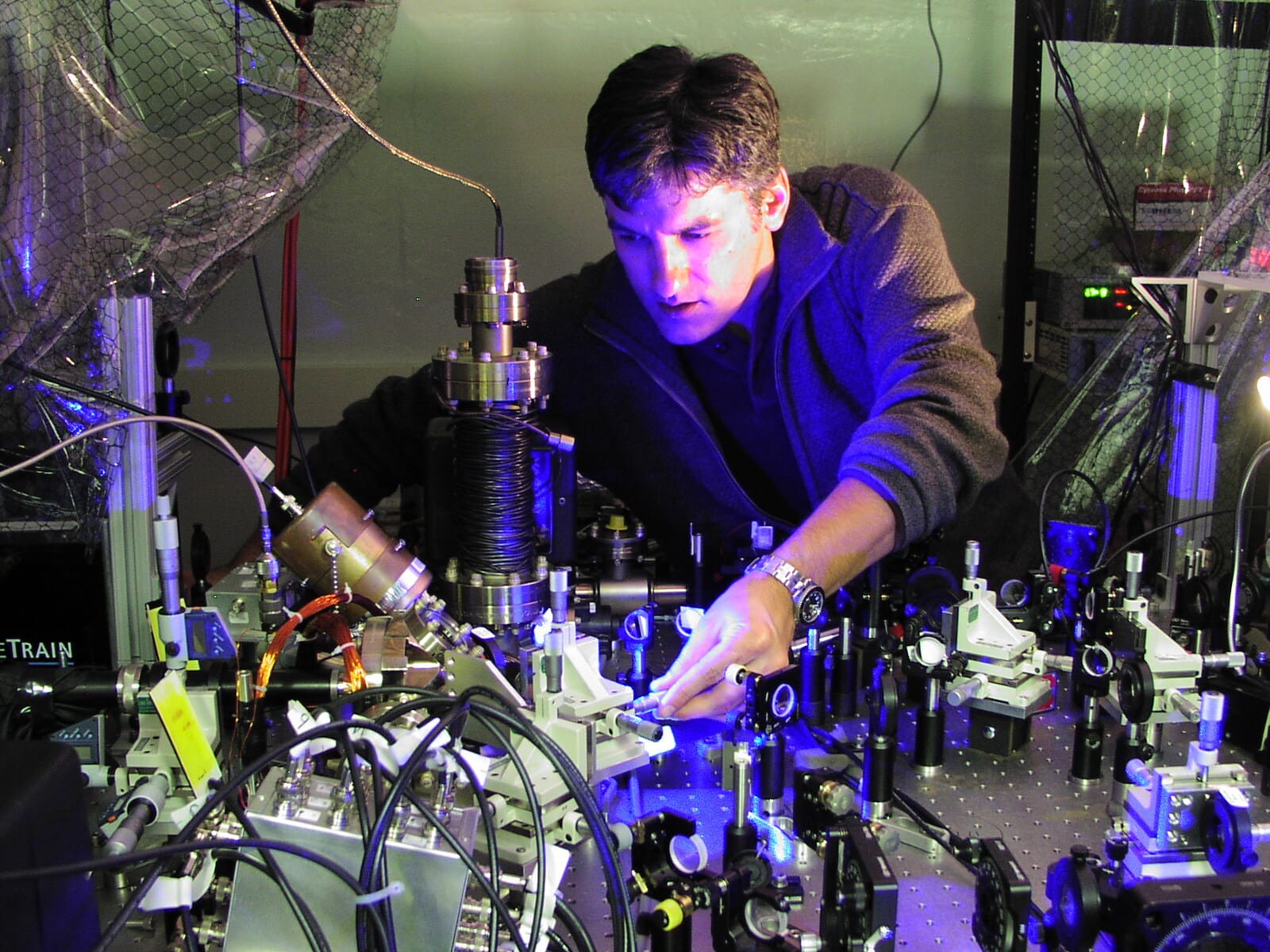
In 1995, Dr. Chris Monroe of IonQ, alongside the research group led by Nobel Laureate Dr. David Wineland, achieved a pivotal advancement in computing at the U.S. atomic clock laboratories within the National Institute of Standards and Technology (NIST) in Boulder, Colorado. They demonstrated the first experimental realization of a quantum logic gate utilizing trapped ions as qubits. This achievement marked the transition of quantum computation from theoretical framework to reproducible hardware, establishing the foundation for gate-based quantum computing. The physics demonstrated in this laboratory experiment continues to define the characteristics of a modern quantum computer thirty years later.
Early Foundations of Quantum Computing
The practical birth of quantum computing occurred on December 18, 1995, at NIST in Boulder, Colorado. Dr. Chris Monroe, with the research group led by Nobel Laureate Dr. David Wineland, demonstrated the first experimental quantum logic gate using trapped ions as qubits. This achievement moved quantum computation beyond theory and into reproducible, measured hardware. The physics demonstrated in that initial lab experiment continues to define what constitutes an actual quantum computer even today, representing a pivotal moment in the field’s development.
Prior to 1995, quantum mechanics existed largely as a theoretical framework, with pioneers like Heisenberg, Born, Jordan, and Schrödinger laying its foundations beginning in the 1920s. Researchers Benioff and Feynman later, in the 1980s, began to articulate how quantum systems could be used for computation. However, the key question of whether it could be physically realized remained unanswered until Dr. Monroe’s demonstration, which proved quantum logic gates—the quantum equivalent of classical gates—could operate on qubits utilizing superposition and entanglement.
The foundational physics underpinning IonQ’s approach was largely completed between 1995 and 2010. This early completion allowed the company to concentrate on engineering, scaling, and commercialization, eventually leading to its founding in 2015. IonQ achieved a significant milestone in 2021, becoming the first public pure-play quantum computing company, and in 2025, it achieved 99.99% two-qubit gate fidelity, setting a new world record in performance.
IonQ’s Development and Commercialization
IonQ’s development began with a pivotal 1995 experiment at NIST, where Dr. Chris Monroe demonstrated the first experimental quantum logic gate using trapped ions. This achievement moved quantum computation from theoretical framework to measurable hardware, establishing the foundation for gate-based quantum computing. The physics demonstrated in this initial work has remained foundational, defining what constitutes an actual quantum computer for over thirty years and enabling IonQ to focus on engineering and scaling.
Founded in 2015 by Dr. Monroe and Dr. Jungsang Kim, IonQ aimed to commercialize trapped-ion quantum computing. This followed more than 20 years of academic research, allowing the company to prioritize practical applications. In 2021, IonQ became the first pure-play quantum computing company to go public, and now operates a complete quantum platform including computing, networking, sensing, and security.
IonQ is focused on scaling its technology, with a roadmap targeting 80,000 logical qubits by the end of the decade, and announced plans to acquire @OxfordIonics to accelerate this goal. Demonstrating leading performance, the company achieved 99.99% two-qubit gate fidelity in 2025. IonQ’s CEO, Niccolo de Masi, highlighted advancements in quantum networking and commercialization strategies at QWC 2025.
Key Quantum Principles and Components
The foundation of modern quantum computing began in 1995 with Dr. Chris Monroe’s experimental demonstration of a quantum logic gate using trapped ions at NIST. This achievement moved quantum computation beyond theory and into measurable hardware, establishing what defines an actual quantum computer. This pivotal moment built on decades of theoretical groundwork laid by pioneers like Heisenberg and Schrödinger, beginning in the 1920s, and later articulated by Benioff and Feynman in the 1980s.
Quantum logic gates operate on qubits, which differ from classical bits by existing in superpositions and becoming entangled. Superposition allows qubits to represent multiple states simultaneously, while entanglement links them into correlated systems enabling massively parallel computation. These properties, combined with high-fidelity measurement, are essential building blocks for quantum circuits and algorithms applicable to fields like chemistry, optimization, and artificial intelligence.
IonQ’s advancements are built on physics established between 1995 and 2010, allowing the company to focus on scaling and commercialization. In 2021, IonQ became the first public pure-play quantum computing company, currently operating a complete quantum platform. They recently achieved 99.99% two-qubit gate fidelity, a world record, and plan to scale to 80,000 logical qubits by 2030, with the acquisition of Oxford Ionics further accelerating this goal.
Superposition allows qubits to exist in multiple states simultaneously, while entanglement links qubits into a single, highly correlated system that can perform massively parallel computation.
Source: https://www.ionq.com