Research demonstrates progress in fabricating photonic integrated circuits that generate and detect continuous-variable quantum states of light. These chip-scale devices aim to enhance quantum technologies, particularly in sensing applications like gravitational wave detection, by operating beyond the limitations imposed by standard light noise.
The demand for enhanced sensing capabilities and secure communication protocols drives ongoing development in quantum technologies. A key challenge lies in translating laboratory demonstrations into practical, scalable devices. Researchers are increasingly focused on photonic integrated circuits – chips that manipulate light – as a means to engineer and control quantum phenomena. A review article, ‘Integrated photonics for continuous-variable quantum optics’, details recent progress in this area, specifically concerning the integration of components for continuous-variable quantum optics. This work, led by Rachel N. Clark, Bethany Puzio, and Oliver M. Green from the University of Bristol, in collaboration with Siva T. Pradyumna of the National Institute of Standards and Technology, and Oliver Trojak and Alberto Politi from the University of Southampton, alongside Jonathan C. F. Matthews, examines the potential of chip-scale devices to generate, manipulate and detect quantum states of light, operating below the limitations imposed by classical noise.
Chip-Scale Integration Advances Continuous-Variable Quantum Photonics
Recent developments demonstrate increasing integration of continuous-variable (CV) quantum photonic systems onto chip-scale photonic integrated circuits (PICs), addressing a critical need for scalable and manufacturable quantum technologies applicable to secure communication and precision sensing. CV quantum photonics utilises properties of light, such as amplitude and phase, to encode and process quantum information, offering advantages in compatibility with existing telecommunications infrastructure.
Investigations consistently demonstrate the feasibility of generating and manipulating CV states within these integrated platforms, achieving key rates and transmission distances relevant to quantum key distribution (QKD). Silicon photonics, leveraging established semiconductor manufacturing techniques, presents a particularly promising platform for this integration. Specifically, recent work achieves data transmission at 10 Gbaud using integrated photonic-electronic receivers and extends CV-QKD to 100km fibre optic links with local oscillator configurations, validating the potential to overcome limitations associated with discrete optical components.
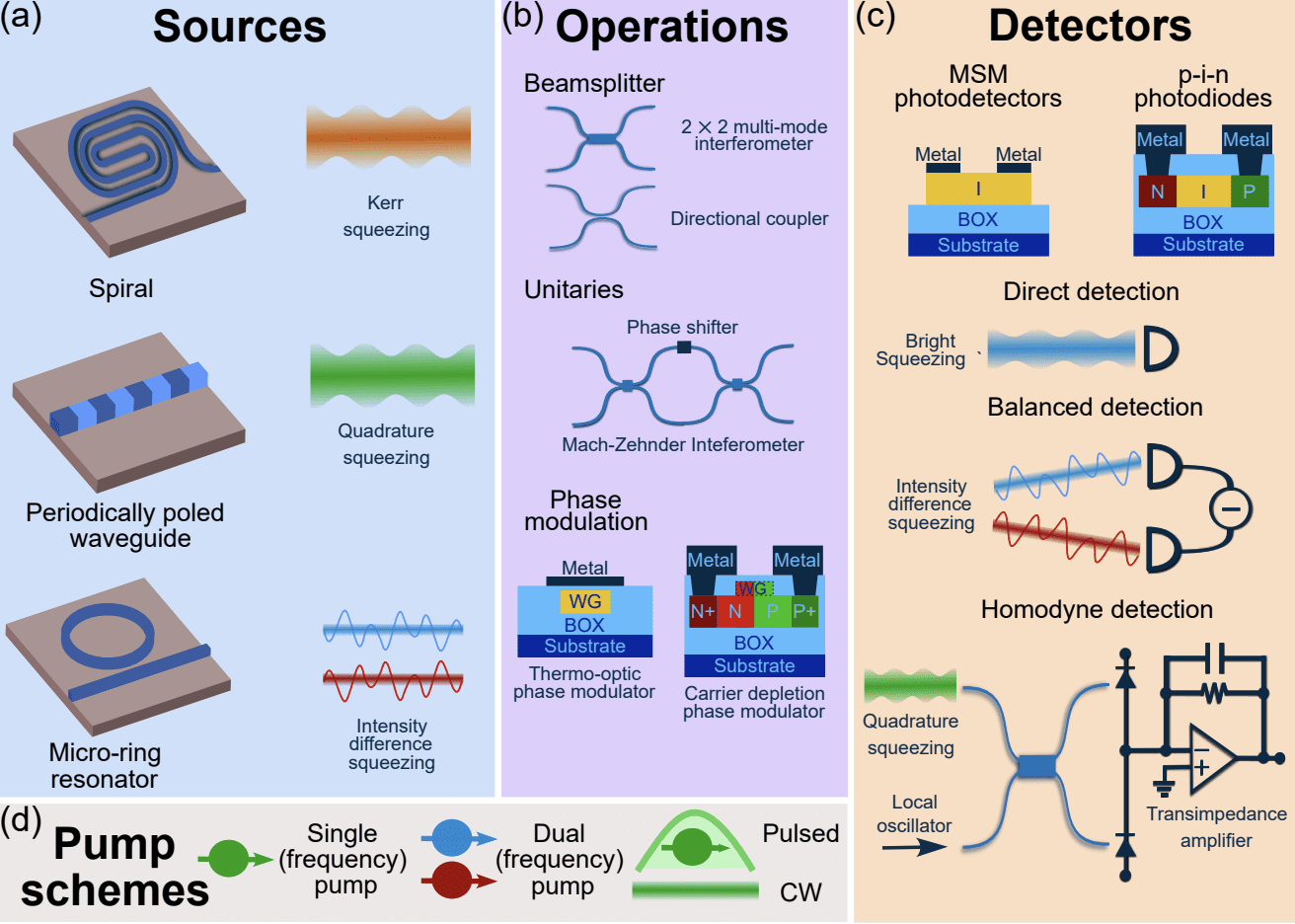
Integrated sources currently employ techniques like spontaneous parametric down-conversion (SPDC) – a nonlinear optical process that creates pairs of entangled photons – though these sources often require high pump powers and exhibit low generation rates. Alternative approaches focus on manipulating light via electro-optic modulation within the PIC to create squeezed states – quantum states exhibiting noise below the standard quantum limit – essential for enhancing sensitivity in applications like gravitational wave detection.
Significant progress also characterises the development of on-chip single-photon detectors compatible with CV states. Superconducting nanowire single-photon detectors (SNSPDs) offer high efficiency and low dark count rates, but their cryogenic operation presents a practical challenge. Alternative detector technologies, such as transition-edge sensors and silicon avalanche photodiodes, are being integrated onto PICs to enable room-temperature operation, albeit often with reduced performance. Crucially, efficient coupling between PIC waveguides and these detectors remains a key area of investigation.
The integration of sources, detectors, and complex photonic circuits onto a single chip facilitates the creation of compact and robust quantum systems, enabling the development of portable and deployable devices.
The exploration of non-Gaussian quantum states remains crucial, as these states offer enhanced performance in certain quantum protocols and unlock new possibilities for quantum information processing. Researchers recognise these states as essential resources for enhancing the performance of both quantum communication and computation, actively addressing the challenges of generating and controlling them through innovative chip designs.
Scalability continues to be a primary concern, as building complex quantum systems requires interconnecting multiple quantum modules and managing the associated control and measurement signals. Modular approaches to photonic quantum computing, utilising networked chip designs, offer a promising pathway towards achieving the necessary scale for practical applications.
Future work should prioritise the development of more efficient and deterministic sources of non-Gaussian states, enabling the creation of complex quantum states with high fidelity and reliability. Improving the integration of detectors with PICs, particularly those operating at room temperature, will also be critical, reducing the complexity and cost of quantum systems. Further investigation into error correction protocols tailored to CV systems is needed to enhance the robustness of quantum communication and computation, protecting quantum information from noise and decoherence.
👉 More information
🗞 Integrated photonics for continuous-variable quantum optics
🧠 DOI: https://doi.org/10.48550/arXiv.2506.04771