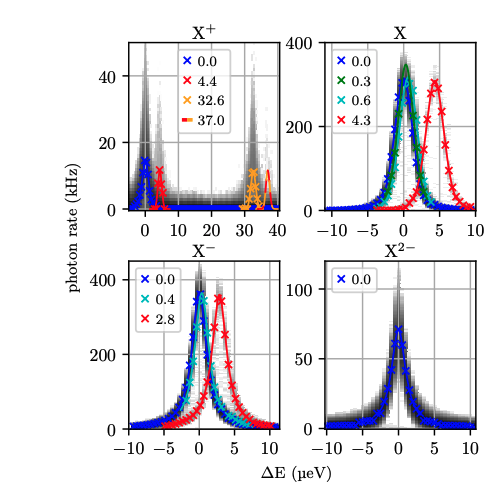
Semiconductor nanocrystals, known as quantum dots, hold considerable promise as sources of single photons for applications in quantum technologies, but their performance is often hampered by unpredictable changes in their electrical charge. Kai Hühn, Lena Klar, and Fei Ding, at the Leibniz Universität Hannover, alongside colleagues including Arne Ludwig and Andreas Wieck at Ruhr-Universität Bochum, now present detailed observations of these charge-related fluctuations in a single gallium arsenide quantum dot. Their research reveals subtle, previously hidden shifts in the dot’s emitted light, caused by the influence of nearby impurities, and quantifies the speed at which charges enter and leave the dot over timescales ranging from milliseconds to seconds. By manipulating the dot’s charge state with an additional laser, the team demonstrates a significant increase in charge occupancy and residence time, offering new insights into controlling these nanoscale light sources and improving their reliability for future quantum devices.
Quantum Dot Charge Dynamics and Optical Properties
This research investigates the charge environment and dynamics of individual quantum dots (QDs) embedded within a semiconductor material, aiming to understand how the charge state affects optical properties and is influenced by imperfections and electrical fields. This understanding is crucial for developing QDs as reliable and controllable components for quantum information processing, where precise charge control is essential. Researchers focused on random fluctuations in QD charge state, which introduce noise and disrupt quantum information, employing spectrally resolved charge noise spectroscopy to characterize these fluctuations and identify their sources. Controlled electrical fields were used to manipulate charge state and study its effects on optical properties, all performed at extremely low temperatures to minimize thermal interference.
The research identifies multiple sources of charge noise, including defects trapping electrons or holes, fluctuations in nearby ionized dopant atoms, and tunneling between the QD and these traps. The frequency spectrum of the charge noise is not uniform, allowing researchers to differentiate between sources, and correlation measurements reveal relationships between different types of noise, suggesting shared underlying mechanisms. Researchers mapped the charge environment around the QD, identifying locations of nearby dopants and defects contributing to the noise. The study demonstrates that applied electrical fields affect charge noise by altering the QD’s charge state and interaction with its environment.
QD size and composition also influence charge noise, with smaller QDs being more susceptible to fluctuations, and interface quality between the QD and surrounding semiconductor material is crucial for minimizing noise. The observed charge noise represents a significant limitation to achieving long coherence times for QD-based qubits. The research employed low-temperature photoluminescence spectroscopy, spectrally resolved charge noise spectroscopy, cross-correlation measurements, and advanced microscopy techniques to provide a detailed understanding of QD charge dynamics. This research provides detailed understanding of QD charge environment and dynamics, crucial knowledge for developing reliable and controllable qubits for quantum information processing. Future research will focus on minimizing charge noise through new materials and fabrication techniques, engineering the charge environment, developing new control techniques, exploring new qubit designs, and improving interface quality. Ultimately, this work contributes to overcoming the challenges of using QDs as qubits and realizing their full potential.
Single Quantum Dot Spectroscopy with PIN Diodes
Researchers investigated single semiconductor nanocrystals, known as quantum dots, using time-resolved resonance fluorescence (RF) spectroscopy, allowing observation of subtle changes in energy emitted by the QD, often masked by background noise. This technique monitors light emitted after excitation, providing a detailed picture of the QD’s internal state and interaction with its environment. A key innovation was a specialized PIN diode sample structure designed to minimize environmental interference and enable precise control over the QD’s charge state. This structure incorporates multiple layers carefully engineered to reduce electrical noise and predictably alter the number of electrons and holes within the QD.
By controlling charge, the team systematically studied its effects on optical properties and identified subtle shifts in emitted light caused by changes in the electrical environment. Measurements involved exciting the QD with laser light and detecting individual photons using a highly sensitive detector, recording the precise arrival time of each photon to build a detailed picture of the QD’s behavior over time. A two-color experimental approach used a second laser to manipulate charge state while simultaneously monitoring fluorescence, allowing the team to observe how changes in charge occupancy affect various processes within the dot. Complementary polarization and gate-voltage dependent photoluminescence measurements confirmed the assignment of different charge states observed in the RF spectra, providing a comprehensive understanding of the QD’s charge dynamics and revealing previously hidden details about electron and hole tunneling rates, as well as the influence of the surrounding electrical environment on its optical properties. High-resolution confocal microscopy and precise temperature control further contributed to the accuracy and reliability of the measurements.
Quantum Dot Energy Levels Revealed by Fluctuations
Semiconductor nanocrystals, known as quantum dots, hold promise as single-photon sources for quantum technologies, but their performance is often limited by fluctuations in charge state and surrounding environment. Recent research focused on understanding and controlling these fluctuations in a tunable quantum dot composed of gallium arsenide, revealing subtle shifts in energy levels caused by changes in the electrical environment and providing insights into charge dynamics within the surrounding material. The investigation demonstrates the existence of multiple, closely spaced energy levels within the quantum dot, even those too subtle to be detected by conventional methods. These shifts are linked to changes in the number of electrons and holes within the dot and its immediate vicinity, and are observed for both neutral and charged states of the nanocrystal.
Notably, the dynamics of these charge changes differ significantly depending on whether the dot is positively or negatively charged, with positive charge exhibiting rapid loss and slow recapture of holes. Researchers significantly increased the number of holes within the dot, more than tenfold, using a second laser, prolonging their residence time and enhancing the rate at which they tunneled into the structure. These findings are corroborated by complementary measurements offering a broader bandwidth, confirming the observed charge dynamics. The ability to manipulate and understand these charge fluctuations represents a significant step towards creating stable and reliable single-photon sources for quantum communication and computation, highlighting the complex interplay between the quantum dot and its environment.
🗞 Spectral shadows of a single GaAs quantum dot
🧠 ArXiv: https://arxiv.org/abs/2507.20290