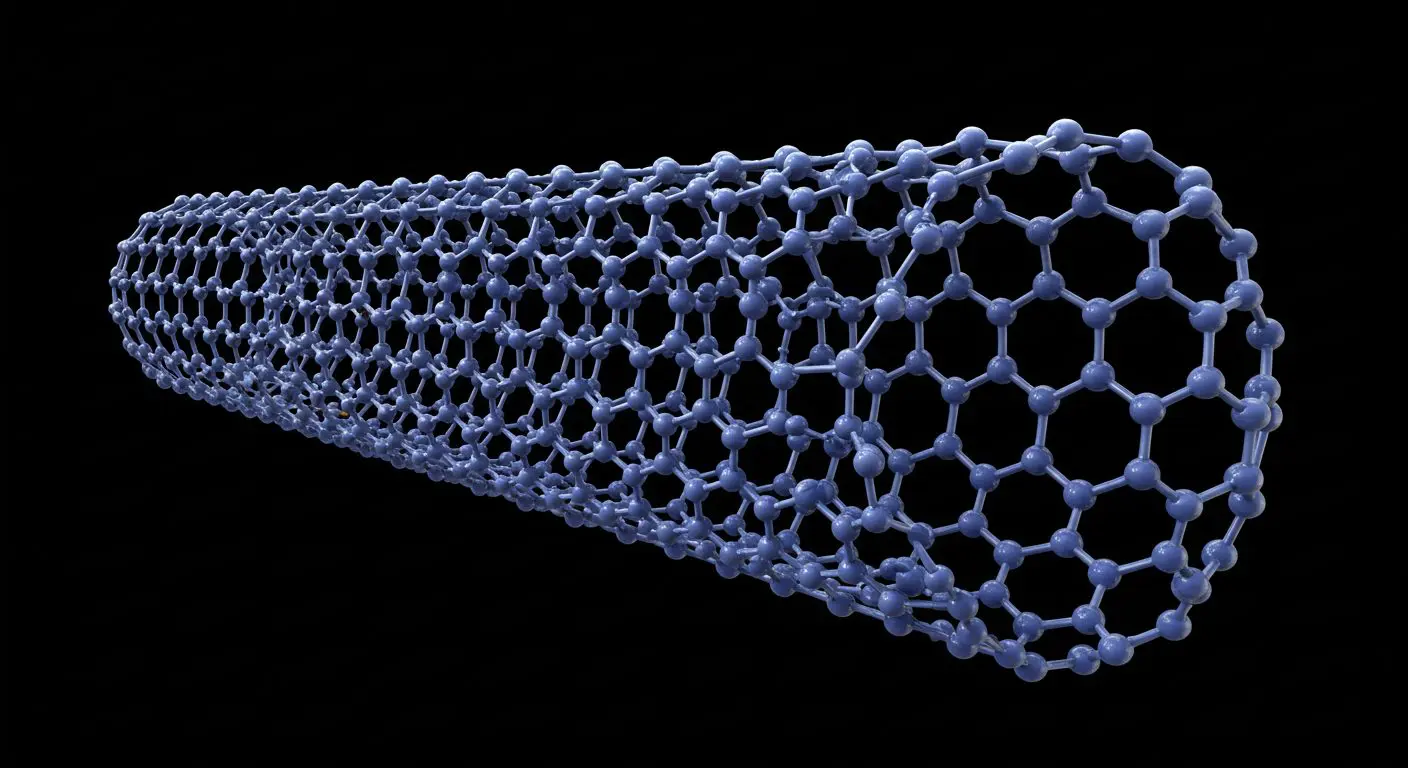
Current noise, a fundamental limitation in nanoscale electronics, significantly impacts the performance of devices such as metallic carbon nanotubes. Aina Sumiyoshi, Keisuke Ishizeki, and Takahiro Yamamoto, all from Tokyo University of Science, have investigated the statistical properties of this noise, revealing how it changes as electrons interact with vibrations within the nanotube. Their theoretical work demonstrates a clear evolution in the distribution of current fluctuations, shifting from a predictable Gaussian pattern in pristine nanotubes to a more complex gamma distribution as the material becomes more disordered. This research is significant because it identifies a statistical imbalance driving current fluctuations and uncovers non-Markovian effects that govern noise at high frequencies, offering crucial insights for designing more reliable and efficient nanoscale electronics.
Researchers theoretically investigate current noise in metallic carbon nanotubes, focusing on the probability distribution of current that characterizes how electrons flow through these nanoscale structures. Quantum transport simulations, combined with analyses of statistical properties, reveal that this distribution evolves continuously from a symmetrical, Gaussian pattern in shorter tubes to a non-symmetrical, Gamma distribution in longer ones. This research addresses a crucial need to understand current fluctuations in nanoscale devices, which are vital for assessing their performance and reliability.
Electron Noise in Carbon Nanotube Transport
This study explores the statistical properties of current fluctuations in metallic carbon nanotubes. Researchers investigated how the distribution of current changes as electrons travel through the nanotube, transitioning from unimpeded flow to increased scattering. The key factor influencing this behaviour is electron-phonon interaction, where electrons collide with vibrations within the nanotube lattice. The research employs sophisticated quantum transport simulations to model electron behaviour and lattice vibrations, then uses statistical analysis to characterize the current fluctuations. The results demonstrate a clear transition in the current distribution.
In shorter nanotubes, current fluctuations are small and random, following a Gaussian distribution. As the nanotube length increases, the distribution shifts towards a Gamma distribution, indicating larger and more frequent current fluctuations. The researchers found that skewness and kurtosis deviate significantly from normal distribution values in the diffusive regime. Furthermore, the variance of the current noise follows a power-law relationship with the nanotube length. This behaviour is attributed to non-Markovian effects, meaning that the current noise depends not only on the current state of the system but also on its history, arising from interactions with high-frequency vibrations.
This research provides a deeper understanding of noise in nanoscale electronic systems and offers a sensitive method to characterize transport regimes and scattering mechanisms in carbon nanotubes. Understanding noise is crucial for designing reliable and high-performance nanoscale electronic devices, and the results validate the accuracy of the simulation methods and developed models. The research provides a way to distinguish between unimpeded and scattered electron flow based on the statistical properties of current noise.
Current Distribution Evolves with Nanotube Length
Researchers have investigated the flow of current through metallic carbon nanotubes, revealing how the distribution of current changes as the nanotubes vary in length. The study demonstrates a clear evolution in current behaviour, transitioning from a predictable, symmetrical distribution in shorter tubes to a more complex, asymmetrical pattern in longer ones. This shift is linked to the way electrons interact with vibrations within the nanotube material, a process known as electron-phonon scattering. In shorter nanotubes, current flows almost unimpeded, resulting in a smooth, symmetrical distribution of current values, closely resembling a Gaussian curve.
However, as the length of the nanotube increases, the probability of electrons scattering increases, leading to a more uneven current flow. The researchers found that at a specific length, approximately equal to the mean free path of the electrons, current fluctuations are maximized, creating the greatest uncertainty in current transmission. This results in a peak in the variance, a measure of how spread out the current values are. Interestingly, the distribution of current becomes increasingly asymmetrical as the nanotube length increases, a phenomenon quantified by the skewness. This asymmetry indicates that high and low current events are no longer equally probable.
In the longest nanotubes, the current distribution ultimately settles into a predictable pattern described by a Gamma distribution, indicating a dominance of electron-phonon interactions. The team demonstrated that the average current decreases with increasing length, aligning with Ohm’s law, while the current variance initially increases and then decays following a power law. These findings provide a detailed understanding of current transport in nanoscale materials and have implications for the design of future nanoelectronic devices. By characterizing the statistical properties of current flow, researchers can better predict and control the behaviour of these materials, potentially leading to more efficient and reliable electronic components.
Current Fluctuations Reveal Nanotube Phonon Interactions
This research investigates current noise in metallic carbon nanotubes, revealing how the distribution of current changes as electrons interact with vibrations within the material, known as phonons. The study demonstrates a transition from symmetrical current statistics in short nanotubes to an asymmetrical distribution in longer nanotubes, indicating increasingly non-symmetrical fluctuations. Specifically, the team found that the skewness and kurtosis of the current distribution reach predictable values in the scattered regime, providing insight into the nature of phonon-induced fluctuations. The findings highlight the importance of considering non-Markovian effects, arising from high-frequency resonances, when modelling current fluctuations in these nanoscale systems.
The researchers observed a power-law decay in current variance with nanotube length, with an exponent smaller than predicted by simpler models, attributing this to the influence of these resonances. This work provides a theoretical basis for interpreting noise signatures in nanoscale devices and suggests that current noise can be used to characterize transport regimes and probe microscopic scattering processes. This study establishes a foundation for understanding current fluctuations in one-dimensional nanomaterials and offers a new perspective on interpreting noise in nanoscale systems.
🗞 Statistical Properties of Current Noise Induced by Electron-Phonon Scattering in Metallic Carbon Nanotubes
🧠 ArXiv: https://arxiv.org/abs/2508.11201