

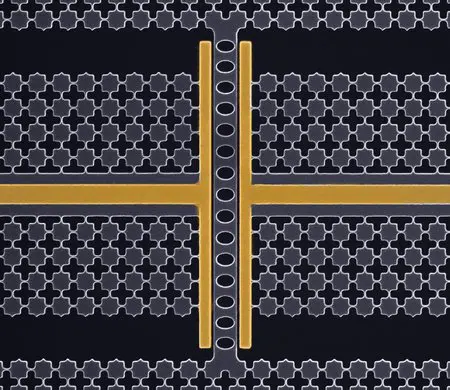
A team led by Alkim Bozkurt and Omid Golami, graduate students at Caltech under the supervision of Mohammad Mirhosseini, assistant professor of electrical engineering and applied physics, has demonstrated a hybrid quantum memory technique for superconducting qubits, achieving storage times up to 30 times longer than previously reported. The research, published in Nature Physics, utilises a translation of electrical information into acoustic waves within the quantum memory, effectively leveraging the properties of sound to preserve quantum states. Specifically, the team constructed a system where quantum states originating from superconducting qubits are converted into phonons – quantised units of vibrational energy – allowing for extended storage durations. This approach addresses a critical limitation in current superconducting quantum computing architectures, where maintaining the superposition of qubits – a fundamental requirement for quantum computation – is hampered by rapid decoherence, and provides a pathway towards more robust and scalable quantum information processing.
Quantum Computing Fundamentals
Quantum computing departs fundamentally from classical computation by leveraging the principles of quantum mechanics. Unlike classical bits, which represent information as either 0 or 1, quantum computers employ qubits.
These qubits exploit the phenomenon of superposition, allowing them to exist in a probabilistic combination of both 0 and 1 simultaneously, thereby enabling the potential for exponentially increased computational power for specific problem classes. This capability promises solutions to currently intractable problems in fields such as materials science, drug discovery, and cryptography.
Many current quantum computing architectures, including those based on superconducting circuits, excel at performing rapid logical operations. However, these systems typically exhibit limited quantum memory storage capabilities, hindering their ability to store quantum information for extended periods.
The duration for which a qubit maintains its superposition is known as coherence time, and extending this is critical for complex computations. Recent research at the California Institute of Technology (Caltech) addresses this limitation through a novel hybrid approach to quantum memory.
Led by graduate students Alkim Bozkurt and Omid Golami, under the supervision of Mohammad Mirhosseini, assistant professor of electrical engineering and applied physics, the team has demonstrated a method for translating electrical information representing quantum states into acoustic waves. This conversion effectively leverages the properties of sound to preserve quantum information for significantly longer durations.
The Caltech team’s methodology involves coupling superconducting qubits to a piezoelectric material, which converts electrical signals into mechanical vibrations – sound waves. By encoding the quantum state onto these acoustic phonons (quantised units of sound), the information can be stored and retrieved with a coherence time up to 30 times longer than achieved in conventional superconducting qubit storage techniques.
This improvement is attributed to the inherent properties of acoustic waves, which exhibit reduced interaction with the surrounding environment, thereby minimising decoherence – the loss of quantum information. The findings, published in Nature Physics, highlight the potential of acoustic quantum memories to overcome the limitations of existing storage technologies.
Mohammad Mirhosseini explains, “Once you have a quantum state, you might not want to do anything with it immediately. You need to have a way to come back to it when you do want to do a logical operation. ”
For that, a robust quantum memory is required, as well as exploring its integration with more complex quantum circuits.
More information
External Link: Click Here For More
The mechanism by which sound waves extend coherence time fundamentally relies on physical decoupling. In traditional superconducting circuits, environmental noise—such as stray electromagnetic fields or quasiparticle generation—directly interacts with the qubit’s energy levels, causing rapid decoherence. By encoding the quantum state onto acoustic phonons within a crystal lattice, the information is translated into a mechanical excitation that couples weakly to these high-frequency electronic noise sources. This quasi-adiabatic process allows the quantum information to temporarily exist in a protected, localized physical mode, effectively “shielding” the superposition state from immediate environmental decay channels.
From an engineering standpoint, successfully scaling this technology requires addressing the extremely low operating temperatures inherent to superconducting circuits. The entire system must function within dilution refrigerators, necessitating the integration of efficient, broadband coupling elements—such as optimized piezoelectric transducers—into microfabricated quantum chip architectures. Researchers must optimize the coupling strength between the superconducting junction and the mechanical resonator to ensure high fidelity transfer of the quantum state, a challenge that requires precise material science control at the nanometer scale.
Furthermore, the achievement of long coherence times directly addresses a critical bottleneck for executing quantum error correction (QEC) codes. These advanced algorithms, necessary for building fault-tolerant quantum computers, demand that quantum information be maintained reliably over a duration significantly longer than the inherent decoherence time of the individual qubits. The ability to store quantum data for extended periods transforms memory from a passive limitation into an active computational resource, enabling the complex, time-gated operations required by codes like the surface code.


