Scientists have made a breakthrough in quantum computing, overcoming a major hurdle to practical applications. Quantum Error Correction (QEC) codes can protect information from errors during computation, but they require fast and efficient decoding algorithms to correct those errors. Researchers at Riverlane and Rigetti, using a Rigetti Quantum Computer, have demonstrated a real-time QEC experiment on eight qubits with logical branching, achieving a full decoding response time of 9.6 microseconds.
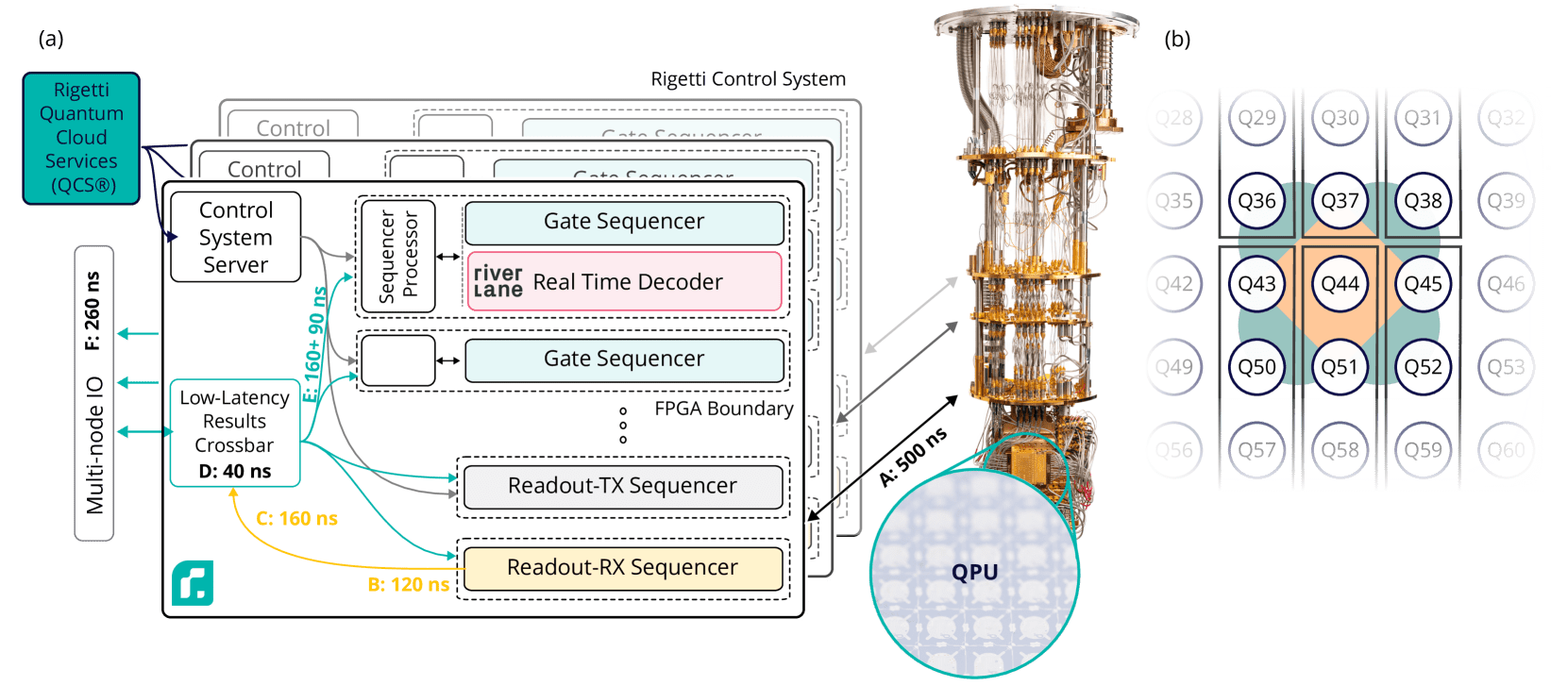
This milestone was made possible by integrating a scalable FPGA implementation of a Collision Clustering decoder into Rigetti’s Ankaa-2 superconducting device’s control system. The team showed that their decoding system can keep up with the rapid generation of measurement data on a superconducting qubit device, avoiding the “backlog problem” that slows down quantum computation. This achievement paves the way for experiments involving logical branching, which is crucial for implementing a fault-tolerant universal gate set.
As we strive to harness the power of quantum computers, one major hurdle stands in our way: errors. Quantum algorithms that offer an advantage over classical ones require hundreds of qubits and billions of operations, making them prone to errors. To combat this noise and unlock the potential of these algorithms, quantum error correction (QEC) is essential.
QEC encodes information across multiple qubits and repeatedly
QEC encodes information across multiple qubits and repeatedly generates data characterizing quantum errors. Classical algorithms, known as decoders, use this data to identify errors that occurred during quantum computation. However, QEC codes alone cannot implement a universal and transversal gate set. Leading proposals for implementing non-Clifford gates require logical branching – a logical operation conditional on a corrected observable, computed by combining the measured value of the observable and the logical correction returned by the decoder.
The rate at which the decoder processes data (throughput) needs to be greater than the rate at which data is generated. On superconducting devices, this can be as fast as one data extraction round per 1 μs . High throughput can be achieved with fast decoders and parallelizing the decoding workload over many decoder threads. However, parallelization strategies are limited by a second key parameter: the full decoding response time. This response time includes the decoding time and communication and control latency times to send data to and from the decoder.
Reducing decoding time, communication, and control latency is crucial to ensure that complex quantum algorithms are executed within reasonable times. Real-time decoding, where data is passed to the decoder and processed as soon as it becomes available, is essential. This contrasts with offline decoding, where decoding can be performed anytime after data collection.
In this work, the team presents a real-time
In this work, the team presents a real-time decoded QEC experiment on 8 qubits with logical branching that measures the full decoding response time to be 9.6 μs, including 6.5 μs decoding time and 3.1 μs communication and control latency times, per 9 measurement rounds. They achieve this by decoding with a scalable FPGA implementation of a Collision Clustering decoder integrated into Rigetti’s Ankaa™-2 superconducting device’s control system.
The experiment demonstrates decoding times per QEC cycle faster than the 1 μs threshold for generating measurement data on a superconducting qubit device, avoiding the backlog problem. They also show logical error suppression for a so-called stability experiment with up to 25 decoding rounds.
The decoding system’s ability to avoid the backlog problem and maintain low-latency feedback opens the door for experiments involving logical branching, which will be vital for implementing a fault-tolerant universal gate set. This work brings us one step closer to practical quantum computation.
External Link: Click Here For More